“The public sphere now includes a great many people whose voices, if they were ever noted at all, were included in footnotes. Women, girls, queer people, people of colour, people living in the margins of our collective cultural script, are suddenly rewriting it. That changes what it means to be a writer, just as it changes what it means to be a human being living and thinking and acting in the world.”
GABBLER RECOMMENDS: Haraway’s ‘Anthropocene, Capitalocene, Plantationocene, Chthulucene: Making Kin’
 So, I think a big new name, actually more than one name, is warranted. Thus, Anthropocene, Plantationocene, and Capitalocene (Andreas Malm’s and Jason Moore’s term before it was mine). I also insist that we need a name for the dynamic ongoing sym-chthonic forces and powers of which people are a part, within which ongoingness is at stake. Maybe, but only maybe, and only with intense commitment and collaborative work and play with other terrans, flourishing for rich multispecies assemblages that include people will be possible. I am calling all this the Chthulucene—past, present, and to come. These real and possible timespaces are not named after SF writer H.P. Lovecraft’s misogynist racial-nightmare monster Cthulhu (note spelling difference), but rather after the diverse earth-wide tentacular powers and forces and collected things with names like Naga, Gaia, Tangaroa (burst from water-full Papa), Terra, Haniyasu-hime, Spider Woman, Pachamama, Oya, Gorgo, Raven, A’akuluujjusi, and many many more. “My” Chthulucene, even burdened with its problematic Greek-ish tendrils, entangles myriad temporalities and spatialities and myriad intra-active entities-in-assemblages—including the more-than-human, other-than-human, inhuman, and human-as-humus. Even rendered in an American English-language text like this one, Naga, Gaia, Tangaroa, Medusa, Spider Woman, and all their kin are some of the many thousand names proper to a vein of SF that Lovecraft could not have imagined or embraced—namely, the webs of speculative fabulation, speculative feminism, science fiction, and scientific fact. It matters which stories tell stories, which concepts think concepts. Mathematically, visually, and narratively, it matters which figures figure figures, which systems systematize systems.
…
I am a compost-ist, not a posthuman-ist: we are all compost, not posthuman. The boundary that is the Anthropocene/Capitalocene means many things, including that immense irreversible destruction is really in train, not only for the 11 billion or so people who will be on earth near the end of the 21st century, but for myriads of other critters too. (The incomprehensible but sober number of around 11 billion will only hold if current worldwide birth rates of human babies remain low; if they rise again, all bets are off.) The edge of extinction is not just a metaphor; system collapse is not a thriller. Ask any refugee of any species.
[Via]
Working cover: glitchy af Laocoön
Thank you to all the bloggers who participated in THE PRE-PROGRAMMING’s Cover Reveal Blog Tour
Visit one of the tour stops for a chance to win a print copy of THE AUTOMATION and read an excerpt from Vol. 2.
Emily Wilson’s translation of Aphrodite’s affair & Hephaestus’s snare – The Odyssey, Book 8, lines 265-367:
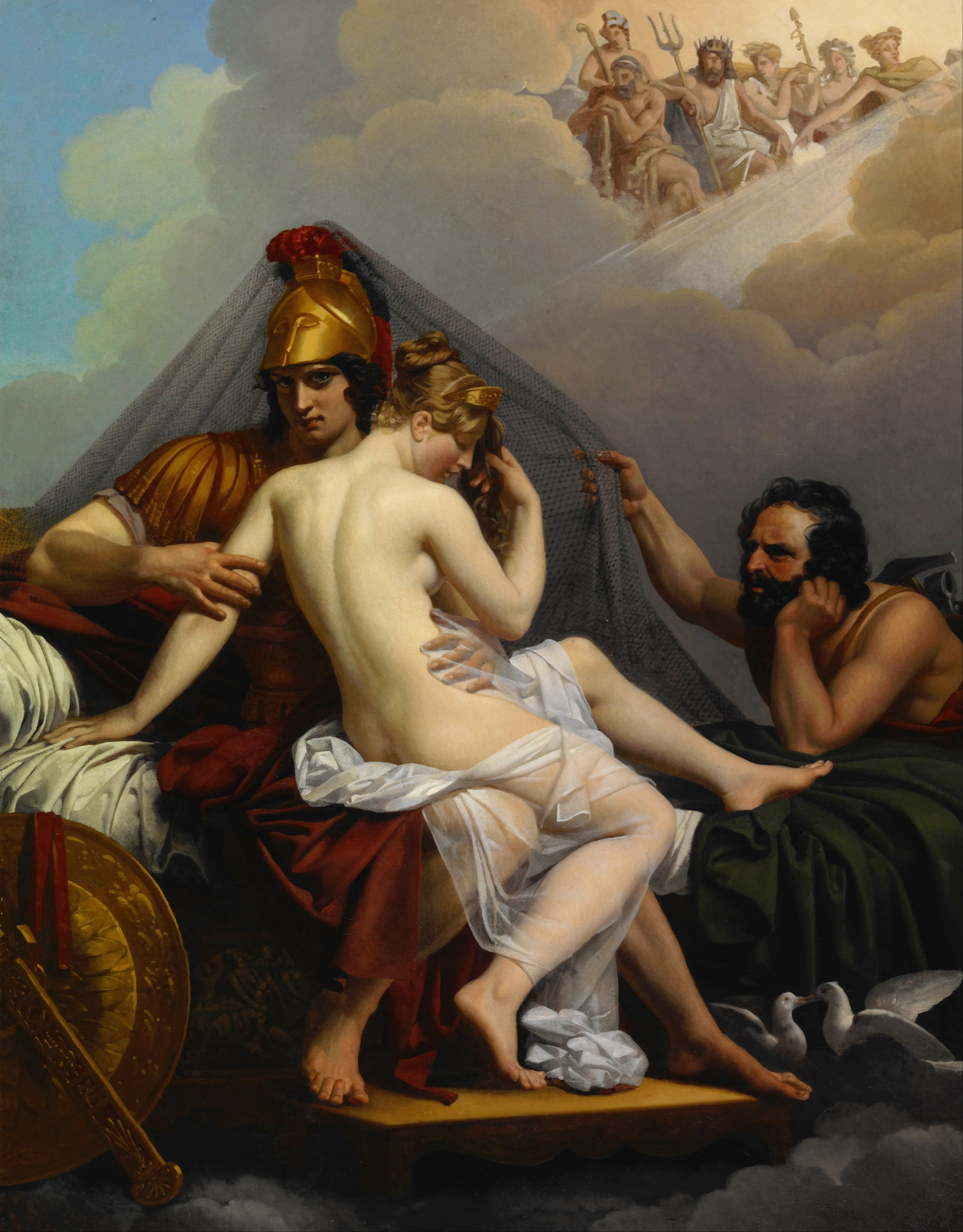
‘The poet strummed and sang a charming song
about the love of fair-crowned Aphrodite
for Ares, who gave lavish gifts to her
and shamed the bed of Lord Hephaestus, where
they secretly had sex. The Sun God saw them,
and told Hephaestus–bitter news for him.
He marched into his forge to get revenge,
and set the might anvil on its block,
and hammered chains so strong that they could never
be broken or undone. He was so angry
at Ares. When his trap was made, he went
inside the room of his beloved bed,
and twined the mass of cables all around
the bedposts, and then hung them from the ceiling,
like slender spiderwebs, so finely made
that nobody could see them, even gods:
the craftsmanship was so ingenious.
When he had set the trap across the bed,
he traveled to the cultured town of Lemnos,
which was his favorite place in all the world.
Ares the golden rider had kept watch.
He saw Hephaestus, famous wonder-worker,
leaving his house, and went inside himself;
he wanted to make love with Aphrodite.
She had returned from visiting her father,
the mighty son of Cronus; there she sat.
Then Ares took her hand and said to her,
“My darling, let us go to bed. Hephaestus
is out of town; he must have gone to Lemnos
to see the Sintians whose speech is strange.”
She was exited to lie down with him;
they went to bed together. But the chains
ingenious Hephaestus had created
wrapped tight around them, so they could not move
or get up. Then they knew that they were trapped.
The limping god drew near–before he reached
the land of Lemnos, he had turned back home.
Troubled at heart, he came towards his house.
Standing there in the doorway, he was seized
by savage rage. He gave a mighty shout,
calling to all the gods,
“O Father Zeus,
and all you blessed gods who live forever,
look! You may laugh, but it is hard to bear.
See how my Aphrodite, child of Zeus,
is disrespecting me for being lame.
She loves destructive Ares, who is strong
and handsome. I am weak. I blame my parents.
If only I had not been born! But come,
see where those two are sleeping in my bed,
as lovers. I am horrified to see it.
But I predict they will not want to lie
longer like that, however great their love.
Soon they will want to wake up, but my rap
and chains will hold them fast, until her father
pays back the price I gave him for his daughter.
Her eyes stare at me like a dog. She is
so beautiful, but lacking self-control.”
The gods assembled at his house: Poseidon,
Earth-Shaker, helpful Hermes, and Apollo.
The goddesses stayed home, from modesty.
The blessed gods who give good things were standing
inside the doorway, and they burst out laughing,
at what a clever trap Hephaestus set.
And as they looked, they said to one another,
“Crime does not pay! The slow can beat the quick,
as now Hephaestus, who is lame and slow,
has used his skill to catch the fastest sprinter
of all those on Olympus. Ares owes
the price for his adultery.” They gossiped.
Apollo, son of Zeus, then said to Hermes,
“Hermes my brother, would you like to sleep
with golden Aphrodite, in her bed,
even weighed down by mighty chains?”
And Hermes
the sharp-eyed messenger replied, “Ah, brother,
Apollo lord of archery: if only!
I would be bound three times as tight or more
and let you gods and all your wives look on,
if only I could sleep with Aphrodite.”
Then laughter rose among the deathless gods.
Only Poseidon did not laugh. He begged
and pleaded with Hephaestus to release
Ares. He told the wonder-working god,
“Now let him go! I promise he will pay
the penalty in full among the gods,
just as you ask.”
The famous limping god
replied, “Poseidon, do not ask me this.
It is disgusting, bailing scoundrels out.
How could I bind you, while the gods look on,
if Ares should escape his bond and debts?”
Poseidon, Lord of Earthquakes, answered him,
“Hephaestus, if he tried to dodge this debt,
I promise I will pay.”
The limping god
said, “Then, in courtesy to you, I must
do as you ask.” So using all his strength,
Hephaestus loosed the chains. The pair of lovers
were free from their constraints, and both jumped up.
Ares went off to Thrace, while Aphrodite
smiled as she went to Cyprus, to the island
of Paphos, where she had a fragrant altar
and sanctuary. The Graces washed her there,
and rubbed her with the magic oil that glows
upon immortals, and they dressed her up
in gorgeous clothes. She looked astonishing.’