‘The poet strummed and sang a charming song
about the love of fair-crowned Aphrodite
for Ares, who gave lavish gifts to her
and shamed the bed of Lord Hephaestus, where
they secretly had sex. The Sun God saw them,
and told Hephaestus–bitter news for him.
He marched into his forge to get revenge,
and set the might anvil on its block,
and hammered chains so strong that they could never
be broken or undone. He was so angry
at Ares. When his trap was made, he went
inside the room of his beloved bed,
and twined the mass of cables all around
the bedposts, and then hung them from the ceiling,
like slender spiderwebs, so finely made
that nobody could see them, even gods:
the craftsmanship was so ingenious.
When he had set the trap across the bed,
he traveled to the cultured town of Lemnos,
which was his favorite place in all the world.
Ares the golden rider had kept watch.
He saw Hephaestus, famous wonder-worker,
leaving his house, and went inside himself;
he wanted to make love with Aphrodite.
She had returned from visiting her father,
the mighty son of Cronus; there she sat.
Then Ares took her hand and said to her,
“My darling, let us go to bed. Hephaestus
is out of town; he must have gone to Lemnos
to see the Sintians whose speech is strange.”
She was exited to lie down with him;
they went to bed together. But the chains
ingenious Hephaestus had created
wrapped tight around them, so they could not move
or get up. Then they knew that they were trapped.
The limping god drew near–before he reached
the land of Lemnos, he had turned back home.
Troubled at heart, he came towards his house.
Standing there in the doorway, he was seized
by savage rage. He gave a mighty shout,
calling to all the gods,
“O Father Zeus,
and all you blessed gods who live forever,
look! You may laugh, but it is hard to bear.
See how my Aphrodite, child of Zeus,
is disrespecting me for being lame.
She loves destructive Ares, who is strong
and handsome. I am weak. I blame my parents.
If only I had not been born! But come,
see where those two are sleeping in my bed,
as lovers. I am horrified to see it.
But I predict they will not want to lie
longer like that, however great their love.
Soon they will want to wake up, but my rap
and chains will hold them fast, until her father
pays back the price I gave him for his daughter.
Her eyes stare at me like a dog. She is
so beautiful, but lacking self-control.”
The gods assembled at his house: Poseidon,
Earth-Shaker, helpful Hermes, and Apollo.
The goddesses stayed home, from modesty.
The blessed gods who give good things were standing
inside the doorway, and they burst out laughing,
at what a clever trap Hephaestus set.
And as they looked, they said to one another,
“Crime does not pay! The slow can beat the quick,
as no Hephaestus, who is lame and slow,
has used his skill to catch the fastest sprinter
of all those on Olympus. Ares owes
the price for his adultery.” They gossiped.
Apollo, son of Zeus, then said to Hermes,
“Hermes my brother, would you like to sleep
with golden Aphrodite, in her bed,
even weighed down by might chains?”
And Hermes
the sharp-eyed messenger replied, “Ah, brother,
Apollo lord of archery: if only!
I would be bound three times as tight or more
and let you gods and all your wives look on,
if only I could sleep with Aphrodite.”
Then laughter rose among the deathless gods.
Only Poseidon did not laugh. He begged
and pleaded with Hephaestus to release
Ares. He told the wonder-working god,
“No let him go! I promise he will pay
the penalty in full among the gods,
just as you ask.”
The famous liming god
replied, “Poseidon, do not ask me this.
It is disgusting, bailing scoundrels out.
How could I bind you, while the gods look on,
if Ares should escape his bond and debts?”
Poseidon, Lord of Earthquakes, answered him,
“Hephaestus, if he tried to dodge this debt,
I promise I will pay.”
The limping god
said, “Then, in courtesy to you, I must
do as you ask.” So using all his strength,
Hephaestus loosed the chains. The pair of lovers
were free from their constraints, and both jumped up.
Ares went off to Thrace, while Aphrodite
smiled as she went to Cyprus, to the island
of Paphos, where she had a fragrant altar
and sanctuary. The Graces washed her there,
and rubbed her with the magic oil that glows
upon immortals, and they dressed her up
in gorgeous clothes. She looked astonishing.’
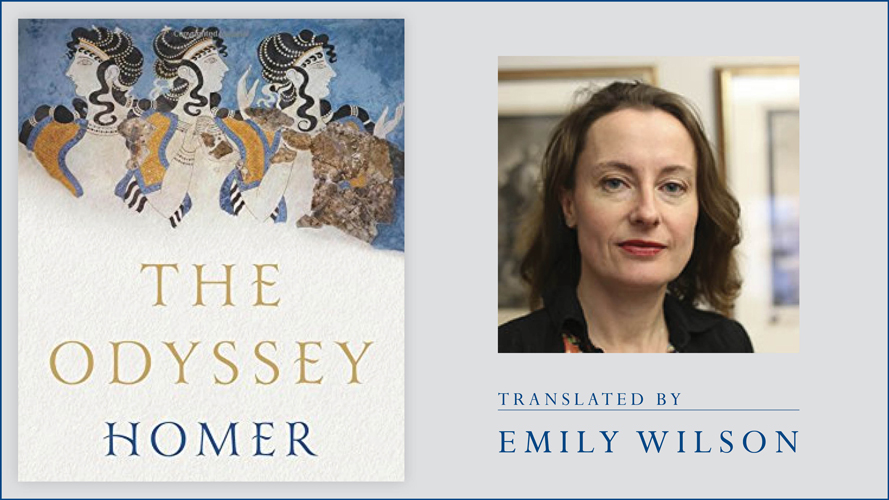 ‘The notion that Homeric epic must be rendered in grand, ornate, rhetorically elevated English has been with us since the time of Alexander Pope. It is past time, I believe, to reject this assumption. Homer’s language is markedly rhythmical, but it is not difficult or ostentatious. The Odyssey relies on coordinated, not subordinated syntax (“and then this, and then this, and then this,” rather than “although this, because of that, when this, which was this, on account of that”). I have frequently aimed for a certain level of simplicity, often using fairly ordinary, straightforward, and readable English. In using language that is largely simple, my goal is not to make Homer sound “primitive,” but to mark the fact that stylistic pomposity is entirely un-Homeric. I also hope to invite readers to respond more actively with the text. Impressive displays of rhetoric and linguistic force are a good way to seem important an invite a particular kind of admiration, but they tend to silence dissent and discourage deeper modes of engagement. A consistently elevated style can make it harder for readers to keep track of what is at stake in the story. My translation is, I hope, recognizable as an epic poem, but it is one that avoids trumpeting its own status with bright, noisy linguistic fireworks, in order to invite a more thoughtful consideration of what the narrative means, and they ways it matters.
 As with a lot of my writing, the reason I chose to do this comes from problems I have with the way other people do things. When I read urban fantasy I generally find it hard to suspend my disbelief — if these things really existed and behaved that way, I’d have to be stupid to have missed them. So I wanted to have magic that was non-falsifiable, and had plausible deniability.”