“Has any writer ever written a masterpiece in an alien language? In a language other than his mother tongue?” I hadn’t claimed to have written a masterpiece (nor to be a “he”), but nevertheless I understood his anger toward a me, a writer who lived in India, wrote in English, and who had attracted an absurd amount of attention. My answer to his question made him even angrier.
“Nabokov,” I said. And he stormed out of the hall.
The correct answer to that question today would of course be “algorithms.” Artificial Intelligence, we are told, can write masterpieces in any language and translate them into masterpieces in other languages. As the era that we know, and think we vaguely understand, comes to a close, perhaps we, even the most privileged among us, are just a group of redundant humans gathered here with an arcane interest in language generated by fellow redundants.
Only a few weeks after the mother tongue/masterpiece incident, I was on a live radio show in London. The other guest was an English historian who, in reply to a question from the interviewer, composed a paean to British imperialism. “Even you,” he said, turning to me imperiously, “the very fact that you write in English is a tribute to the British Empire.” Not being used to radio shows at the time, I stayed quiet for a while, as a well-behaved, recently civilized savage should. But then I sort of lost it, and said some extremely hurtful things. The historian was upset, and after the show told me that he had meant what he said as a compliment, because he loved my book. I asked him if he also felt that jazz, the blues, and all African-American writing and poetry were actually a tribute to slavery. And if all of Latin American literature was a tribute to Spanish and Portuguese colonialism.
Notwithstanding my anger, on both occasions my responses were defensive reactions, not adequate answers. Because those incidents touched on a range of incendiary questions—colonialism, nationalism, authenticity, elitism, nativism, caste, and cultural identity—all jarring pressure points on the nervous system of any writer worth her salt. However, to reify language in the way both men had renders language speechless. When that happens, as it usually does in debates like these, what has actually been written ceases to matter. That was what I found so hard to countenance. And yet I know—I knew—that language is that most private and yet most public of things. The challenges thrown at me were fair and square. And obviously, since I’m still talking about them, I’m still thinking about them.
[Via]
 So, I think a big new name, actually more than one name, is warranted. Thus, Anthropocene, Plantationocene, and Capitalocene (Andreas Malm’s and Jason Moore’s term before it was mine). I also insist that we need a name for the dynamic ongoing sym-chthonic forces and powers of which people are a part, within which ongoingness is at stake. Maybe, but only maybe, and only with intense commitment and collaborative work and play with other terrans, flourishing for rich multispecies assemblages that include people will be possible. I am calling all this the Chthulucene—past, present, and to come. These real and possible timespaces are not named after SF writer H.P. Lovecraft’s misogynist racial-nightmare monster Cthulhu (note spelling difference), but rather after the diverse earth-wide tentacular powers and forces and collected things with names like Naga, Gaia, Tangaroa (burst from water-full Papa), Terra, Haniyasu-hime, Spider Woman, Pachamama, Oya, Gorgo, Raven, A’akuluujjusi, and many many more. “My” Chthulucene, even burdened with its problematic Greek-ish tendrils, entangles myriad temporalities and spatialities and myriad intra-active entities-in-assemblages—including the more-than-human, other-than-human, inhuman, and human-as-humus. Even rendered in an American English-language text like this one, Naga, Gaia, Tangaroa, Medusa, Spider Woman, and all their kin are some of the many thousand names proper to a vein of SF that Lovecraft could not have imagined or embraced—namely, the webs of speculative fabulation, speculative feminism, science fiction, and scientific fact. It matters which stories tell stories, which concepts think concepts. Mathematically, visually, and narratively, it matters which figures figure figures, which systems systematize systems.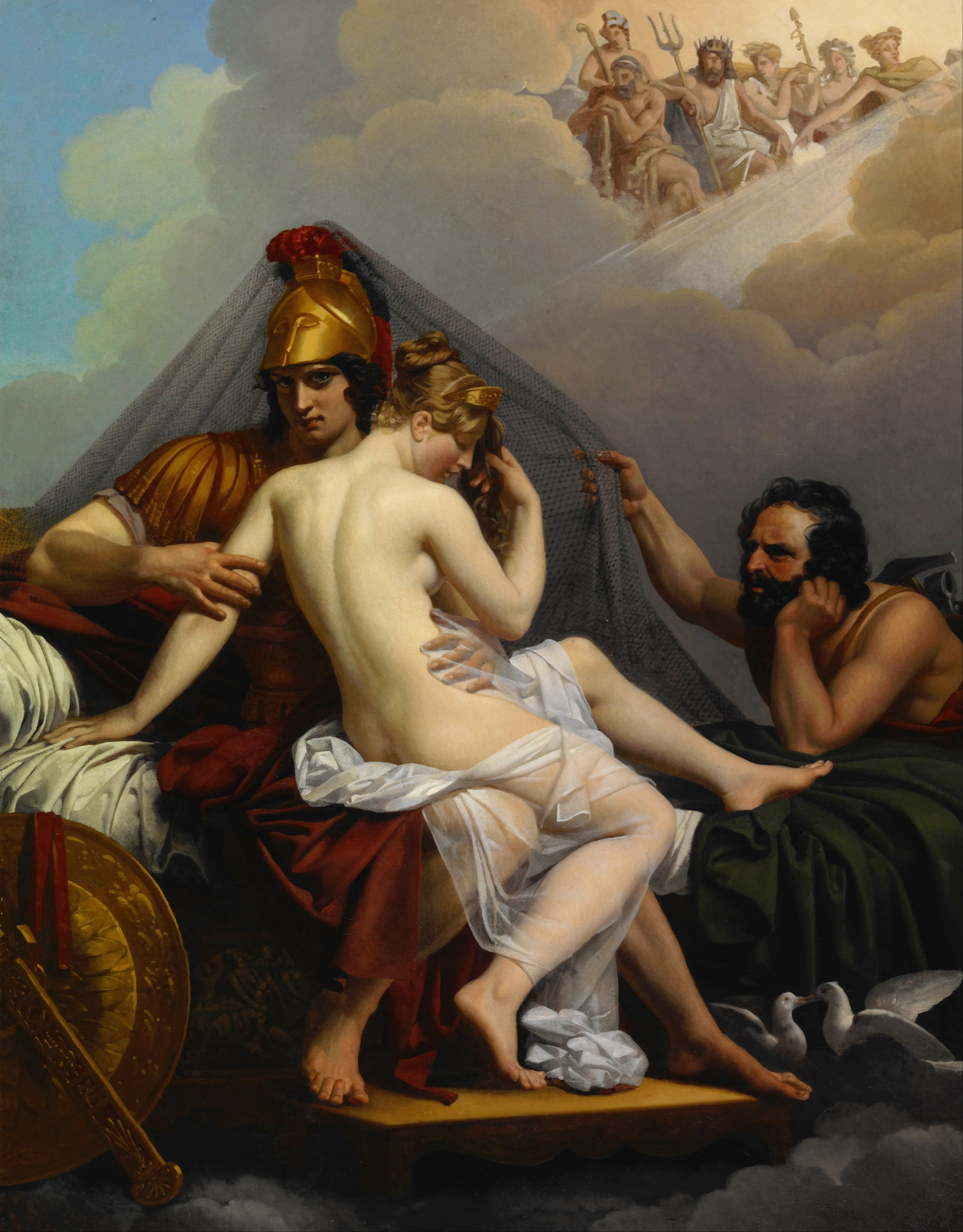
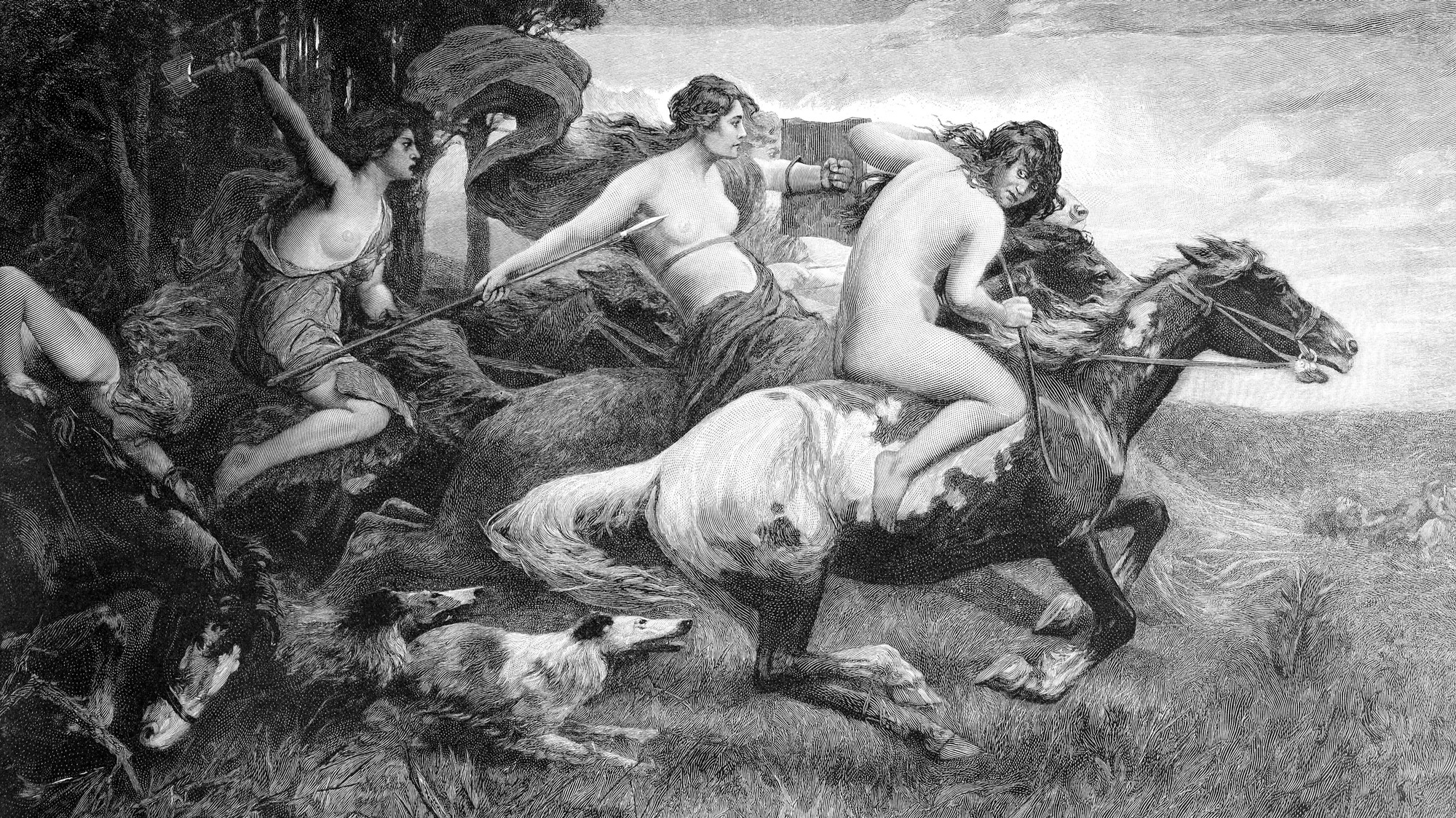 Most of what the Greeks wrote about the Amazons can be dismissed out of hand. The idea of all-female tribes that reproduced through sex with strangers and murdered their male infants sounds more like a paranoid male fantasy than historical fact. Similarly, the idea that Amazons cut off one of their breasts to improve their bow skills is laughable to any woman who has managed to master archery with their chest intact. (Not to mention the high fatality rate that such a drastic procedure would have incurred, given the medical capabilities of the time.)