GABBLER RECOMMENDS: Comforting Myths Notes from a purveyor By Rabih Alameddine

Where I disagree with Achebe is that, because of the racism in Heart of Darkness, he refuses to consider it a masterwork. Like all books, Conrad’s novel is limited by his vision, his biases, his worldview. There is no writer with limitless vision, no writer whose worldview is shared by everyone. The problem is not that people read Heart of Darkness as a masterpiece—it is one—it’s that few read books unsanctioned by empire, and even if you wanted to, there aren’t that many available. Today’s imperial censorship is usually masked as the publisher’s bottom line. “This won’t sell” is the widest moat in the castle’s defenses.

A number of years ago I was a juror for the Neustadt International Prize for Literature, an award sponsored by the University of Oklahoma and the magazine World Literature Today. Since this is an international prize, the jury is always composed of international writers. There were jurors representing Lebanon, Mexico, Egypt, Nepal, Palestine, South Africa, Ukraine, the Philippines, and Italy. Only the Italian actually lived in Italy. The rest of us were primarily Americans, living in the United States, almost all associated with American universities. The Mexican was a Texan, the Egyptian a New Yorker; the Nepali taught at Ohio State. Every interview I did as a juror included questions about peace in the Middle East and whether we can achieve it in my lifetime, what it is like in Beirut, and whether I found the trip to Oklahoma tiring. Norman is a four-hour flight from San Francisco. (And while we’re talking about universities: MFA programs are a kind of indoctrination, too. Certain stories, certain types of stories and certain ways of telling stories, are made more valid than others, and this can be dangerous. From the Congo to the Punjab, if you go to Iowa, you will be learning the Iowa Way. You risk becoming a purveyor of comforting myths.)

Every group needs to have an other. I don’t know how a society can exist without classifying another as the other. The question for the writers who are getting to talk is where we stand. Inside, outside, in the middle? For so-called world-literature writers, it’s a troubling question.

You might think this is diversity, but it seems more like homogenization. Sometimes, not always, when I read a novel presented or marketed as “foreign,” I feel that I’m reading that common thing, a generic novel hidden behind an alluring facade, a comfortable and familiar book with a sprinkling of exoticness. The names of foods are italicized. Instead of visiting Beijing, I end up at its airport with the same bright Prada and Starbucks stores, maybe one dumpling stand in the corner.

And sometimes even that little stand is troublesome. When I wrote a novel about a reclusive woman who bucks society’s rules by having a rich inner life filled with books and art, I was surprised by how many readers identified with her, and more so that many considered her a tragic figure because she lived in a country that had no respect for women. You know: we live in an exceptional country, it’s only over there where they ostracize women who refuse to conform. (Our world might not be perfect, but that other world, that world of the other is just simply horrid.)


[Via]
GABBLER RECOMMENDS: Business Musings: Cultural Change And The Traditional Writer

“So many writers still want that traditional “validation.” They want someone else to take control of their career. They want someone else to praise their book and make it a bestseller.

They want to put their entire artistic and creative future into a machine that’s designed to chew people up and spit them out—even if those people aren’t on some blacklist.

I see writer after writer after writer who wants to sell their books to traditional publishers or who want to go into Hollywood with a “free” option or who willingly give away the rights to something just for “the opportunity” to play in this shark tank.

The film industry hasn’t yet gone through the full-fledged transition that book publishing and comics are going through right now. It’s not easy to make a film without big money backing and get it distributed worldwide. It is possible to write a book and get it distributed worldwide now.

That self-published book just won’t get the attention that a handful of books got thirty and forty years ago. But that 2018 book will stay on the virtual shelves while the older books rarely stayed on any shelf.

There’s a lot of upside to indie. A bit of downside too, which we’ll be discussing in the next few weeks. But the biggest upside to me is that we are not subject to the whims of someone who will only spend money to market a book on a writer because she’s pretty or because she meets the current cultural norm.

(I just got offered a big quick turn-around tie-in novel this past month, for which I would have been paid in the low six-figures. When I said I wasn’t interested and offered to give the person a list of writers who might have the time to write this project, she asked if any of them were female. I said no, none of them were. [I wasn’t looking at gender; I was looking at availability for a rush job.] Well, to be honest, she said, we only picked you because you were the most visible female tie-in author we could find. We don’t want men at all. Again, that flash of disappointment rose in me. I was chosen, not because my work is good, but because I’m female. I understand the corrective urge in the marketplace, but jeez, that comment felt as insulting as having my book marketed because I was considered pretty 25 years ago.)

Writers who choose to take their novels and their nonfiction books into traditional publishing are choosing to give their careers to the “tastemakers” who sometimes make their decisions based on their prejudices, their “understanding” of a marketplace that (in reality) does not exist, and who will do their best to destroy anyone who questions them.

Think I’m exaggerating? I’m not. I’ve been through my share of whisper campaigns too, including one that went on for nearly thirty years—from the moment that guy lost a big prestigious job to me until the day he died.

I used to tell writers that you need a tough skin to be in this business. And you still do. Although not a scaly hide that nothing can penetrate. These days, if you’re going indie, you need to be tough enough to handle the ups and downs of owning your own business. You need to be tough enough to weather bad reviews and low sales. You need to be strong enough to keep moving forward in the face of disappointment.

If you’re going traditional, you need to be made of alligator skin. You need a hide so thick that nothing can pierce it, or if something does, you need to have a system to deal with the pain so you can get up and move forward again.

Just because we’re having these conversations in the culture right now doesn’t mean that everything has changed for the better. This kind of change doesn’t happen overnight, no matter how it feels.

Remember, the news cycle is on overdrive right now, and what might seem too big and important to ignore might vanish in the wake of yet another scandal or large catastrophe that we can’t even imagine right now.

I’m hoping this kind of change we’re seeing is not a bubble. But I’ve been through enough bubbles to know that’s a risk.

Is becoming a traditionally published author so important to you that you’re willing to succeed on any terms? Is becoming a traditionally published author so important to you that you’re willing to put your career (and your copyrights) in the hands of people who still haven’t figured out that diversity means more than publishing a few books about discrimination?

And if your answer is yes, then do this: Use your imagination.”

[Via]

Emphasis mine.

GABBLER RECOMMENDS: Westworld’s Female Hosts Signal a Shift In Our Fear of Robots by Becky Ferreira

“If we look at the early stories around creating artificial women, like Pandora, who was an artificial creation by the gods, of course she unleashed all the terror in the world,” Devlin, whose forthcoming book Turned On examines human-robot sexual interactions, told me over Skype.

“She did the wrong thing and messed up,” she said. “It’s the whole Christian Eve [narrative] as well. You’ve got this really long-standing trope about women—don’t let them do anything, they’ll get it wrong, they’ll do it bad.”

Empowering women with knowledge is hardwired into Western storytelling as a recipe for disaster, regardless of whether those women are human or robotic. This is the central dynamic in that opening scene between Bernard and Dolores. Bernard is not physically intimidated by Dolores; he specifies that it’s her mind and its evolution that frightens him. What will be the outcome of all her ruminations?

Bernard suspects, and the show confirms, that it will be bloody and chaotic, just like so many past stories in which women get wise and wreak havoc. Ex Machina toys with a similar undercurrent in which a female robot (Alicia Vikander) learns enough about the men keeping her captive to exploit their weaknesses.

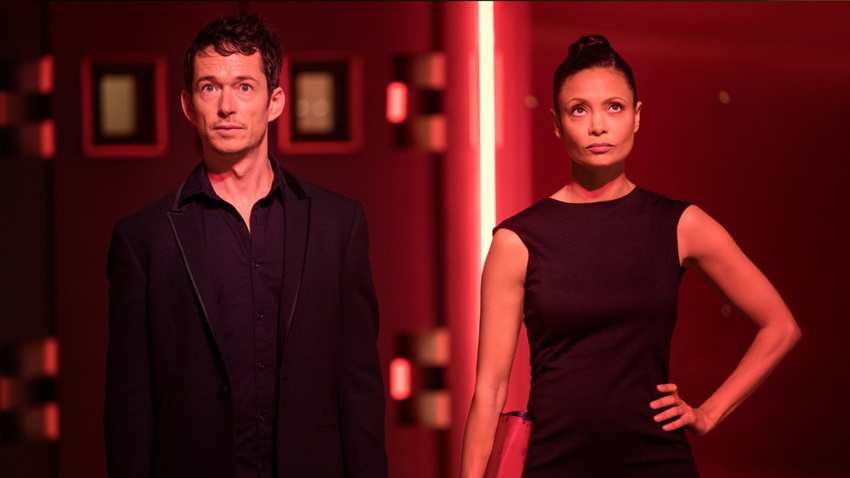
That connection between female intellectual maturation and extremely watchable catastrophe is further reflected in Westworld’s choice to make female hosts, particularly Dolores and Maeve (Thandie Newton), much more active agents of rebellion than their male companions Teddy (James Marsden) and Hector (Rodrigo Santoro).

These artificial men are also repeatedly victimized in the show—we see implied sexual violence against them by the staff and they are treated as target practice for the guests. But Teddy follows Dolores somewhat questioningly, and Hector follows Maeve totally unquestioningly, and both seem to experience their newfound independence vicariously through the women.

What makes these unthinking male warrior robots so scary is that they don’t generally buck their directives. Even in cases where male robots are able to supercede their programming, like Sonny in the 2004 film I, Robot or HAL-9000 in 2001: A Space Odyssey, they do so in dedication to a larger mission goal rather than for their own independence.

..

With this response, she further undermines Lee’s dignity, while simultaneously demonstrating that she can be self-aware about her own coding.

[Via]

GABBLER RECOMMENDS: “Peach Scone” by Hobo Johnson for NPR Tiny Desk Submission

GABBLER RECOMMENDS: Animal agents by Amanda Rees

“Self-aware animal protagonists have always existed within the human world. Usually, however, they’ve been imaginary, and mostly they’ve appeared in the pages of children’s stories. Characters such as the talking animals in The Chronicles of Narnia (1950-56) by C S Lewis, for example, were relatively simple. For all their animal appearance, their thoughts, actions and emotions were largely indistinguishable from those of humans. Other stories have exploited differences in human and animal experience to teach moral or ethical lessons, by precept or example. In some cases, this involved close exploration of the inner lives of animal protagonists – the gradual civilisation of the wolf-dog in Jack London’s White Fang (1906), for example, or the mature suffering of the horse in Anna Sewell’s Black Beauty (1877). But more often than not, the author’s aim was to use the animal to explore the human, and humane.

Many other aspects of human-animal relationships have now been scrutinised by historians, sociologists, linguists, geographers and anthropologists: the emergence of the pet industry; the changing appearance and functions of zoos; or the continuing significance of hunting and fishing to industrialised urban societies. Their results throw light on changing relations within and between human societies, as well as on the ethical and moral issues they posed. It is in short order becoming plain that human history has depended – in any number of ways – on the contribution of different animal species.

But does this mean that animals can be considered agents of history? Their contribution, after all, wasn’t planned or deliberate. Rats, for example, despite the best efforts of poison manufacturers to portray them as such, are not an invading army. And while the European colonisation of the Americas might have depended on the contribution made by livestock animals, those animals were not themselves conscious of their role. In this sense, the humanities’ turn towards animals has merely rendered human histories more inclusive. The subject matter has expanded, rather than a new perspective emerging. At most, such stories chart the way that humans have made use of animals, or those aspects of their lives that have interested human observers. Recovering, or accessing the lived experiences of nonhuman, nonverbal animals, and writing animal-focused histories, still seemed impossible.

Nonetheless, some scholars tried. As with the efforts of scientists to see the world from the animal’s perspective, scholars have drawn on ethology, on evolutionary theory and physiological studies, in a sustained attempt to write histories – or, with Sandra Swart, ‘horse-stories’ – from an animal perspective. They’ve called for a combination of methods (archives, experiments, their imaginations) to put themselves in the place of the embodied other. What if sound was tasted, or felt, as much as it was heard? What would social life be like, if meetings were haunted by the olfactory presence of absent friends (or enemies)? Alongside these attempts to record animal experiences, the question of intent and deliberation continues to cloud debates about whether animals can, in fact, be agents of their own history. Animals might have shaped human history, and might make their own history, but, especially in the age of the Anthropocene, they seem to do so under circumstances of human choosing.

For those of us who share our lives with pets, companions or working animals, managing our daily lives depends on recognising not just the needs, but the intentions, capacities and capabilities of the nonhuman – not least the extent to which we rely on such qualities. For the past century or so, these commonsense, lay understandings of animal agency have been marginalised as examples of sloppy anthropomorphism. It is now past time to take this tacit, non-expert knowledge seriously. By adopting a new approach to animal agency, we can develop new ways of thinking about multiple, distributed agencies and the way that they are remaking the world. In the age of the Anthropocene, we cannot afford to assume that these changes will always and forever be under conscious human control.”

[Via]