Theistic conceptions of artificial intelligence


Other scholars recognise elements of theism in the discourse around AI and its potential impact on our future. Robert Geraci suggests in his 2010 book, Apocalyptic AI: Visions of Heaven in Robotics, Artificial Intelligence, and Virtual Reality, that AI can fulfil the same role in apocalyptic imaginings as a singular theistic god. Bearing in mind that the biblical apocalypse is an optimistic cosmic transformation, he also draws out parallels with the aims of AI, which often describe hopeful aspirations for a world-yet-to-come, an AI eschatology. In an early part of this particular work, Geraci draws on Rudolph Otto’s 1917 description of god as mysterium tremendum et fascinans (Otto 1917), using it to identify a type of awe-inspiring and fearsome being that at different times in our history can be a god, or in our contemporary modern world, AI. Elsewhere, Geraci’s work has engaged with virtual worlds, drawing attention to the role of transhumanists, including Giulio Prisco, discussed below, in claiming new potential spaces to practice and evolve religion towards transhumanist ends. In such spaces, including Second Life and the World of Warcraft (the MMORPG-a massively multiplayer online role-playing game), Geraci argues a step closer to the fulfilment of transhumanist salvation is being made- “a heavenly realm to inhabit” (Geraci 2014 177). Twitter is another virtual space, but one dominated by discourse rather than aesthetics and virtual embodiment like Second Life and World of Warcraft. However, this article proposes that the expressions of religious metaphor, parody, and tropes on Twitter as in the BBtA tweets represent continuities of theism, continuities enabled by new technological spaces as well as uncertainties about the nature and the volition of ‘the algorithm’.

However, the ‘AI fits into the god-space’ argument can be in danger of supporting a rather strict version of the Secularisation Thesis, and this idea’s historical veracity has been debated by anthropologists and sociologists of religion (see Ward and Hoelzl 2008). This article, and connected research, seeks to add to this debate in by drawing attention to continuities of religiosity and enchantment in super-agential concepts of AI and AI NRMs. Second, this god-space argument can suggest that religion is spurred on by ‘need’ only, a pathology interpretation of religion that ignores other elements of religious inspiration and innovation such as desire, culture, aesthetics, and, often in the online environment, affective virality.

Theistic interpretations of AI do undeniably owe a lot to older cultural conceptions of a singular god. Randall Reed pares this kind of god down to three theological characteristics (with long historical and philosophical roots) that often map easily onto our conceptions of AI superintelligences. These are omnipotence, omniscience, and omnipresence (Reed 2018, 7). Reed also raises the question of omnibenevolence. He notes that AI philosophers such as Nick Bostrom of the Future of Humanity Institute have focussed on the issues of malevolence through “perverse instantiation”, a failure of value alignment leading to unforeseen damage from a superintelligent AI, such as in Bostrom’s famous Paperclip Maximiser thought experiment (Bostrom 2003). Bostrom’s Orthogonality Thesis from his 2012 paper ‘Superintelligent Will’ is also relevant; the argument that intelligence is not intrinsically linked to ‘goodness’, and that an AI could have any number of combination of degrees of both characteristics (Bostrom 2012).

– “Blessed by the algorithm”: Theistic conceptions of artificial intelligence in online discourse by Beth Singler
 

GABBLER RECOMMENDS: The Hero’s Journey is BULL#$&@

GABBLER RECOMMENDS: ‘Is Abortion Sacred?’ by Jia Tolentino

‘The idea that a fetus is not just a full human but a superior and kinglike one—a being whose survival is so paramount that another person can be legally compelled to accept harm, ruin, or death to insure it—is a recent invention. For most of history, women ended unwanted pregnancies as they needed to, taking herbal or plant-derived preparations on their own or with the help of female healers and midwives, who presided over all forms of treatment and care connected with pregnancy. They were likely enough to think that they were simply restoring their menstruation, treating a blockage of blood. Pregnancy was not confirmed until “quickening,” the point at which the pregnant person could feel fetal movement, a measurement that relied on her testimony. Then as now, there was often nothing that distinguished the result of an abortion—the body expelling fetal tissue—from a miscarriage.
Abortion is often talked about as a grave act that requires justification, but bringing a new life into the world felt, to me, like the decision that more clearly risked being a moral mistake. The debate about abortion in America is “rooted in the largely unacknowledged premise that continuing a pregnancy is a prima facie moral good,” the pro-choice Presbyterian minister Rebecca Todd Peters writes. But childbearing, Peters notes, is a morally weighted act, one that takes place in a world of limited and unequally distributed resources. Many people who get abortions—the majority of whom are poor women who already have children—understand this perfectly well. “We ought to take the decision to continue a pregnancy far more seriously than we do,” Peters writes.’

The scholar Katie Gentile argues that, in times of cultural crisis and upheaval, the fetus functions as a “site of projected and displaced anxieties,” a “fantasy of wholeness in the face of overwhelming anxiety and an inability to have faith in a progressive, better future.” The more degraded actual life becomes on earth, the more fervently conservatives will fight to protect potential life in utero. We are locked into the destruction of the world that birthed all of us; we turn our attention, now, to the worlds—the wombs—we think we can still control.

There is a loss, I think, entailed in abortion—as there is in miscarriage, whether it occurs at eight or twelve or twenty-nine weeks. I locate this loss in the irreducible complexity of life itself, in the terrible violence and magnificence of reproduction, in the death that shimmered at the edges of my consciousness in the shattering moment that my daughter was born. This understanding might be rooted in my religious upbringing—I am sure that it is. But I wonder, now, how I would square this: that fetuses were the most precious lives in existence, and that God, in His vision, already chooses to end a quarter of them. The fact that a quarter of women, regardless of their beliefs, also decide to end pregnancies at some point in their lifetimes: are they not acting in accordance with God’s plan for them, too?


[Via]


See also:

What we talk about when we talk about post-apocalyptic stories; when the apocalypse is solved through natalist tropes

I don’t know if I necessarily agree with this article but… “How the Golem Came to Prague”

As we have seen, the move to the center (both religiously and geographically, since Prague is much closer to the heart of the Hapsburg Empire than the Polish city of Chelm) was a spectacular success. For nearly a quarter of a century after Grimm’s report there is no written record of any specific ecotype of the Golem legend, and one could imagine countless variants circulating orally. But once the tale is fixed in Prague, it quickly becomes the standard reflex and ultimately the authoritative version through Weisel, dominating the next six decades until it is swallowed up by Rosenberg’s more fully developed Prague narratives.26 That the attachment of Grimm’s uprooted Golem to the Maharal is in large part an attempt to emphasize the power of the holy word is evident in one of the main differences between Jewish and Christian accounts of the Golem in this period. All Christian accounts follow Grimm in identifying the utterance of holy words as the key to the animation process. The Jewish versions, on the other hand, emphasize the act of writing the secret name and inserting it into a cavity of the head (usually the mouth), an act which by definition defies pronunciation. It is not a magical spell that brings the Golem to life; it is an act of literacy, that is, an act of reading, studying, and writing, which are all meditations on the nature of God. This act strongly distances itself from the conjuring power of the words used by Grimm’s anonymous ‘‘they,’’ where ‘‘Schemhamphoras’’ is more like abracadabra.27 Moreover this act of literacy is about rewriting or reclaiming the creation in Eden by transferring the divine voice into the written form of the divine name. It would seem, then, that only a rabbi with a specific name can control the Holy Name. Man might not be able to speak for God, but he can quote him on parchment.

[Via]

I don’t know how necessarily fair it is to say/imply that Christians emphasized the speaking of the word/oral traditions, when it was a Jewish concept in the book of Exodus that names spoken aloud have power (God to Moses). 

There’s also likely something to be said about the word “nephesh” but I’m too lazy to get into an argument requiring research right now.


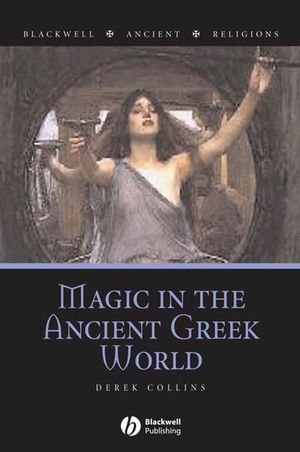
Quotes from ‘Magic in the Ancient Greek World’

Magic in the ancient greek worldLévy-Bruhl helps us to understand why statues and figurines were treated in this way, without resorting to a notion of irrationality defined (in our Western manner) by a failure to draw the proper dividing line between animate and inanimate objects. In Greece in particular, matter itself could have an ambiguous status. To give a specific example, or some highly educated thinkers such as the late seventh/early sixth-century BCE philosopher Thales of Miletus, stones that had magnetic properties were thought to contain souls…It is not hard to see how magnetic stones that attracted to iron fillings, in the absence of an available electromagnetic theory, could be thought to be animate – in other words to contain a soul. Reality as we know it in the mechanical, casual Western view, with its sharp dividing line between organic and inorganic matter, is collapsed in Thales’ view of the magnet…”


“Greeks harbored many different beliefs about dead souls, and scaled them in different ways, from heroes who rested at their leisure in the Elysium fields and the Isles of the Blessed, to an altogether different sort of underworld community whose anger was beyond human appeasement.”


“The shocking and bizarre nature of an epileptic seizure, as every Greek who knew Herakles’ own sufferings could attest, was so extraordinary that it almost begged for divine explanation. But to the Greeks, the fact that a divinity could invade a human body was a familiar experience, most famously illustrated in the case of the Pythia at Delphi being invaded by Apollo who thereby provided her with an oracular voice. In this case Apollo’s divine visitation was invited and controlled and unlike a sudden epileptic seizure, where it was not even clear which divinity might in fact be present…. The Greeks construed an epileptic seizure in terms of divine invasion, and in anthropological terms this kind of cultural phenomenon is called possession. The issue now for the patient, however, according to the author of On the Sacred Disease, was to determine which divinity was responsible for the possession.”

From, Magic in the Ancient Greek World by Derek Collins