On the death of the exposed author:

“Though I have scaled back those honest reviews, I miss them sometimes. I miss saying what I really think. I’d be lying if I told you I didn’t occasionally consider creating another persona, a pseudonym, who could speak the raging, blinding, ballsy truth I want to piss all over the internet some days…

Back in 1967, a writer named Alice Sheldon created a whole new life, an entire persona, called James Tiptree, Jr. She managed this fiction for many years. Robert Silverberg famously said of Tiptree, ‘It has been suggested that Tiptree is female, a theory that I find absurd, for there is to me something ineluctably masculine about Tiptree’s writing.’

Sheldon found a particularly beautiful world in that persona, for many reasons, among them the cofidence ad freedom it brought. After she was outed as Tiptree in 1976 (after fans saw a letter of Tiptree’s about his mother dying in Chicago, they looked up the obituary and made the connection), she said ‘My secret world had been invaded ad the attractive figure of Tiptree — he did strike several people as attractive — was revealed as nothing but an old lady in Virginia.’

Being outed was devastating, but the secret, like all secrets, was bound to come out, and Sheldon must have known that as much as Requires Hate did when she decided to turn her hand at publishing fiction in the very venues she’d critiqued, befriending the very authors whose work she’d been shiv-grindingly reviewing for the lulz…

In my heart of hearts, I’d hoped it would all go away. God knows people like Harlan Ellison have been saying the dumbest, most abusive and hateful shit for years and no on seems to fucking care, even when they assault another writer onstage. But for some reason folks were really, really upset that a woman who ranted angrily on the internet for the entertainment value of a few hundred people was going to be successful by pure virtue of how great her writing was.

Somehow duping everyone into thinking they were some nice person was a hateful crime against humanity, as if we all haven’t been pretending to be somebody else on the internet ever since there was a fucking internet.

Doxxing — the revealing of someone’s personal information o the internet — to me always screams of punishment. It screams of anger. Of fighting hate with hate. Burning someone down to make yourself feel better. It’s someone screaming angrily that if they can’t be happy, no one can be happy…

We make excuses for men. We make room for men.

You should keep being Tiptree. You aren’t the same if you’re Sheldon. Sheldon is just an old woman from Virginia. We can burn burn Sheldon down and erase her.

In truth, many writers are assholes. They aren’t people you want to go to tea with. I don’t like people, generally. I find them exhausting. I don’t want to be friends with Harlan Ellison or Larry Correia or Orson Scott Card. Nick Mamatas has been one of the genre’s biggest fucking trolls for ten years, and nobody blacklisted him or sent around a petition, and when he’s got his asshole meter turned down, he too can be terribly entertaining on the internet…

We get angry for feeling hurt, for feeling duped, when the best way to respond when someone plays a masterful game is, quite simply, this:

‘Well played. You’re a remarkable writer. I wish you the greatest success in your career.’

We say that shit because we are fucking adults. Because the writing is good. We’re not here to be friends. I don’t like a lot of writers. But when their writing is not bullshit, I still read it, quite often. The persona may be a lie. All of them may be a lie. Shit, the work may even be a lie! But we are not in love with pixels on the internet; we are not in love with the ideas of people and their petty fucking feuds and scrambling attention-grabbing. We are in love with their work.” -Kameron Hurley, The Geek Feminist Revolution. 

GABBLER RECOMMENDS: A Pound of Flesh By Katherine Angel

‘Ferrante’s books are, it’s worth remembering, significantly about women’s negotiation of the public and private realm, and about the violence and surveillance women routinely experience.

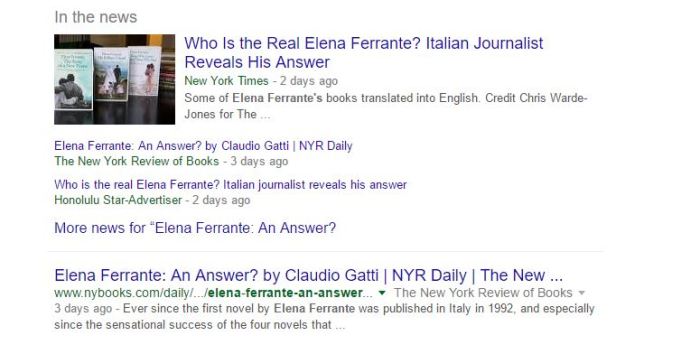
This investigation, of a kind that might ordinarily be reserved for corrupt politicians, relies on a conviction that Ferrante has committed a clear wrong by requesting her privacy. She owes us her real identity, Gatti thinks. Moreover, the phenomenal success of her books, according to Gatti’s dubious logic, legitimizes his pursuit into that identity. There are, of course, no grounds for the violent exposure of who she might be. An author owes her readers nothing beyond the work itself. Artists create artwork, which we consume; this does not entitle us to consume their person.

The punitive edge to Gatti’s intrusion speaks of a desire to make some writers offer up a pound of flesh for their success – to make them pay some penance for it. Why should we feel we can extract this price? It is significant that Ferrante’s ‘unmasking’ has occurred in the context of tiresome debates about whether she is really a woman or, in fact, a man. This persistent preoccupation is suggestive of the tendency to measure a writer’s literary worth in relation not just to the work, but also to other markers: of gender, race, class. The urge to uncover the ‘real’ Ferrante enacts an imperative to locate her in these systems – and finally, perhaps, to decide on her literary significance. The crime that Ferrante has committed, in Gatti’s eyes, is that of witholding the signs by which he might read her as a “woman writer”.’

[Via]

GABBLER RECOMMENDS: Bluebeard – By protecting her privacy, Elena Ferrante protected ours by Dayna Tororici

a


‘For an anonymous author, Elena Ferrante is not stingy. She has given many interviews, usually through written correspondence, and furnished her critics with ample material to aid in their task of interpretation. She has shared her literary influences, her political views, an account of her process, and her working definition of literary truth. She has also explained ad nauseam her insistence on being “absent” as an author, her refusal to appear in public as Ferrante or publish under her given name. Her initial reason was shyness. “I was frightened at the thought of having to come out of my shell,” she told the Paris Review, a hesitation most writers will understand. (Writing, at least in theory, is the rare type of performance at which the timid, nervous, and physically ungainly can excel.) Over time, she came to embrace the implicit stance against publicity, the “self-promotion obsessively imposed by the media,” and the facile readings that author-worship tends to encourage. The trouble with reading biographically—as anyone who’s tried it can tell you—is how quickly it slips into reading symptomatically: search the author for clues to the novel and soon you’ll be searching the novel for clues to the author. It’s not a crime, to read this way, but it tends to foreclose other interpretive paths. It also mistakes the author for an analysand, the novel for a dream. Ferrante’s absence keeps things open: “Remove that individual [the author] from the public eye,” she said, and “we discover that the text contains more than we imagine.”

…For Ferrante, an author’s absence merely restored the basic conditions of literature to the public: it enabled the writer to write and the reader to read. There would be no time-consuming book tour or demoralizing spreads in the Thursday Styles section, where the women writers often go. (What is Elena Ferrante wearing? Can you imagine?) Nor would there be any irritating authority figure saying this or that character is really X, no obnoxious public presence we would have to square, somehow, with the beautiful things she wrote. The persona of the author is an intrusion on the solitary psychic space of a novel. By protecting her privacy, Ferrante protected ours.

Many attempts have been made to locate the “true” identity of Ferrante, some more aggressive than others. For more than a decade, Italian newspapers have argued that Ferrante was the novelist Domenico Starnone, citing thematic and stylistic resemblances between his fiction and hers. One academic called on researchers to use quantitative analysis, in the style of Franco Moretti, to substantiate the claim. After Ferrante was nominated for the prestigious (and rigged) Strega Prize for literature in 2015, the gossip blog Dagospia wrote, “Even the stones know that Elena Ferrante is Anita Raja,” Starnone’s wife.1 The prevalence of this rumor hasn’t stopped the latest unmasking from feeling like a fresh discovery. The investigative journalist Claudio Gatti’s “months-long investigation” into public real estate records in Rome makes the compelling case that Ferrante is, as the stones knew, Anita Raja. Gatti’s previous subjects include JP Morgan Chase and Silvio Berlusconi—targets more deserving of his skills. The article was rolled out in multiple languages simultaneously, like the NSA leak: “in English by NYR Daily, in Italian by Il Sole 24 Ore, in German by the Frankfurter Allgemeine Zeitung, and in French on the investigative website, Mediapart,” as the footnote read. Reporting on the reaction to Gatti’s story, the New York Times reached Ferrante’s publisher, Sandra Ozzola Ferri, for comment. “If someone wants to be left alone, leave her alone,” she said. “She’s not a member of the Camorra, or Berlusconi. She’s a writer and isn’t doing anyone any harm.”

Ferrante’s readers were quick to denounce Gatti’s revelation. I myself was irritated. Even the stones know that Ferrante is Ferrante, and that’s the way her readers want it. More than Ferrante herself, her readers have benefited from her choice, spared so much extradiegetic noise. We are as invested in her anonymity—and her autonomy—as she is. It is a compact: she won’t tell us, we won’t ask, and she won’t change her mind and tell us anyway. In exchange, she’ll write books and we’ll read them. The feminist defense of Ferrante’s privacy was especially swift. It’s difficult to read a man’s attempt to “out” a writer who has said she would stop writing if she were ever identified as anything but an attempt to make her stop writing.

“I believe that, today, failing to protect writing by guaranteeing it an autonomous space, far from the demands of the media and the marketplace, is a mistake,” Ferrante told the Financial Times last year. This is an uncontroversial truth. Writers need space to work. One word for this space is room; another is freedom; another is privacy. Each writer finds this space where she can. Woolf pragmatically emphasized the material: “give her a room of her own and five hundred a year, let her speak her mind and leave out half that she now puts in, and she will write a better book one of these days.” (She needed the metaphysical, too: “I need solitude,” Woolf wrote in her diaries. “I need space. I need air. I need the empty fields around me; and my legs pounding along roads; and sleep; and animal existence.”) Kafka found his space at night: “The burning electric light, the silent house, the darkness outside, the last waking moments, they give me the right to write even if it be only the most miserable stuff. And this right I use hurriedly. That’s the person I am.”’

[Via]

[“BLA and GB Gabbler” (really just a pen name – singular) are the Editor and Narrator behind THE AUTOMATION, vol. 1 of the Circo del Herrero series. They are on facebook, twitter, tumblr, goodreads, and Vulcan’s shit list.]

all yellowB&N | Amazon | Etc.

June, July, August, September Roundup: Dear Hades, keep your wife.

So, the monthly roundup isn’t so monthly anymore…

In June, we posted about how authors shouldn’t guilt trip readers and about Theodora Goss on why she writes.  One of June’s BookTuber Tuesday posts covered an interesting discussion on Book Packagers, and a GABBLER RECOMMENDS included Maria Bamford’s Lady Dynamite. 

In July, we started the EPIC CATALOG category on the blog. Check out all the lists we have categorized so far. That month, we posted about a film written by AI and what not to do with a nom de plume.  Also, why we need to consider how ghostwriting/ghostwriters harm our culture.

August led to BLA’s rants on The Cursed Child and this post about how multiple versions of a book might sway opinion of it. Gabbler RECOMMENDED this RadioLab podcast about why Homer never mentions the color blue (not just because he’s never sad; seriously, listen to it!).

In September we celebrated the anniversary of THE AUTOMATION by hosting a giveaway. If you didn’t win, that’s OK, you can read it for free or download it as an ebook on Goodreads.  A #BLAThoughtOfTheDay included this post on why we need to talk about Lionel Shriver. And, to end with, we really recommend reading this opinion piece by Amy Hungerford on why you might not want to read ALL THE BOOKS.

Here’s to the next season when we’ll eventually get to our monthly roundup!

Tweets of the Week: Nest Egg