
BookTuber Tuesday – Sunaura Taylor reads from Beasts of Burden
Recommend a BookTuber video in the comments and it could make our Tuesday post!
[“BLA and GB Gabbler” (really just a pen name – singular) are the Editor and Narrator behind THE AUTOMATION, vol. 1 of the Circo del Herrero series. They are on facebook, twitter, tumblr, goodreads, and Vulcan’s shit list.]
GABBLER RECOMMENDS: Beasts of Burden by Sunaura Taylor
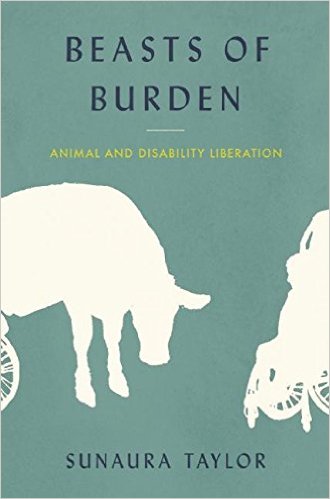 “Dependency has been used to justify slavery, patriarchy, imperialism, colonization, and disability oppression. The language of dependency is a brilliant rhetorical tool, allowing those who use it to sound compassionate and caring while continuing to exploit those they are supposedly concerned about.
In many ways the thinking behind the humane meat movement is a philosophy built on the idea of independence. Domesticated animals and human being shave evolved together to be interdependent—animals help human beings, and we in turn help the animals—or so the argument goes… Instead a disability perspective on interdependence recognizes that we are all vulnerable and receive care (more often than not doing both at once) over meat conversation is a much-needed analysis of what it means to be accountable to beings who are vulnerable.
…
People also justify it through ableist conceptions of the natural and of dependency, which suggest that there is a depoliticized thing called ‘nature’ that determines what kinds of bodies and minds are exploitable and killable, and that excuses uses those who are weaker and dependent for our own benefit. When animal commodification and slaughter is justified through ableist positions, veganism becomes a radical anti-ableist position that corporeality—socially, politically, environmentally, and in what we consume. In other words, veganism is not just about food-it is an embodied practice of challenging ableism through what we eat, wear, and use and a political position that takes justice for animals as integral to justice for disabled people… Veganism is an embodied act of resistance to objectification and exploitation across difference—a corporeal way of enacting one’s political and ethical beliefs daily.” – Sunaura Taylor, Beasts of Burden.
GABBLER RECOMMENDS: The Promise and Potential of Fan Fiction By Stephen Burt
“The interesting question at this point is not whether fan fiction can be good, by familiar literary standards. (Of course it can; cf. Virgil.) Rather, it’s this: What is fan fiction especially, or uniquely, good at, or good for? Early defenses presented the practice as a way station, or an incubator. Writers who started out with fanfic and then found the proper mix of critique and encouragement could go on to publish “real” (and remunerated) work. Other defenses, [focused] on slash, described it as a kind of safety valve: a substitute for desires that could not be articulated, much less acted out, in our real world. If women want to imagine sex between people who are both empowered, and equal, the argument ran, we may have to imagine two men. In space.
It’s true that a lot of fanfic is sexy, and that much of the sex is kinky, or taboo, or queer. But lots of fanfic has no more sex than the latest “Spider-Man” film (which is to say none at all, more or less). Moreover, as that shy proto-fan T. S. Eliot once put it, “nothing in this world or the next is a substitute for anything else.” It’s a mistake to see fanfic only as faute de mieux, a second choice, a replacement. Fanfic can, of course, pay homage to source texts, and let us imagine more life in their worlds; it can be like going back to a restaurant you loved, or like learning to cook that restaurant’s food. It can also be a way to critique sources, as when race-bending writers show what might change if Agent Scully were black. (Coppa has compared the writing of fanfic to the restaging of Shakespeare’s plays.)
…
Moreover, fanfic requires neither cultural capital nor much actual capital to make. You don’t have to take a class, or move to the city, or find an angel, or find an agent; most of your readers may never know your offline name. For all these reasons, fanfic can give its creators a powerful sense of participatory equality. In this respect, what Coppa calls its “defiantly amateur” scene is a far cry from the world of trade publishers and prestige novelists, and a bit more like the avant-garde-poetry world in the nineteen-seventies, where the slogan was “Work your ass off to change the language & never get famous,” or else like American indie rock before Nirvana, except that—and it’s a notable difference—the fanfic world is largely female.”
[Via]
#TBT – F*ck Me, Ray Bradbury
That time Ray Bradbury got a song written about him. 2010.