BookTuber Tuesday – On Book Packagers and Art and Honesty

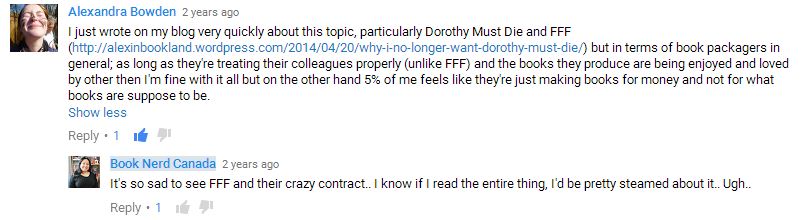
Comments from the video on YouTube:
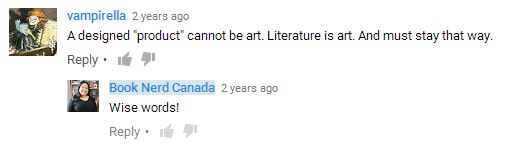
comments

comments

[High art vs. low art argument aside, book packagers’ bottom line is to deceive readers into thinking inspiration wasn’t packaged like processed meat. Instead of allowing cheating in the “system,” perhaps authors and readers should note why cheating was considered in the first place and what this says about their culture and the “art” it produces (or lack thereof).]

Check out other book vlogs we’ve featured here.

Have a book vlog video you want us to check out? Submit a link below in the comments and it could make the CIRCO blog.

[“BLA and GB Gabbler” (really just a pen name – singular) are the Editor and Narrator behind THE AUTOMATION, vol. 1 of the Circo del Herrero series. They are on facebook, twitter, tumblr, goodreads, and Vulcan’s shit list.]
all yellowB&N | Amazon | Etc.

On Little Gods

[Little gods, or little myths? Rather, to be a muse for a product…]

veschwab's avatarVictoria (V.E.) Schwab

I’ve been thinking a lot about control. As a writer, you sculpt a world from scratch, populate it with people, with stories, and control them all. From the geography to the folklore, the smallest details to the largest plots. It’s in your hands.

In that sense, as a writer, you become a ‘little god’.

But in publishing–that business side of the art, your control dissolves.

You don’t control whether the book sells.

You don’t control the marketing budget if he does.

You don’t control the publisher’s investment.

You don’t control your place in-house.

You don’t control the sales plan.

You don’t control the cover art.

You don’t control the jacket copy.

You don’t control how the book is portrayed, publicized, given, sold to the world.

You don’t control anything.

Or at least, it can feel that way.

Because, of course, you still control one thing.

The words.

The content between…

View original post 190 more words

Ursula K. Le Guin doesn’t want readers to search her texts for key words and phrases. Why?

The Authors Guild and several writers sued Google in 2005, saying the digital library was a commercial venture that drove down sales of their work. In their petition seeking Supreme Court review, they said “this case represents an unprecedented judicial expansion of the fair-use doctrine that threatens copyright protection in the digital age.”

The petition to the Supreme Court also included a brief signed by a group of prominent authors, including the playwright Tony Kushner, the historian Taylor Branch and the novelists Margaret Atwood, J. M. Coetzee, Peter Carey and Ursula K. Le Guin.

[Via]

[“BLA and GB Gabbler” (really just a pen name – singular) are the Editor and Narrator behind THE AUTOMATION, vol. 1 of the Circo del Herrero series. They are on facebook, twitter, tumblr, goodreads, and Vulcan’s shit list.]

all yellowB&N | Amazon | Etc.

The gods don’t need your worship

There is something even more narcissistic than post-apocalyptic literature. It’s modern takes on mythology.

In Neil Gaiman’s American Gods, the gods need more believers. They are shadows of their once-selves. And new gods are forming—gods of the Media and the Internet—simply because humans pay more attention to them. This puts a lot of power in the unknowing hands (or heads) of mortal humans.

This plot point is what’s called “The gods need prayer badly” and it occurs so often in mythology stories that it’s become a trope on TVtropes.

In the 2010 reboot of Clash of the Titans, humans need to be reminded of “the order of things” because the gods can “feel their power draining”—as if their existence depends on humans in the first place (never mind that the gods created THEM). See deleted scene:

TVtropes even comments on the sequel:

“In the sequel Wrath of the Titans, prayers have dwindled so much that the gods have all lost their immortality and many have died before the movie even started. They still have most of their powers, but they are fading. Thus, the Titans are breaking free. On a Fridge Logic note, why are the Titans still around? The gods fuel their immortality with worship, what do the Titans use? And before there were humans to empower them, the gods took down the Titans, didn’t they?”

I could continue to list where else this lazy trope shows up, but I think you get the point. It simply doesn’t make sense and it cheats the audience out of an honest look at why myths exist. I’ll explore the following reasons:

  1. If gods exist because you believe in them, then how are they said to create man and other worldly things/creation itself? When talking about creation myths, it’s not a “chicken before the egg” dilemma. If using myth-based facts, then MEN CAME AFTER GODS. The very thought “gods exist based on human worship” (Read: American Gods) is stocked full of more hubris than the idea you’re just as powerful or as good as them (Read: Andromeda’s beauty in Clash of the Titans). HOWEVER, I will admit that the plot of “humans overthrowing their creators” (paralleled to robots vs. humans, Zeus vs. Cronus) is entirely legitimate. See number three.
  2. It’s one thing to say that the gods require worship and sacrifice for attention or for additional power. It’s entirely another to say it’s what sustains them. The gods don’t need you. You need them. That’s why you keep them happy. At most, they need you like a human needs a pet. How does prayer/worship/sacrifice legitimately feed them? Sure, it might fuel them. Their egos. But it’s not what keeps them alive. What were they “eating” before humans came along? Instead of them somehow farming humans as a concocted food immortality supply, it’s a much stronger plot point to suggest that gods created humankind out of boredom—out of wanting someone to play with—loneliness—to give themselves purpose. Thus, when that purpose is threatened, of course they’d be upset. Every parent or authority figure wants to be respected.
  3. Man may be responsible for creating out of belief, but that doesn’t mean he can kill out of disbelief. Just like believing in Santa Claus doesn’t make him real (sorry kiddos–and what the hell are you doing reading this blog?), disbelieving in gravity, that the earth is round, in global warming doesn’t make it less real. No, I’m not going to dissect Nietzsche‘s “God is dead” argument for you (in fact, Gabbler told me not to—told me to focus only on the literary points, not the philosophy), but sure, let’s go ahead and pretend that we are a threat to gods. But what kind of a threat—on what level? At the basic level, our disbelief threatens our need of them. We become self-reliant. But that could hardly be seen as an entirely bad thing for ALL the gods (for example: some of the “good” gods having to clean up our messes like 1) wars and 2) general human horribleness must get tiring). Gods only “need” us in so much as as we fight their wars for them, hurt others for them, are entertainment for them. We may not need them, but we cannot kill them from it. Sure, there may be a constant fear within every creator that they will be overthrown or overshadowed by their successors. But even when Cronus overthrew Uranus, did he really die? Indeed, in some accounts he was was merely castrated. Changed. Overthrown does not mean death.

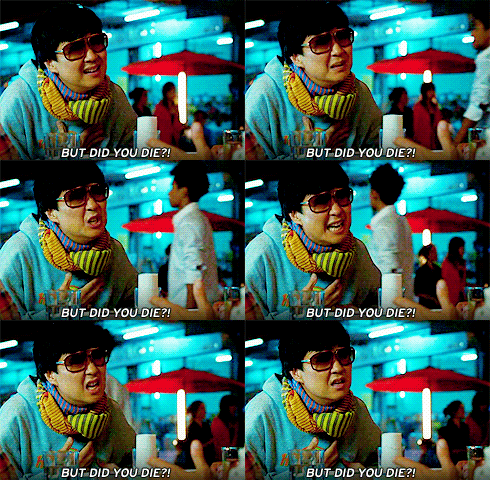
pic1

“Gods need prayer badly” is wearing thin—to the point of ignoring entire historical cultures and tradition. Not only is it a lazy excuse for why the gods don’t get involved in our affairs anymore (i.e. because they’re dead or weak), but it assumes that these “old gods” have lost their inspirational powers. Which isn’t so. Otherwise, we’d stop talking about them in our stories so much.

By BLA. Edited for curse words and self-righteousness by GBG (without a single footnote!).

[“BLA and GB Gabbler” (really just a pen name – singular) are the Editor and Narrator behind THE AUTOMATION, vol. 1 of the Circo del Herrero series. They are on facebook, twitter, tumblr, goodreads, and Vulcan’s shit list.]
all yellowB&N | Amazon | Etc.

Post updated on 4/30/17

Ursula K. Le Guin, on being a man:

‘I am a man. Now you may think I’ve made some kind of silly mistake about gender, or maybe that I’m trying to fool you, because my first name ends in a, and I own three bras, and I’ve been pregnant five times, and other things like that that you might have noticed, little details. But details don’t matter… I predate the invention of women by decades. Well, if you insist on pedantic accuracy, women have been invented several times in widely varying localities, but the inventors just didn’t know how to sell the product. Their distribution techniques were rudimentary and their market research was nil, and so of course the concept just didn’t get off the ground. Even with a genius behind it an invention has to find its market, and it seemed like for a long time the idea of women just didn’t make it to the bottom line. Models like the Austen and the Brontë were too complicated, and people just laughed at the Suffragette, and the Woolf was way too far ahead of its time.

…

That’s who I am. I am the generic he, as in, “If anybody needs an abortion he will have to go to another state,” or “A writer knows which side his bread is buttered on.” That’s me, the writer, him. I am a man. Not maybe a first-rate man. I’m perfectly willing to admit that I may be in fact a kind of second-rate or imitation man, a Pretend-a-Him. As a him, I am to a genuine male him as a microwaved fish stick is to a whole grilled Chinook salmon.’

[Via]

[“BLA and GB Gabbler” (really just a pen name – singular) are the Editor and Narrator behind THE AUTOMATION, vol. 1 of the Circo del Herrero series. They are on facebook, twitter, tumblr, goodreads, and Vulcan’s shit list.]

all yellowB&N | Amazon | Etc.