#BLAThoughtOfTheDay: Neil Gaiman implies that Norse Gods are more popular than Greek and Roman gods?

“I didn’t get any Greek and Roman gods in, because at the time I couldn’t convince myself there was any particular reason to bring Greek and Roman gods in. Now, a few years ago I read about the discovery of some ancient Roman coins in the mud of the Ohio River, and they’re definitely ancient Roman coins. There are differences of belief as to whether they were coins that somebody hid there and they got lost or whether they date back 2,000 years. But I don’t need any kind of proof on this. All I need is to be able to point to something in the way I could point to the Egyptian stuff. Now I have something that I can hold onto and go, “Well, there is a case now for ancient Romans knocking around America which gives me the whole panoply of Roman gods, too.”

Having said that, the other reason I never used them was at the time I felt they were overused, and I like the idea of using ones that were a little bit underused and was proud of myself for having done so.”


-Neil Gaiman

[Via]

So is Neil Gaiman saying that, though Greco-Roman gods are “overused” they are not as popular as the Norse? The fact there would be no appearance of them in American Gods seems to imply that Americans don’t favor them as much as Norse–that they do not have as many worshipers to make them relevant or prevalent. Which is illogical due to the the fact that 1) we know more about the Greco-Roman myths and 2) the entire West is built upon or around their mythos (philosophy, the Arts, arguably Christianity). So the reason they aren’t seen in his book seems to imply something about their status. The biggest fan base for Norse myth stems from the comic book craze (read: Thor). I still wouldn’t say it overshadows the following of Greco-Roman gods, though.

It seems like a weak argument — something overlooked when he was trying to build a mythos. He may have highlighted some marginal gods, but at the cost of his mythos.


From THE DEATH OF THE AUTHOR by ROLAND BARTHES

‘We know that a text does not consist of a line of words, releasing a single “theological” meaning (the “message” of the Author-God), but is a space of many dimensions, in which are wedded and contested various kinds of writing, no one of which is original: the text is a tissue of citations, resulting from the thousand sources of culture. Like Bouvard and Pecuchet, those eternal copyists, both sublime and comical and whose profound absurdity precisely designates the truth of writing, the writer can only imitate a gesture forever anterior, never original; his only power is to combine the different kinds of writing, to oppose some by others, so as never to sustain himself by just one of them; if he wants to express himself, at least he should know that the internal “thing” he claims to “translate” is itself only a readymade dictionary whose words can be explained (defined) only by other words, and so on ad infinitum: an experience which occurred in an exemplary fashion to the young De Quincey, so gifted in Greek that in order to translate into that dead language certain absolutely modern ideas and images, Baudelaire tells us, “he created for it a standing dictionary much more complex and extensive than the one which results from the vulgar patience of purely literary themes” (Paradis Artificiels). succeeding the Author, the writer no longer contains within himself passions, humors, sentiments, impressions, but that enormous dictionary, from which he derives a writing which can know no end or halt: life can only imitate the book, and the book itself is only a tissue of signs, a lost, infinitely remote imitation.’

[Via]

#TBT – On Automatons

That time we explained the Automatons in THE AUTOMATION, 2014.

“In ancient mythology, Hephaestus/Vulcan created robotic helpmates of animal, human, and monster form. Daedalus created some too, but they were never as dope-ass divine, probably. Probably.

Anyways, there were a few – about ten – of such god-forged creations that didn’t make it into classical mythology (they’re old, but not THAT old). That’s why there’s a new modern epic devoted to them here“.

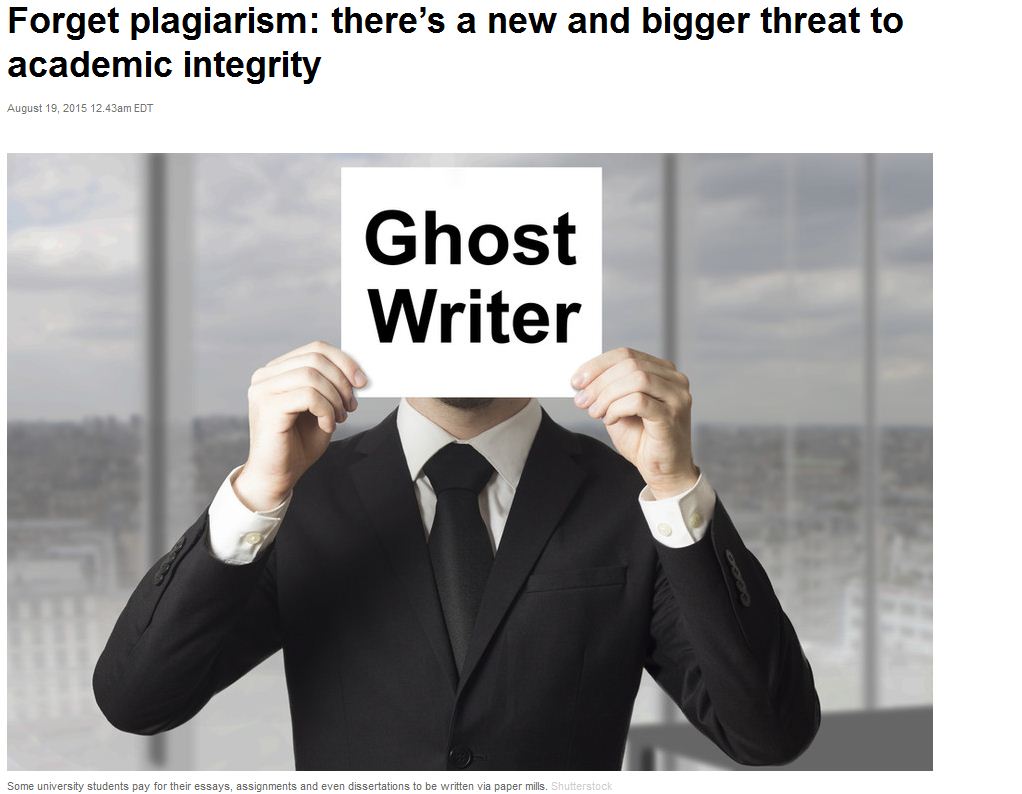
#BLAThoughtOfTheDay – If paying for someone to do your homework is wrong, isn’t it wrong for a ghost writer to write novels for other people?

Where does artistic and academic integrity differ? How to do we define integrity; if we’re making money off something does it become irrelevant? Has anyone asked James Patterson or the Big 5 these questions?

ghost writer image

“There is another problem with calling on academics alone to tackle plagiarism. Research suggests that many may themselves be guilty of the same [offense] or may ignore their students’ dishonesty because they feel investigating plagiarism takes too much time.

It has also been proved that cheating behaviour thrives in environments where there are few or no consequences. But perhaps herein lies a solution that could help in addressing the problem of plagiarism and paper mills.”

[Via]

See also: Why Literature Is No Longer Art & On Book Packagers & Art & Honesty

[“BLA and GB Gabbler” (really just a pen name – singular) are the Editor and Narrator behind THE AUTOMATION, vol. 1 of the Circo del Herrero series. They are on facebook, twitter, tumblr, goodreads, and Vulcan’s shit list.]

all yellowB&N | Amazon | Etc.

Why I’m already concerned about the Starz TV adaptation of Neil Gaiman’s American Gods

Hi. BLA here. Coming to remind you of what Neil Gaiman said back in 2010 about not setting one of his books in “America”:

“The great thing about having an English cemetery is I could go back a very, very, very long way. And in America, you go back 250 years (in a cemetery), and then suddenly you’ve got a few dead Indians, and then you don’t have anybody at all, unless you decide to set it up in Maine or somewhere and sneak in some Vikings.” [Via]

A “few dead Indians” is what you’re supposed to pay attention to here. Now, surpassing debates on what he meant or didn’t intend to do in that interview, we can look at his colonial mentality in his work itself. Take this statement about American Gods:

And perhaps most offensive, we’ll get the book’s Big Statement About America, which is bizarrely insulting to Native Americans. Near the end of the novel, a Native American with magical powers named Whiskey Jack tells Shadow he’s not a god, but rather a “culture hero,” because the land we call America “is not a good country for gods.” [Via]

Neil Gaiman consistently glazes over Native Americans/Indigenous peoples and their cultures. Something I’m sure he has learned to correct by this point, but it was something I had hoped the creators of the new TV show adaptation would rethink in the story. However, it doesn’t seem likely. Sure, sure, they can update Technology Boy to not be so technologically illiterate or culturally offensive, but this recent EW article doesn’t give me hope for the story’s cultural literacy:

“Neil created this wonderfully stuffed toy box filled with all sorts of cultural points of view on how American operates as a system, and that was so fascinating and mythological in and of itself,” says Fuller. “It’s really much more of an immigration story than it is a god story.” Green adds, “One of the biggest challenges was stripping the idea of gods as X-Men or giant empowered creatures who stomp on cities and throw the oceans. We wanted them to be people with problems. It’s not about lightning bolts – it’s about the question of day-to-day survival.”

So, we’re still talking about immigrants? Colonizer problems? Nothing has changed. Dear Hollywood and Neil Gaiman, just because your story doesn’t whitewash doesn’t mean it’s not racist.

See also, The Gods Don’t Need Your Worship. 

[“BLA and GB Gabbler” (really just a pen name – singular) are the Editor and Narrator behind THE AUTOMATION, vol. 1 of the Circo del Herrero series. They are on facebook, twitter, tumblr, goodreads, and Vulcan’s shit list.]

all yellowB&N | Amazon | Etc.