My first suggestion for ritual catharsis:
My second is we stop eating beef.
View this post on InstagramA post shared by Leonardo DiCaprio (@leonardodicaprio) on
[a website for the Editor and Narrator of the Circo del Herrero series]
My first suggestion for ritual catharsis:
My second is we stop eating beef.
All of which, with the use of this smooth, clever transition sentence, leads me to my topic, 99 Practical Methods of Utilizing Boiled Beef, a book that has sweetened me on self-published books (even if it’s not technically self-published). A few years ago, when I was ready to publish my first book, the award-non-winning novel Barn Again: A Memoir, I learned, after a year of researching and querying agents and publishers, that no one else was ready for it to be published. Skip to the part where I finally say fuck it, I’ll publish the motherfucker myself and unlike certain people I’ll actually proofread it. And to mask the shame of self-publishing I put it out under a phony publisher name, Malarkey Books. And because of that this website exists and other people are even writing for it, and dozen of people have read my books, and I’m writing this review of a book that was published by another small-time publisher. The thing is, you won’t hear about it on the news or any of the big magazines or literary websites, but some of the most interesting books being published today are being self-published or released by extremely small presses that use the exact same publication method as the self-publishers, which is print-on-demand. Usually with either CreateSpace or Ingram Spark. Obviously Malarkey uses Ingram Spark because CreateSpace is owned by Amazon and Amazon is an anagram for Satan. Cow Eye Press, the publisher of Boiled Beef, also uses Ingram Spark. I asked, but I didn’t need to. You can tell. CreateSpace books are easy to spot because they have this crease near the spine on the front and back covers. You’re right, they should change their name to CreaseSpace. Ingram, once you hold a few, you can tell by the feel of the cover, also the barcode at the back of the book.
You’d have to be sort of nuts to buy this book. You’d have to be sort of nuts to publish it. I mean, it’s just a book of recipes, none of which is particularly detailed or—can’t even tell if this is the vegetarian in me or the old picky eater in me—appetizing, for cooking boiled beef. But it’s not just a book about boiled beef. It’s also a meditation on publishing and independent literature. What the good folks at Cow Eye Press have done is pluck an obscure manuscript from the public domain and turn it into a metaphor for the existence of the modern writer. The twenty-first-century update of Boiled Beef is prefaced by a note from a fictional intern, who thinks “no more than five people will read this new edition.” But it doesn’t matter how many people read it, the point of this book is that “Nobody’s gonna read a book of recipes for boiled beef” is not a critique but a formula. “Nobody’s gonna read a book of/about/for/by” + whatever category or genre doesn’t really sell. For writers and publishers outside the publishing establishment, we know this, and we do it anyway. Because we’re stubborn or vain or deluded—or because it’s worth doing, even if there ain’t a big fucking market for what we do.
…
“As an independent publisher,” writes Natalie Zeldner in a note at the beginning of the book,
I sometimes wonder why we even bother. It is unlikely that anyone will take note of the books we publish. No reviewer will discuss them. Bookstores will not stock them. The common reader, already drowning in a sea of heavily marketed titles, will never suspect that ours also exist. Our books will be excluded from the prominent “Best Of….” lists and literary awards that have become the last refuge for gaining editorial credibility and an external audience — but that to this day remain the privileged birthright of the publishing establishment and its legacy of patronage and prestige, of old money, of esoteric tradition, of economic expediency, of timeliness, of genre.
She still went and published this book. That’s what we do. Agents tell us no, so politely. Book reviewers ignore our emails. Bookstores charge us consignment fees. We keep writing. We keep publishing. We keep reading. Boiled Beef is more than a book, it’s an homage to those of us who work in the dark, whose publications exist and matter and are met, as Cow Eye Press put it on twitter, with overwhelming silence. For those of us in the independent publishing world, we don’t have publicists or marketing teams. We don’t have agents, managers, or brand strategists. All we have is each other.
[Via]
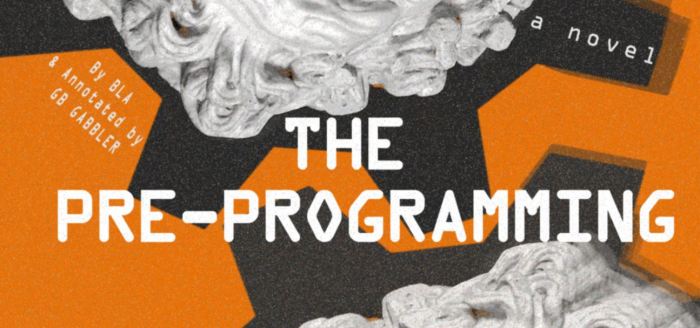
[The crippled god of metallurgy, fire, and alchemy has many names and many faces—sometimes Hephaestus, Ptah, or Vulcan. He changes to suit his needs. And just like his names, his creations have gone through countless revisions. This time, he’s finally onto something—his Automata have turned the heads of other gods. They’ve noticed their pre-programmed potential. There’s a reason Vulcan didn’t scrap the Automata—a reason he left them in the care of humans all this time. They were just the beta testers for his most intricate windup toy yet…
Vulcan’s ancient Automata find their purpose rebooted in the second installment of the CIRCO DEL HERRERO/THE BLACKSMITH’S CIRCUS series. Their immortal human Masters will drop like flies—superfluous in the next round as the gods shuffle in a new deck of fateful cards. The Masters can choose how and when, but they will all die to free the Automata of their earthly chains. Odys and his Automaton, Maud, struggle to protect his twin sister from the plotting of his dual-bodied adversaries. But his sister, Odissa, finds herself a willing participant in The Blacksmith’s latest exhibition—could she be the missing cog to the god’s tightly wound machine all along?
In this thrilling sequel to THE AUTOMATION, the Narrator and Editor drag readers deeper into the dark history and even darker future of the Automata. When the subterranean god emerges with his postlapsarian blueprint, so will the truth about B.L.A. and G.B. Gabbler. Ideal for fans of Scott Hawkin’s The Library at Mount Char, Jo Walton’s The Just City, and all the way to Homer’s The Odyssey, THE PRE-PROGRAMMING is a literary outrage that dares you to keep reading between the lines and the footnotes.]
Signup for our email alerts in the right sidebar of our blog for updates on THE PRE-PROGRAMMING.
For someone who doesn’t want to be controlled by the corporate world and protect her freedom, she’s participating in corporate publishing and stifling honest writers — promoting a book that James Patterson didn’t even write. We feel like she can do better.
For more of our opinion on this, see this essay.
“It may seem a stretch to claim that The Girl With All The Gifts is an anti-natalist story when its most pro-natalist characters aren’t necessarily pro-baby, but pro-species. The logic behind both, however, stems from the same selfish and oppressive choices. Humans, until this point, have treated the new, immune second generation like just another thing to be colonized to secure their own posterity. They subject the children to captivity and dissection. This is all done in search for an antidote so that the old generation of humans can keep on living and therefore breeding. It is never in the interest of the new generation/Other. It is here I would like to emphasize natalist vs. pro-natalist. Pro-natalism goes beyond the status quo of humans’ natalist tendencies to promote a birthrate without reason or through ignoring ethical critique.”
[Via]