#BLAThoughtOfTheDay – If paying for someone to do your homework is wrong, isn’t it wrong for a ghost writer to write novels for other people?

Where does artistic and academic integrity differ? How to do we define integrity; if we’re making money off something does it become irrelevant? Has anyone asked James Patterson or the Big 5 these questions?

a1

“There is another problem with calling on academics alone to tackle plagiarism. Research suggests that many may themselves be guilty of the same [offense] or may ignore their students’ dishonesty because they feel investigating plagiarism takes too much time.

It has also been proved that cheating behaviour thrives in environments where there are few or no consequences. But perhaps herein lies a solution that could help in addressing the problem of plagiarism and paper mills.”

[Via]

See also: Why Literature Is No Longer Art & On Book Packagers & Art & Honesty

[“BLA and GB Gabbler” (really just a pen name – singular) are the Editor and Narrator behind THE AUTOMATION, vol. 1 of the Circo del Herrero series. They are on facebook, twitter, tumblr, goodreads, and Vulcan’s shit list.]
all yellowB&N | Amazon | Etc.

BookTuber Tuesday – Lionel Shriver, on being Childfree and writing

“I want to be both genders.”


Check out other book vlogs we’ve featured here.

Have a book vlog video you want us to check out? Submit a link below in the comments and it could make the CIRCO blog.

[“BLA and GB Gabbler” (really just a pen name – singular) are the Editor and Narrator behind THE AUTOMATION, vol. 1 of the Circo del Herrero series. They are on facebook, twitter, tumblr, goodreads, and Vulcan’s shit list.]
all yellowB&N | Amazon | Etc.

Why I’m already concerned about the Starz TV adaptation of Neil Gaiman’s American Gods


Hi. BLA here. Coming to remind you of what Neil Gaiman said back in 2010 about not setting one of his books in “America”:

“The great thing about having an English cemetery is I could go back a very, very, very long way. And in America, you go back 250 years (in a cemetery), and then suddenly you’ve got a few dead Indians, and then you don’t have anybody at all, unless you decide to set it up in Maine or somewhere and sneak in some Vikings.” [Via]

A “few dead Indians” is what you’re supposed to pay attention to here. Now, surpassing debates on what he meant or didn’t intend to do in that interview, we can look at his colonial mentality in his work itself. Take this statement about American Gods:

And perhaps most offensive, we’ll get the book’s Big Statement About America, which is bizarrely insulting to Native Americans. Near the end of the novel, a Native American with magical powers named Whiskey Jack tells Shadow he’s not a god, but rather a “culture hero,” because the land we call America “is not a good country for gods.” [Via]

Neil Gaiman consistently glazes over Native Americans/Indigenous peoples and their cultures. Something I’m sure he has learned to correct by this point, but it was something I had hoped the creators of the new TV show adaptation would rethink in the story. However, it doesn’t seem likely. Sure, sure, they can update Technology Boy to not be so technologically illiterate, but this recent EW article doesn’t give me hope for the story’s cultural literacy:

“Neil created this wonderfully stuffed toy box filled with all sorts of cultural points of view on how American operates as a system, and that was so fascinating and mythological in and of itself,” says Fuller. “It’s really much more of an immigration story than it is a god story.” Green adds, “One of the biggest challenges was stripping the idea of gods as X-Men or giant empowered creatures who stomp on cities and throw the oceans. We wanted them to be people with problems. It’s not about lightning bolts – it’s about the question of day-to-day survival.”

So, we’re still talking about immigrants? Colonizer problems? Nothing has changed. Dear Hollywood and Neil Gaiman, just because your story doesn’t whitewash doesn’t mean it’s not racist.

See also, The Gods Don’t Need Your Worship. 

[“BLA and GB Gabbler” (really just a pen name – singular) are the Editor and Narrator behind THE AUTOMATION, vol. 1 of the Circo del Herrero series. They are on facebook, twitter, tumblr, goodreads, and Vulcan’s shit list.]
all yellowB&N | Amazon | Etc.

BookTuber Tuesday – On Book Packagers and Art and Honesty

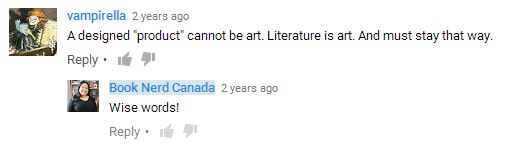
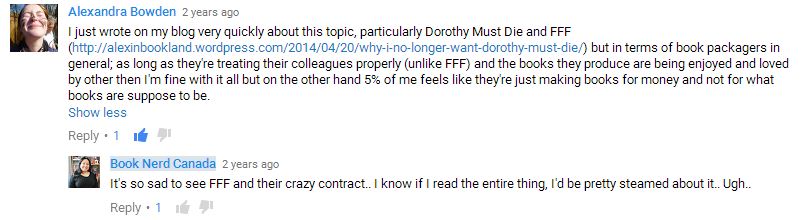
Comments from the video on YouTube:

comments

comments

[High art vs. low art argument aside, book packagers’ bottom line is to deceive readers into thinking inspiration wasn’t packaged like processed meat. Instead of allowing cheating in the “system,” perhaps authors and readers should note why cheating was considered in the first place and what this says about their culture and the “art” it produces (or lack thereof).]

Check out other book vlogs we’ve featured here.

Have a book vlog video you want us to check out? Submit a link below in the comments and it could make the CIRCO blog.

[“BLA and GB Gabbler” (really just a pen name – singular) are the Editor and Narrator behind THE AUTOMATION, vol. 1 of the Circo del Herrero series. They are on facebook, twitter, tumblr, goodreads, and Vulcan’s shit list.]

all yellowB&N | Amazon | Etc.

On Little Gods

[It’s good to remember that those big gods would be nothing without little gods. They’d have no Olympus without them–just empty thrones. In some ways, I’d prefer Olympus to fall… Such a sad post about the loss of an author’s power–at the risk of the creation. Are you a “good little god” if what you create suffers under your own apathy to let it be abused?]

veschwab's avatarVictoria (V.E.) Schwab

I’ve been thinking a lot about control. As a writer, you sculpt a world from scratch, populate it with people, with stories, and control them all. From the geography to the folklore, the smallest details to the largest plots. It’s in your hands.

In that sense, as a writer, you become a ‘little god’.

But in publishing–that business side of the art, your control dissolves.

You don’t control whether the book sells.

You don’t control the marketing budget if he does.

You don’t control the publisher’s investment.

You don’t control your place in-house.

You don’t control the sales plan.

You don’t control the cover art.

You don’t control the jacket copy.

You don’t control how the book is portrayed, publicized, given, sold to the world.

You don’t control anything.

Or at least, it can feel that way.

Because, of course, you still control one thing.

The words.

The content between…

View original post 190 more words