GABBLER RECOMMENDS: A World Ordered Only By Search The Convivial Society: Vol. 2, No. 17

This kind of reading was grounded not just in the book generically, but in a particular book. Remember, of course, that books were relatively scarce artifacts and that reproducing them was a laborious task, although often one lovingly undertaken. This much is well known. What might not be as well known is that many features that we take for granted when we read a book had not yet been invented. These include, for example, page numbers, chapter headings, paragraph breaks, and alphabetical indexes. These are some of the dozen or so textual innovations that Illich had in mind when he talks about the transformation of the experience of reading in the 12th century. What they provide are multiple paths into a book. If we imagine the book as an information storage technology (something we can do only on the other side of this revolution) then what these new tools do is solve the problems of sorting and access. They help organize the information in such a way that readers can now dip in and out of what now can be imagined as a text independent of the book.

I’ve found it helpful to think about this development by recalling how Katherine Hayles phrased one of the themes of How We Became Posthuman. She sought to show, in her words, “how information lost its body.” Illich is here doing something very similar. The text is information that has lost its body, i.e. the book. According to Illich, until these textual innovations took hold in the 12th century, it was very hard to imagine a text apart from its particular embodiment in a book, a book that would’ve born the marks of its long history—in the form, for example, of marginalia accruing around the main text.

I’ve also thought about this claim by analogy to the photograph. The photograph is to the book as the image is to the text. This will likely make more sense if you are over 35 or thereabouts. Today, one can have images that live in various devices: a phone, a laptop, a tablet, a digital picture frame, the cloud, an external drive, etc. Before digital photography, we did not think in terms of images but rather of specific photographs, which changed with age and could be damaged or lost altogether. Consequently, our relationship to the artifact has changed. Roland Barthes couldn’t be brought to include the lone photograph he possessed of his mother in his famous study of photography, Camera Lucida published in 1980. The photograph was too private, his relationship to it too intimate. This attitude toward a photographic image is practically unintelligible today. Or, alternatively, imagine the emotional distance between tearing a photograph and deleting an image. This is an important point to grasp because Illich is going to suggest that there’s another analogous operation happening in the 12th century as the individual detaches from their community. But we’ll come back to that in the last section.

[Via]
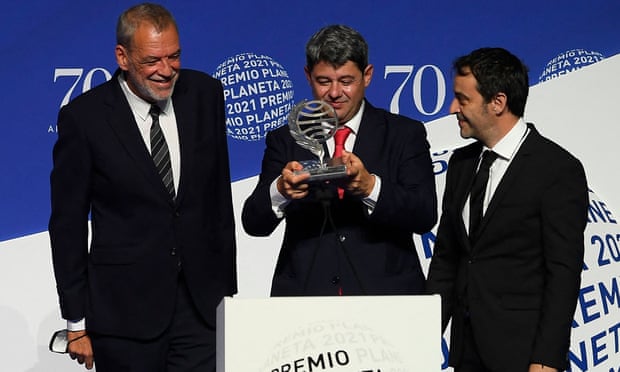
” Female Spanish thriller writer Carmen Mola revealed to be three men”

“The men had published under the pseudonym Carmen Mola, which roughly translates as “Carmen’s cool”.

When one of their books won the lucrative Planeta prize, the trio went public to pick up the cheque at a glitzy ceremony attended by the Spanish king.”

[Via]

I don’t know if I necessarily agree with this article but… “How the Golem Came to Prague”

As we have seen, the move to the center (both religiously and geographically, since Prague is much closer to the heart of the Hapsburg Empire than the Polish city of Chelm) was a spectacular success. For nearly a quarter of a century after Grimm’s report there is no written record of any specific ecotype of the Golem legend, and one could imagine countless variants circulating orally. But once the tale is fixed in Prague, it quickly becomes the standard reflex and ultimately the authoritative version through Weisel, dominating the next six decades until it is swallowed up by Rosenberg’s more fully developed Prague narratives.26 That the attachment of Grimm’s uprooted Golem to the Maharal is in large part an attempt to emphasize the power of the holy word is evident in one of the main differences between Jewish and Christian accounts of the Golem in this period. All Christian accounts follow Grimm in identifying the utterance of holy words as the key to the animation process. The Jewish versions, on the other hand, emphasize the act of writing the secret name and inserting it into a cavity of the head (usually the mouth), an act which by definition defies pronunciation. It is not a magical spell that brings the Golem to life; it is an act of literacy, that is, an act of reading, studying, and writing, which are all meditations on the nature of God. This act strongly distances itself from the conjuring power of the words used by Grimm’s anonymous ‘‘they,’’ where ‘‘Schemhamphoras’’ is more like abracadabra.27 Moreover this act of literacy is about rewriting or reclaiming the creation in Eden by transferring the divine voice into the written form of the divine name. It would seem, then, that only a rabbi with a specific name can control the Holy Name. Man might not be able to speak for God, but he can quote him on parchment.

[Via]

I don’t know how necessarily fair it is to say/imply that Christians emphasized the speaking of the word/oral traditions, when it was a Jewish concept in the book of Exodus that names spoken aloud have power (God to Moses). 

There’s also likely something to be said about the word “nephesh” but I’m too lazy to get into an argument requiring research right now.


The synopsis for our third mythpunk novel THE LATHING:

The Lathing (Vol. 3 of the Circo del Herrero Series) Synopsis:

[Smack dab in the Bible Belt’s buckle, Vulcan arranges His pagan pieces. The tribal casinos are nothing but referential backdrop for His latest hustle. The gods have all paid to play. They’ve offered up parts of themselves to help make “The Game”—some more than others—but their chimeric incarnations are not where they place their bets. It is the human players they gamble on. The gods know the game is rigged but that’s half the fun, figuring out just what Vulcan has pre-programmed— how it works—how they, too, might cheat.

And like the gods, some Automata think they’ve found the secret mechanism that makes it all tick. Other Automata, however, are not so sure. They choose opposing humans—humans with flaws and sins so much like their own. Those they pick show less about the beings they’ve become than the ghosts that still haunt and possess them…

THE LATHING is the final attestation of the Narrator and the Editor—the final volume in the CIRCO DEL HERRERO series. In it, once-gods may find forgiveness and be made whole again if they pick the winning team. Automata may find a self that is worth knowing and saving. But the humans, well, they were just lucky the game found them before Death did. They’ll live just a little while longer before finding something truly worth dying for. At the end of it all is glory and godhood and possibly a cat.]

GABBLER RECOMMENDS: ‘The Rise of the ‘Lowercase Girl’’

Pre-internet, decapitalisation has a radical history. The poet e.e cummings, invariably stylised his name (as well as “I”) in lower case order to allow the reader a more fluid reading process and show his disavowal of hierarchy. The feminist theorist bell hooks decapitalises her name (itself borrowed from her grandmother) in order to decentre herself so that her readers focus on her ideas instead.

This upturning of grammatical norms is a means of questioning the status quo. “There is a prescriptivist attitude to capitalisation you learn in English classes,” says deandre miles-hercules, a PhD researcher in sociolinguistics at the University California Santa Barbara. “We can use language to reflect on and push back against systems and create new stylistic practises that bring attention to the systems by which we mean to deconstruct racism and sexism […] When [hooks] writes ‘imperialist’, ‘capitalist’, ‘white supremacist’, ‘patriarchy’ she is linking all these things together in a way that is fundamentally inseparable and rejecting conventional forms of writing that are embedded in that system.”

Interpreted literally, capitalisation might also be used to interrogate ideas of capital and capitalism. “Why do I capitalise ‘Black’, for example?” asks miles-hercules. “It is related to the fact that Blackness in its inception as a racialising category was actually about capital, turning people who came to be known as black into literal capital – property – in order to generate profit.”

While miles-hercules believes that artists tend to be at the forefront of cultural trends, they feel somewhat sceptical about the co-option of lowercasing by the mainstream: “There is a way in which these writing systems and orthography have taken on trendy or artsy connotations, without particular attention to its history. As soon as you might see someone using unconventional capitalisation on their single you see it on commercials for Target. It has become a way for brands to be relevant and connected to their audiences. It appeals to folks for the sake of profit rather than being actually disruptive.”

[Via]