“I will not, however, want to claim that maenadic omophagy is even a mythic of imaginative example of Dionsysiac sacramentalism, for the very reason that it is not sacrifice at all. Instead, it constitutes the inversion of normal sacrificial procedure, in which a domesticated (and not wild) animal is ritually selected (and not merely chanced upon), killed, systematically cut up (and not dismembered by force), and eaten cooked (and not raw). Maenadic sparagamos followed by omophagy thus stands in complete contradistinction to ordinary sacrifice and can thus be viewed as a kind of inverted character myth, setting for the way in which sacrifice should not take place, much as the account of the dismemberment of the young Dionysus by the Titans invert the original, paradigmatic division of the sacrificial victim by (another Titan) Prometheus.
…
Raw meat in these instances is to be associated with highly marginal, unusual, and infrequent situations of ritual exception and solution. One may compare the Hephaestia on Lemnos, a time of dissolution and exception, in which all fire is extinguished for nine days until new fire is brought from Delos.* During the exceptional period sacrifices continue to be performed without fire; there is thus no normal food (consumption of raw meat is actually not attested). So also in the case of maenadic sacrifice there is an infrequent (“trietetric,” i.e., every other year), periodic (though short-lived) ritual and commemorative regression to an aboriginal period in cultural history, with the mythical worshipers of Dionysus “regressively transformed into bestial predators.”
…
I suspect that if you asked a Theban of Delphic maenad if they performed sparagmos during their oreibasiai, the answer would have been, ‘No, but we used to do so. It’s just we don’t do that anymore. Other people, those people,” they might have said, “up there [Thracians, perhaps], still do it.” (The same is often said by one culture of another culture about cannibalism[…].)
*Philostratus Heroicus 67.7 (de Lannoy 1977): during the exceptional nine-day period ‘fid the ship brining new fire from Delos arrives before the funerary sacrifice are over, it may not be brought to anchor on Lemnos.’ Cf. Burkert 1983, 190-96, especially on the Dionysiac elements with further bibliography: ‘Sacrifice was clearly a part of the exceptional period at Lemnos, sacrifice without fire; so that one could eat at most only raw pieces of meat, burying the rest or throwing it intot he sea’ (193).
Author: blablablaandgabbler
[BLA and GB GABBLER are two halves of the pen name behind the CIRCO DEL HERRERO series. Vol. 2, THE PRE-PROGRAMMING out now!]
Last day to download THE PRE-PROGRAMMING for free in our St. Patrick’s WEEK giveaway:

Who needs a Leprechaun when these Automata have the Midas touch:
Both of these ebooks are free right now. See below:
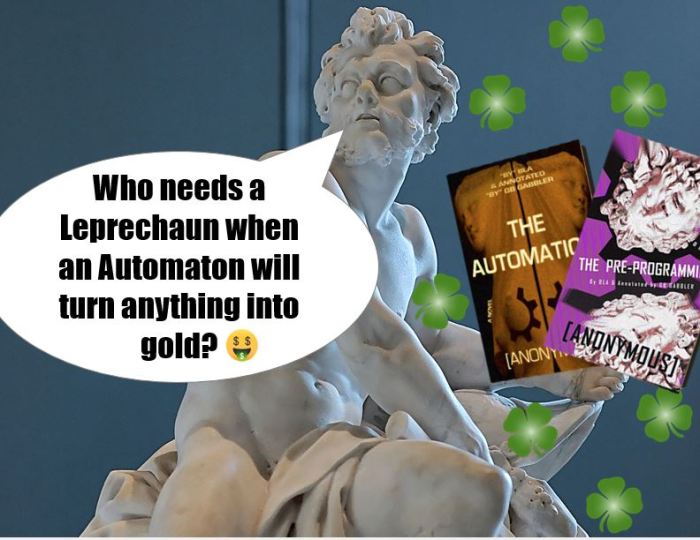
Download links for free copies of the Circo del Herrero series.
The synopsis for our third mythpunk novel THE LATHING:
The Lathing (Vol. 3 of the Circo del Herrero Series) Synopsis:
[Smack dab in the Bible Belt’s buckle, Vulcan arranges His pagan pieces. The tribal casinos are nothing but referential backdrop for His latest hustle. The gods have all paid to play. They’ve offered up parts of themselves to help make “The Game”—some more than others—but their chimeric incarnations are not where they place their bets. It is the human players they gamble on. The gods know the game is rigged but that’s half the fun, figuring out just what Vulcan has pre-programmed— how it works—how they, too, might cheat.

And like the gods, some Automata think they’ve found the secret mechanism that makes it all tick. Other Automata, however, are not so sure. They choose opposing humans—humans with flaws and sins so much like their own. Those they pick show less about the beings they’ve become than the ghosts that still haunt and possess them…
THE LATHING is the final attestation of the Narrator and the Editor—the final volume in the CIRCO DEL HERRERO series. In it, once-gods may find forgiveness and be made whole again if they pick the winning team. Automata may find a self that is worth knowing and saving. But the humans, well, they were just lucky the game found them before Death did. They’ll live just a little while longer before finding something truly worth dying for. At the end of it all is glory and godhood and possibly a cat.]
Saint Patrick’s Day? More like Saint Patrick’s WEEK. Both our ebooks are free right now.
You might already know that THE AUTOMATION, Vol. 1 of the Circo del Herrero Series is already permafree on the Internet Archive, but did you know that our Vol. 2 is also free right now until 19th? Download it here.

What people are saying on Goodreads:
“There are interesting explorations of freedom, and what this means – do we have choice at all, or are we all pre-programmed robots destined to live out what the gods decide for us?” Reviewer
“This novel is dark, unpredictable, and innovative, a unique gem for fans of Urban Fantasy and Greco-Roman mythology who appreciate a little sensationalism.” Reviewer
“…there is probably the most drastic left-turn that I have ever seen a series take, and I still don’t know quite what to make of it.” Reviewer