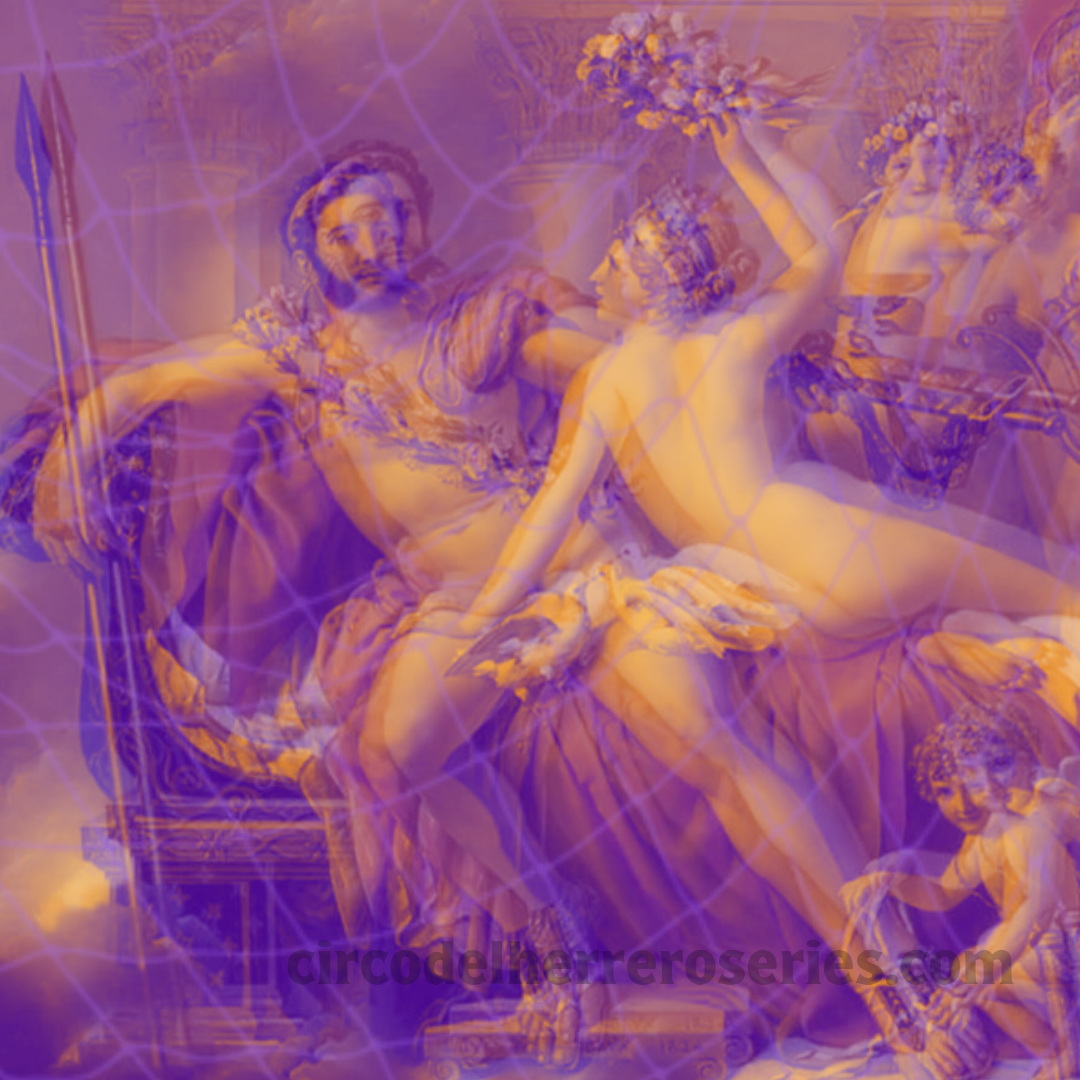
“Demodokos struck the lyre and began singing well the story
about the love of Ares and sweei-garlanded Aphrodite,
how they first lay together in the house of Hephaistos
secretly; he gave her much and fouled the marriage
and bed of the lord Hephaistos; to him there came as messenger
Helios, the sun, who had seen them lying in love together.
Hephaistos, when he had heard the heartsore story of it,
went on his way to his smithy, heart turbulent with hard sorrows,
and set the great anvil upon its stand, and hammered out fastenings
that could not be slipped or broken, to hold them fixed in position.
Now when, in his anger against Ares, he had made this treacherous
snare, he went to his chamber where his own dear bed lay,
and spun his fastenings around the posts from every direction,
while many more were suspended overhead, from the roof beams,
thin, Iike spider webs, which not even one of the blessed
gods could see. He had fashioned it to be very deceptive.
But when he had spun about the bedstead all of his treacherous
device, he started for Lemnos, the strong-founded citadel,
which, of all territories on earth, was far dearest to him.
Nor did Ares of the golden reins keep a blind watch on him,
as he saw Hephaistos the glorious smith go away, but he then
took his course so he entered the house of glorious Hephaistos,
lusting after the love of sweet-garlanded Kythereia.
She had lately come in from the house of her father, the powerful
son of Kronos, and sat there when Ares entered the house. Then
he took her by the hand and spoke to her and named her, saying:
‘Come, my dear, let us take our way to the bed, and lie there,
for Hephaistos is no longer hereabouts, but by this time
he must have come to Lemnos and the wild-spoken Sintians.’
So he spoke, and she was well pleased to sleep with him. These two
went to bed, and slept there, and all about them were bending
the artful bonds that had been forged by subtle Hephaistos,
so neither of them could stir a limb or get up, and now
they saw the truth, and there was no longer a way out for them.
The glorious smith of the strong arms came and stood near. He had
turned back on his way, before ever reaching the Lemnian country,
for Helios had kept watch for him, and told him the story.
He took his way back to his own house, heart grieved within him,
and stood there in the forecourt, with the savage anger upon him,
and gave out a terrible cry and called to all the immortals:
‘Father Zeus and all you other blessed immortal
gods, come here, to see a ridiculous sight, no seemly
matter, how Aphrodite daughter of Zeus forever
holds me in little favor, but she loves ruinous Ares
because he is handsome, and goes sound on his feet, while I am
misshapen from birth, and for this I hold no other responsible
but my own father and mother, and I wish they never had got me,
Now look and see, where these two have gone to bed and lie there
in love together. I am sickened when I look at them, and yet
I think they will not go on lying thus even for a little,
much though they are in love, I think they will have no wish
for sleeping, but then my fastenings and my snare will contain them
until her father pays back in full all my gifts of courtship
I paid out into his hand for the sake of his bitch-eyed daughter.
The girl is beautiful indeed, but she is intemperate.’
So he spoke, and the gods gathered to the house with the brazen
floor. Poseidon came, the shaker of the earth, and the kindly
Hermes came, and the lord who works from afar, Apollo,
but the female gods remained each at her home, for modesty.
The gods, the givers of good things, stood there in the forecourt,
and among the blessed immortals uncontrollable laughter
went up as they saw the handiwork of subtle Hephaistos.
And thus they would speak to each other, each looking at the god next
him:
‘No virtue in bad dealings. See, the slow one has overtaken
the swift, as now slow Hephaistos has overtaken
Ares, swiftest of all the gods on Olympos, by artifice,
though he was lame, and Ares must pay the adulterer’s damage.’
This was the way of the gods as they conversed with each other,
but the lord Apollo son of Zeus said a word to Hermes:
‘Hermes, son of Zeus, guide and giver of good things, tell me,
would you, caught tight in these strong fastenings, be willing
to sleep in bed by the side of Aphrodite the golden?’
Then in turn the courier Argeiphontes answered:
‘Lord who strike from afar, Apollo, I wish it could only
be, and there could be thrice this number of endless fastenings,
and all you gods could be looking on and all the goddesses,
and still I would sleep by the side of Aphrodite the golden.’
He spoke, and there was laughter among the immortals, only
there was no laughter for Poseidon, but he kept entreating
Hephaistos, the famous craftsman, asking him to set Ares
free, and spoke aloud to him and addressed him in winged words:
‘Let him go, and I guarantee he will pay whatever
you ask, all that is approved among the immortal deities.’
Then in turn the renowned smith of the strong arms answered:
‘Shaker of the earth, Poseidon, do not urge this on me.
The business of wretches is wretched even in guarantee giving.
To what could I hold you among the immortal gods, if Ares
were to go off, avoiding both his debt and his bondage?’
Then in turn Poseidon, shaker of the earth, answered:
‘Hephaistos, if Ares goes off and escapes, not paying
anything he may owe you, then I myself will pay it.’
Then in turn the renowned smith of the strong arms answered:
‘It cannot be, and it is not right, that I should deny you.’
So mighty Hephaistos spoke and undid the fastenings. Straightway
the two of them, when they were set free of the fastening, though it
was so strong, sprang up, and Ares took his way Thraceward,
while she, Aphrodite lover of laughter, went back to Paphos
on Cyprus, where lies her sacred precinct and her smoky altar,
and there the Graces bathed her and anointed her with ambrosial
oil, such as abounds for the gods who are everlasting,
and put delightful clothing about her, a wonder to look on.
So the famous singer sang his song, and Odysseus
enjoyed it in his heart as he listened, as did the others
there, Phaiakians, men of the long oar, famed for seafaring.”
