Both volumes 1 and 2 are currently free.
While you might know volume 1 is permafree (fine, compare us to a drug dealer), we need you to now volume 2 is free for a limited time as a Kindle ebook here.

[a website for the Editor and Narrator of the Circo del Herrero series]
Both volumes 1 and 2 are currently free.
While you might know volume 1 is permafree (fine, compare us to a drug dealer), we need you to now volume 2 is free for a limited time as a Kindle ebook here.
1) The Tyranny of the Tale by By Parul Sehgal: ‘Anyone in my line has every incentive to fall in step, to proclaim the supremacy of narrative, and then, modestly, to propose herself, as one professionally steeped in story, to be of some small use. Blame it on the cortisol, though: there’s no stanching the skepticism. How inconspicuously narrative winds around us, soft as fog; how efficiently it enables us to forget to look up and ask: What is it that story does not allow us to see?
…
Return to storytelling’s primal scene: Scheherazade telling tales in order to live to see another dawn. Before it is anything else, a story is a way we can speak to one another without necessarily being ourselves; that is its risk and relief, its portable privacy. The fact that children ask for stories at night is used to defend the notion of storytelling as natural, deeply human—a defense against the dark. But Margaret Wise Brown, the author of “Goodnight Moon,” was convinced that children didn’t care much about plot; it was their parents who did. When children ask for stories, what they’re asking for is the presence of the adult. One wonders just whom Scheherazade was regaling in that room. When did her gaze shift from the king to the children, as it must have? What kind of armor did she think she was providing them?
…
It is also a strange, inadvertent echo of Peter Pan. Peter cannot grow up, he tells Wendy, because he was never told stories: “None of the lost boys know any stories.” Without being imparted a sense of narrative, he cannot establish his own.’ [Via]
2) Letting the Story Go: Field Notes from a Brutal Time by Janet Steen: ‘I gave up on the basic elements of storytelling. Setting, plot, character, theme. When I applied them to my brother’s life, I couldn’t get things to line up. What exactly was the “rising action”? What was the beginning of the denouement? What were the salient details? “I wanted to know more about the main character,” people always say in writing workshops. Yes, I wanted to know more about the main character. I had assumed I would have years and years to learn more about him. …
Stories were a way to freeze time. And time was an illusion anyway, my various guides were telling me. And everything was constantly changing, constantly becoming something else we couldn’t possibly imagine or predict. Memories were essentially old stories. The present moment was the only place where the memories and fantasies ceased.
This change in view felt both liberating and destructive. Who are you if you aren’t your conditioning, if you’re not the product of your past? What exactly is under there?
The most radical part of this process was finding out that I could withstand an enormous amount of emotional pain. Rupert Spira’s teachings especially helped with this, or maybe I was just partial to his gentle, deeply intelligent explanations in the YouTube videos I found and devoured. He was in the nondual tradition stemming from Advaita Vedanta, and what he calls the direct path. The direct path led you straight to your essential nature, which was pure awareness and devoid of, or beyond, thought or emotional content or objective experience.
But he also talked about the tantric approach, which was about bringing feelings close, so close that it was just the raw experience—not the story, not the thought, but “the raw experience in the body.” So instead of the separate self going into flight from the experience, you were absolutely up against it, feeling it as sensation.
I tried this. I went up against the grief, the longing, the missing, the keening, the despair. I touched into it, withdrew, touched into it again. I stayed there with it for as long as I could.
If something shocking and terrible happens, you might feel that you’re going to be consumed by the feelings about it. The intensity of them threatens absolutely everything and, naturally, you don’t want to go near them. But then you do. And in doing so there is some kind of distillation. It is nothing other than what it is in its purest form. And then, although I didn’t know this for quite some time, there begins to be an alchemical change.
…
In good moments I make him into a character, a mythic figure, because I can. Who is to stop me? It’s a creative act. I can make him into what I want and need him to be. He’s not a ghost. He’s a guide, a teacher, showing me the way out of darkness. He’s a doorway leading me out of a closed room.’ [Via]
3) The Movie James Franco Doesn’t Want You To See by Lola Sebastian:
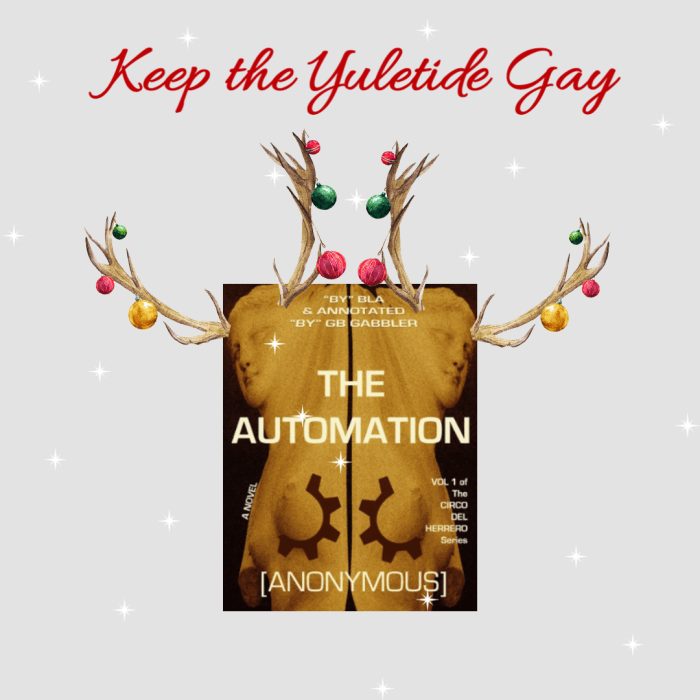
❄️🦌❄️ Trapped with your family? Here’s a way to avoid conversation. Free ebook of Vol. 1 here at our website and/or on the Internet Archive. Forever and always. ❄️🦌❄️
.
A Between the Covers Podcast episode from TinHouse.
I liked what Yuknavitch had to say about her polyvocal story, about objects as characters. Particularly as someone who has a polyvocal narrative and objects (no matter how anthropomorphized) as characters in their own novel.
Like most other American systems and professions, delusions around meritocracy continue to pervade the writing world. Those of us who are not bolstered by outside sources, those of us who are but still struggle, and say it out loud, often run the risk of seeming whiny or ungrateful; maybe we worry we will just be thought not good enough. To be a writer is a choice, after all, and I continue to make it. But perpetuating the delusion that the choice is not impossibly risky, precarity-inducing, only hurts the participants’ ability to reconsider the various shapes their lives might take in service of sustaining it and them.
[Via]