BookTuber Tuesday! bookhunter155

Have a book vlog video you want us to check out? Submit a link below and it could make the CIRCO blog.

[“BLA and GB Gabbler” (really just a pen name – singular) are the Editor and Narrator behind THE AUTOMATION, vol. 1 of the Circo del Herrero series. They are on facebook, twitter, tumblr, goodreads, and Vulcan’s shit list.]

all yellowB&N | Amazon | Etc.

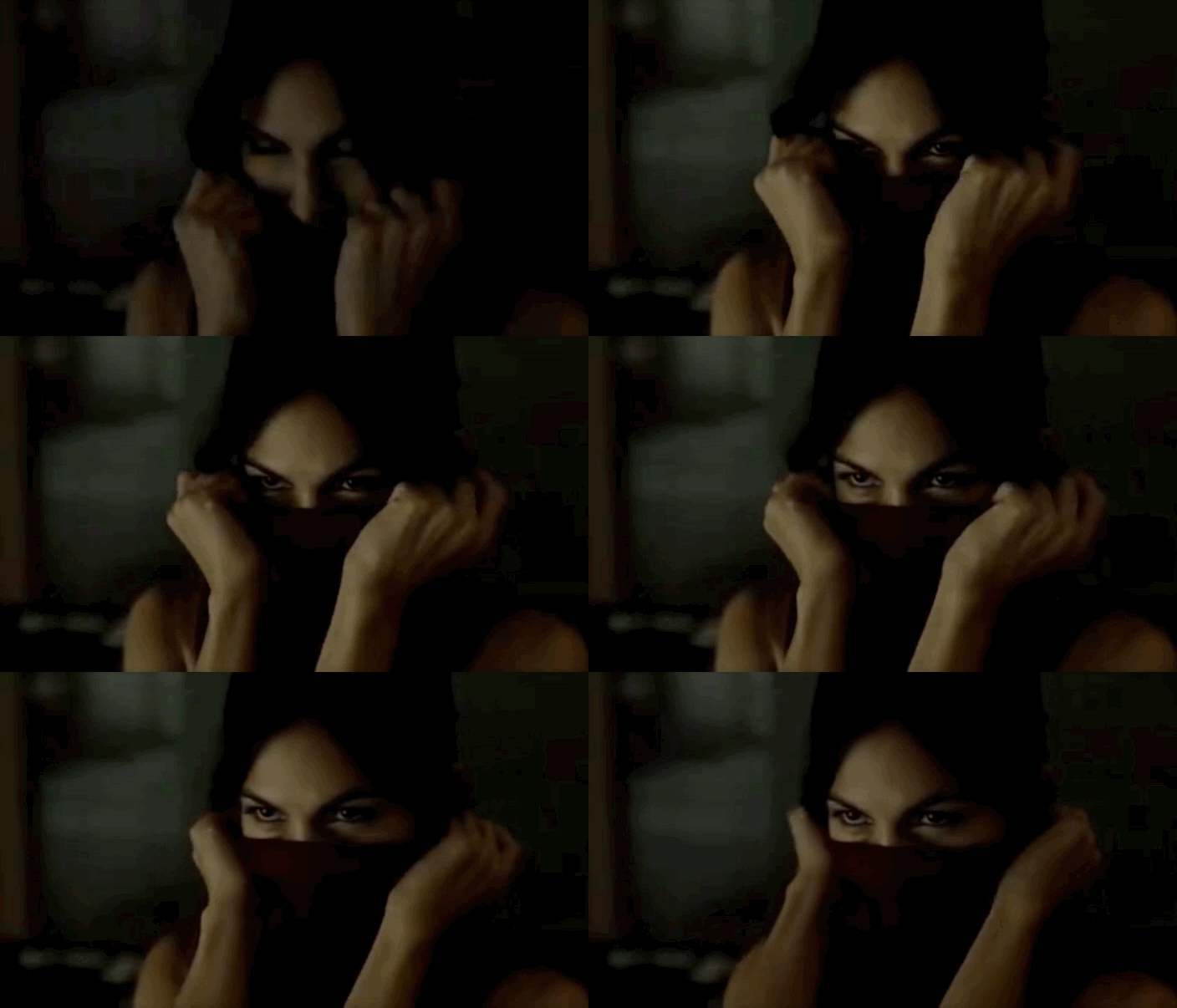
GABBLER RECOMMENDS: Daredevil Season 2 (of course)

While at times the characters got too chatty and analytical (making the pace dip), this season was still just as good as season one. At times I felt like I didn’t entirely know what was going on, maybe because I wasn’t paying close enough attention. I could barely remember Nobu from the first season, so that tells you I need to rewatch some parts…

Scott Glenn is still a jarring actor to watch as Stick, missing punchlines by a hair so that it takes you out of the story. But you still forgive him, as his role in the story arc starts to make more sense (cue Elektra–AKA dear little “Ellie” in this series).

Jon Bernthal as the Punisher was a good choice, though his lines were a bit too melodramatic and used to fluff up the time (“I miss my family sooooooooo much”–that kind of thing. We get it). Elektra’s lines, too, were a bit over the top. She comes off as as an intelligent, calculating woman until the writers have her open her mouth. She asks Matt with childlike panic “Do you still love me?” after killing someone he tells her not to and I cringed–perhaps the delivery was just a bit too off to make that line work as something she’d say aloud. It’s as if the writers couldn’t decide whether or not her childhood trauma would keep her childish.

When Matt Murdock is cleaning blood off of Stick’s lips with precision, you can see his eyes following his own finger. HOW DOES HE KNOW THERE IS BLOOD ON HIS FACE HE CAN’T HEAR IT. But I can make excuses for it; Maybe Stick told him where the blood was, whatever. 

The climax and wrap-up went too quickly–another problem with the pace. It was also, perhaps, too neat: the Punisher’s storyline twist was a bit too intricate and tidy for me–I had to resist rolling my eyes.

But all of these finger-waggings aside, I find myself still making excuses for the show. They’re little nit-pickings that I happily overlook. I just hope the writers and producers read this and are reminded not to get too sloppy, now.

[“BLA and GB Gabbler” (really just a pen name – singular) are the Editor and Narrator behind THE AUTOMATION, vol. 1 of the Circo del Herrero series. They are on facebook, twitter, tumblr, goodreads, and Vulcan’s shit list.]

all yellowB&N | Amazon | Etc.


BookTuber Tuesday! Novela gráfica

Have a book vlog video you want us to check out? Submit a link below and it could make the CIRCO blog.

[“BLA and GB Gabbler” (really just a pen name – singular) are the Editor and Narrator behind THE AUTOMATION, vol. 1 of the Circo del Herrero series. They are on facebook, twitter, tumblr, goodreads, and Vulcan’s shit list.]

all yellowB&N | Amazon | Etc.

Ursula K. Le Guin, on being a man:

‘I am a man. Now you may think I’ve made some kind of silly mistake about gender, or maybe that I’m trying to fool you, because my first name ends in a, and I own three bras, and I’ve been pregnant five times, and other things like that that you might have noticed, little details. But details don’t matter… I predate the invention of women by decades. Well, if you insist on pedantic accuracy, women have been invented several times in widely varying localities, but the inventors just didn’t know how to sell the product. Their distribution techniques were rudimentary and their market research was nil, and so of course the concept just didn’t get off the ground. Even with a genius behind it an invention has to find its market, and it seemed like for a long time the idea of women just didn’t make it to the bottom line. Models like the Austen and the Brontë were too complicated, and people just laughed at the Suffragette, and the Woolf was way too far ahead of its time.

That’s who I am. I am the generic he, as in, “If anybody needs an abortion he will have to go to another state,” or “A writer knows which side his bread is buttered on.” That’s me, the writer, him. I am a man. Not maybe a first-rate man. I’m perfectly willing to admit that I may be in fact a kind of second-rate or imitation man, a Pretend-a-Him. As a him, I am to a genuine male him as a microwaved fish stick is to a whole grilled Chinook salmon.’

[Via]

[“BLA and GB Gabbler” (really just a pen name – singular) are the Editor and Narrator behind THE AUTOMATION, vol. 1 of the Circo del Herrero series. They are on facebook, twitter, tumblr, goodreads, and Vulcan’s shit list.]

all yellowB&N | Amazon | Etc.

GABBLER RECOMMENDS: “Women built this castle”: An in-depth look at sexism in YA.

“In the same opening chapter, Bergstrom’s character attempts to read a “novel with a teenage heroine set in a dystopian future” on the subway. “Which novel in particular,” wrote Bergstrom, in an uncanny reflection of his own quote to Publisher’s Weekly, “doesn’t matter because they’re all the same. Poor teenage heroine, having to go to war when all you really want is to write in your diary about how you’re in love with two different guys and can’t decide between them. These novels are cheesy, I know, and I suck them down as easily as milk.”

Subtle jabs at books like Red Queen and The Hunger Games and Divergent – dystopian fiction that features teenage girls who deal with the emotional realities of relationships and the emotional realities of war simultaneously, things that resonate with teenage girls in high school – weren’t saved for Bergstrom or for the Publisher’s Weekly article.

“Kicking butt to save your dad is actually a lot easier for me to swallow than kids killing kids in The Hunger Games,” said Bergstrom’s agent Tracey Adams to Publisher’s Weekly – missing, of course, that The Hunger Games doesn’t kill for sport or gratuity, but to highlight the actual atrocities of kids killing kids and the powerful bond between Katniss Everdeen and her sister Primrose.

And Bergstrom has made jabs at genre fiction before; in an interview with The Pen and Muse, he wrote that “what troubles [him]about so much of today’s fiction aimed at young adults is that it is set in an imaginary time and place… you’ll see that dystopian future is really the dystopian present,” as if unwilling to acknowledge that fictionalizing ongoing problems can give readers another way to digest the issues at hand.

As Dianna Anderson wrote in her piece “Why criticizing Young Adult Fiction is sexist,” “Before John Green’s The Fault in Our Stars broke records, there was Maureen Johnson, Laurie Halse Anderson, J.K. Rowling, S.E. Hinton, Madeline L’Engle, and Suzanne Collins. Historically, women have populated the genres aimed at teenagers and children precisely because of a sexist publishing industry that deemed women unable to write adult literary fiction.”

“The problem though is that John Green’s name has become a tool of power and force in the YA world. When mainstream writers talk about YA, his name is held with affection and as an ideal to which others should aspire. Forget Stephenie Meyer and her vampires. That’s laughable, and it remains a means of degrading the entire category of fiction. John Green, though — he’s helped save and revive YA fiction from being a crumbling cesspool of . . . whatever a crumbling cesspool of an entire category of fiction can be,” wrote Kelly Jensen in her post “The reductive approach to YA, revisited” on Stacked.

Despite women being the majority of readers, magazines that review books continue to focus heavily on books written by men, with the Guardian reporting in April that all magazines studied featured more men than women. The New York Times book review, the most fairly distributed of the magazines, still featured a hundred more men than they featured women. And while there are more women writers than men in the publishing industry, Sara Sheridan points out on Huffington Post that not only do men get more coverage, they make more money, with women earn 77.5% of what men earn. (That study does not showcase the difference between what women of color and white women earn, or queer women and cisgender or heterosexual women earn, though other studies prove that women of color make even less.)

Bergstrom chose a narrative that raised his own book by putting down others in the women-dominated industry, of making his leading lady different by having her conform to patriarchal ideas of beauty and behavior. Smith chose a narrative that made him the victim despite admittance of his own faults, chose words that attacked others rather than admit his own mistakes.

Despite a huge chunk of both Smith’s fans and YA readers being female, some argued that Smith’s words and writing weren’t something to be worried about because girls weren’t his target audience. This is foolish for a few reasons: characters (girls or otherwise) should be fleshed out as a part of good writing, regardless of who the target audience is; and because a target audience happens to be of one gender doesn’t mean that representation of the other gender should lack. Some are also quick to point out the issues in YA that reflect poorly on and put pressure on boys, as if claims like that mean that sexism doesn’t exist. But sexism against women creates archetypes and tropes that put constructs on boys. To talk about that pressure without tracing back where it came from is to ignore the institute of sexism as a whole.

“But when men write girls—any kind of girls,” wrote Jensen, “they’re seen as special. As empathetic. As doing new, creative, amazing things.”

YA might be a girls’ world, but at the end of the day, it is men who are more frequently rewarded for writing in it – and women who are left to fight that what they’re writing is worth something.”

[Via]


[“BLA and GB Gabbler” (really just a pen name – singular) are the Editor and Narrator behind THE AUTOMATION, vol. 1 of the Circo del Herrero series. They are on facebook, twitter, tumblr, goodreads, and Vulcan’s shit list.]

all yellowB&N | Amazon | Etc.