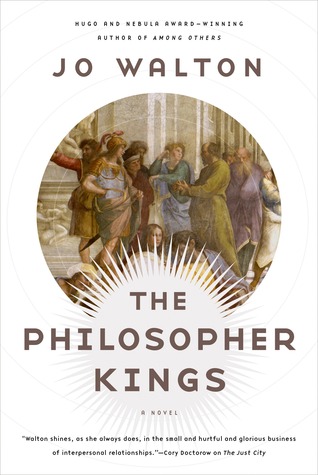
#BLAThoughtOfTheDay: TWO predictions for the number TWO book in the Thessaly Series by Jo Walton

Two book predictions for the number two book in the Thessaly series:

If you haven’t read THE JUST CITY, then don’t read these SPOILERS underlying my predictions for THE PHILOSOPHER KINGS (out June 30, 2015). Disclaimer: I have not received an advanced copy and these are just guesses (but I would gladly check myself before I wreck myself, dear publisher Tor. SEND ME A COPY). Though, I have read the first chapter online for free.

Prediction #1: Athena (AKA Athene) will be redeemed in some way. She kind of came off as an irrational jerk in the last one. Aaaand, she also — shall we say — fudged the data in her “experiment,” which made her seem like a cheater who was more guilty than clever. My guess is Athena will admit to wanting the experiment to fail. Maybe so far as for the purpose of teaching her brother an elaborate lesson. Give Athena some credit, I mean. She’s the motherf*cking goddess of wisdom, man. Only she could have pulled off such an elaborate scam — and get the god Apollo to fall for it. And let’s be honest. Apollo raped someone. IN THE BEGINNING OF THE BOOK. Won’t say he wouldn’t deserve it.

Prediction #2: Pytheas/Apollo will sacrifice himself. He is an incarnation, after all. It’s bound to happen. What kind of a god would waste a perfectly good body on old age? (Cough, cough).

So, there you have it. If you’ve read the first book, what are your predictions? If you’ve got your hands on an ARC copy of the second, shut up and give it to me.

[BLA and GB Gabbler (really just a pen name – singular) are the Editor and Narrator behind THE AUTOMATION, vol. 1 of the Circo del Herrero series. They are on facebook, twitter, tumblr, goodreads, and Vulcan’s shit list.]
all yellow B&N | Amazon | Etc.

GABBLER RECOMMENDS: The Real Don Quixote, on Radiolab

Liked for obvious reasons:

“Is our obsession with blurring the boundaries of reality a new thing? Or has it always been there? Everybody’s heard of the book Don Quixote, but we had no idea how totally insane, and how stirringly modern, Miguel Cervante’s masterpiece really was. It’s a story within a story within a story that beat Seinfeld to the punch by more than 400 years.”

The first Western novel was more meta than anything the Narrator and I could come up with.

[BLA and GB Gabbler (really just a pen name – singular) are the Editor and Narrator behind THE AUTOMATION, vol. 1 of the Circo del Herrero series. They are on facebook, twitter, tumblr, goodreads, and Vulcan’s shit list.]

all yellow B&N | Amazon | Etc.

Oscar Wilde’s words ring true for Baltimore protestors:

“They try to solve the problem of poverty, for instance, by keeping the poor alive or, in the case of a very advanced school, by amusing the poor.

But this is not a solution: it is an aggravation of the difficulty. The proper aim is to try and reconstruct society on such a basis that poverty will be impossible…

…Sometimes the poor are praised for being thrifty. But to recommend thrift to the poor is both grotesque and insulting. It is like advising a man who is starving to eat less…Man should not be ready to show that he can live like a badly-fed animal. He should decline to live like that, and should go on the rates, which is considered by many to be a form of stealing. As for begging, it is safer to beg than to take, but it is finer to take than to beg. No: a poor man who is ungrateful, unthrifty, discontented, and rebellious is probably a real personality, and has much in him. He is at any rate a healthy protest. As for the virtuous poor, one can pity them, of course, but one cannot possibly admire them. They have made private terms with the enemy, and sold their birthright for very bad pottage…

…They have to be told of [their misfortune] by other people, and they often entirely disbelieve them…That is the reason why agitators are so absolutely necessary.

…Slavery was put down in America, not in consequence of any action on the part of the slaves, or even any express desire on their part that they should be free. It was put down entirely through the grossly illegal conduct of certain agitators in Boston and elsewhere, who were not slaves themselves, nor owners of slaves, nor had anything to do with the question really. It was, undoubtedly, the Abolitionists who set the torch alight, who began the whole thing…”

-Oscar Wilde, “The Soul of Man under Socialism.”

[BLA and GB Gabbler (really just a pen name – singular) are the Editor and Narrator behind THE AUTOMATION, vol. 1 of the Circo del Herrero series. They are on facebook, twitter, tumblr, goodreads, and Vulcan’s shit list.]

all yellow B&N | Amazon | Etc.

Pen Names—Necessary Evil or Ticket to Crazyville?

[As someone who technically uses two pen names for one book, I bought my tickets to Crazyville a long-ass time ago. In fact, I’m probably the mayor of it. But I also had hopes that pinning the extra word “Anonymous” to the cover would let the readership automatically know what craziness they dealt with. For this series, the contrived anonymity of it all is half the fun. — The Author, from Crazyville].

Author Kristen Lamb's avatarKristen Lamb's Blog

Image via Flickr Creative Commons courtesy of gaelx Image via Flickr Creative Commons courtesy of gaelx

Today we are going to talk about a somewhat touchy subject. The pen name. Before anyone gets in a fluff, understand two things. First, I’m on your side. Secondly, this is only a decision you can make. My goal here is to make sure you guys are making educated business decisions. Thus, I won’t stop anyone from having a pen name, but about 95% of the time? It’s unnecessary.

In my opinion? Pen names are more hassle than they are worth and they’re a fast way to land in Crazyville. Pen names used to offer benefits, but most of those benefits have evaporated because the world is digital and connected. In fact, pen names can actually hurt book sales and stall a platform and brand.

Let’s look at some of the advantages pen names used to offer that no longer exist.

I…

View original post 2,283 more words

Sam Sacks on “The Rise of the Nameless Narrator”:

“When modern writers wish to set their tales outside of time, they often employ this technique. The characters in Franz Kafka’s subversive fables “In the Penal Colony” and “A Hunger Artist” are named for their roles or vocations; Philippe Claudel’s more recent “The Investigation” (2012) centers, naturally, on the Investigator. Realist novels occasionally do this to evoke a sense of folklore, giving us the Whiskey Priest of Graham Greene’s “The Power and the Glory” and the Consul of Malcolm Lowry’s “Under the Volcano.” Sometimes, the unnamed figure is a pure narrator, so to speak: a character with no part in the book except as an intermediary between tale and reader. We don’t have anything to call the person who tells us Marlow’s story in “Heart of Darkness,” because we have no reason to refer to him. He is simply the Storyteller.

…Behind this effacement, there seems to lurk a deepening distrust in writing itself, a crisis of faith in the ability of words to either capture the essence of a life or else speak truthfully to its essenceless condition. Consider the Bible, one of the earliest textual cases to deal with the conundrum of naming. In much of it, God is identified by what theologians call the tetragrammaton, four letters that cannot be spoken—because the word lacks vowels, no one really knows how it should be pronounced—and must be substituted with generic placeholders. If God had a commonplace proper name, He would merely be distinguished from other deities. Being the one true God, His name is sacred and unutterable.”

Read the rest at The New Yorker. 

[“BLA and GB Gabbler” (really just a pen name – singular) are the Editor and Narrator behind THE AUTOMATION, vol. 1 of the Circo del Herrero series. They are on facebook, twitter, tumblr, goodreads, and Vulcan’s shit list.]
all yellow B&N | Amazon | Etc.