…By the 1830s Wordsworth had effectively linked the notion of genius — defined as the introduction of a new element into the intellectual universe — to legal stakes in the copyright wars. Arguing that artistic genius was often not recognized by contemporaries but only after an author’s death, he became an active lobbyist for extending copyright to 60 years after an author’s death. Wordsworth’s duality in invoking the author as a solitary genius as well as an interested economic agent was symptomatic of the complicity between Romantic aesthetics and the logic of commodification. The Romantic worldview tried to elevate art to a pure space above commodity production, but its definition of the creative work as property reintegrated art into the very sphere it sought to negate.
…
But if physical property can be stolen, can intelligence or ideas be stolen? If your land is stolen, you cannot use it anymore, except on the conditions set by its new private “owner.” If ownership of an idea is analogous to the ownership of material property, it should be subject to the same conditions of economic exchange, forfeiture, and seizure — and if seized it would then cease to be the property of its owner. But if your idea is used by others, you have not lost your ability to use it – so what is really stolen? The traditional notion of property, as something that can be possessed to the exclusion of others, is irreconcilable with intangibles like ideas. Unlike a material object, which can exist in only one place at a given time, ideas are non-rivalrous and non-exclusive. A poem is no less an authors’ poem despite its existence in a thousand memories.
Intellectual property is a meaningless concept — ideas don’t behave like land and cannot be possessed or alienated. All the intellectual property debates fought in courthouses and among pamphleteers during the 18th century intuitively grasped this contradiction. What became obvious in these debates was that the rights to own ideas would have to be qualitatively different from the rights to own material property, and that the ease of reproducing ideas posed serious problems for enforcing such rights. In parallel to the philosophical debates about the nature of intellectual property, a monumental discourse criminalizing piracy and plagiarism began to emerge. The most famous rant against piracy was Samuel Richardson’s 1753 pamphlets denouncing unauthorized Irish reprints of his novel Sir Charles Grandison. Contrasting the enlightened English book industry with the savagery and wickedness of Irish piracy, Richardson criminalizes the reprints as theft. In actuality his claims had no legal basis since Ireland was not subject to England’s intellectual property regime. And what he denounced as piracy, Irish publishers saw as a just retaliation against the Stationers Company’s monopoly. A year before Richardson’s pamphlets, there were street riots in Dublin against British taxation policies, which were part of a larger political struggle of Irish independence from Britain. By arguing that this Cause is the Cause of Literature in general, Richardson framed the battle over literary property in purely aesthetic terms, isolating it from its political and economic context. But his use of the piracy metaphor recalled Britain’s colonial history and brutal repression of sea pirates. 18th century maritime piracy has itself been interpreted as a form of guerilla warfare against British imperialism, which also created alternative models of work, property and social relations based on a spirit of democracy, sharing, and mutual insurance.
…
Artistic creation is not born ex nihilo from the brains of individuals as a private language; it has always been a social practice. Ideas are not original, they are built upon layers of knowledge accumulated throughout history. Out of these common layers, artists create works that have their unmistakable specificities and innovations. All creative works reassemble ideas, words and images from history and their contemporary context. Before the 18th century, poets quoted their ancestors and sources of inspiration without formal acknowledgement, and playwrights freely borrowed plots and dialogue from previous sources without attribution. Homer based the Iliad and the Odyssey on oral traditions that dated back centuries. Virgil’s Aeneid is lifted heavily from Homer. Shakespeare borrowed many of his narrative plots and dialogue from Holinshed. This is not to say that the idea of plagiarism didn’t exist before the 18th century, but its definition shifted radically. The term plagiarist (literally, kidnapper) was first used by Martial in the 1st century to describe someone who kidnapped his poems by copying them whole and circulating them under the copier’s name. Plagiarism was a false assumption of someone else’s work. But the fact that a new work had similar passages or identical expressions to an earlier one was not considered plagiarism as long as the new work had its own aesthetic merits. After the invention of the creative genius, practices of collaboration, appropriation and transmission were actively forgotten. When Coleridge, Stendhall, Wilde and T.S. Eliot were accused of plagiarism for including expressions from their predecessors in their works, this reflected a redefinition of plagiarism in accordance with the modern sense of possessive authorship and exclusive property. Their so-called “theft” is precisely what all previous writers had regarded as natural.
Ideas are viral, they couple with other ideas, change shape, and migrate into unfamiliar territories. The intellectual property regime restricts the promiscuity of ideas and traps them in artificial enclosures, extracting exclusive benefits from their ownership and control. Intellectual property is fraud — a legal privilege to falsely represent oneself as the sole “owner” of an idea, expression or technique and to charge a tax to all who want to perceive, express or apply this “property” in their own production. It is not plagiarism that dispossesses an “owner” of the use of an idea; it is intellectual property, backed by the invasive violence of the state, that dispossesses everyone else from using their common culture. The basis for this dispossession is the legal fiction of the author as a sovereign individual who creates original works out of the wellspring of his imagination and thus has a natural and exclusive right to ownership. Foucault unmasked authorship as a functional principle that impedes the free circulation, the free manipulation, the free composition, decomposition, and recomposition of knowledge. The author-function represents a form of despotism over the proliferation of ideas. The effects of this despotism, and of the system of intellectual property that it shelters and preserves, is that it robs us of our cultural memory, censors our words, and chains our imagination to the law.
And yet artists continue to be flattered by their association with this myth of the creative genius, turning a blind eye to how it is used to justify their exploitation and expand the privilege of the property owning elite. Copyright pits author against author in a war of competition for originality – its effects are not only economic, it also naturalizes a certain process of knowledge production, delegitimates the notion of a common culture, and cripples social relations. Artists are not encouraged to share their thoughts, expressions and works or to contribute to a common pool of creativity. Instead, they jealously guard their “property” from others, who they view as potential competitors, spies and thieves lying in wait to snatch and defile their original ideas. This is a vision of the art world created in capitalism’s own image, whose ultimate aim is to make it possible for corporations to appropriate the alienated products of its intellectual workers.
[Via]
 “The last beachheads of uniqueness have been polluted if not turned into amusement parks–language tool use, social behaviour, mental events, nothing really convincingly settles the separation of human and animal. And many people no longer feel the need for such a separation; indeed, many branches of feminist culture affirm the pleasure of connection of human and other living creatures. Movements for animal rights are not irrational denials of human uniqueness; they are a clear-sighted recognition of connection across the discredited breach of nature and culture. Biology and evolutionary theory over the last two centuries have simultaneously produced modern organisms as objects of knowledge and reduced the line between humans and animals to a faint trace re-etched in ideological struggle or professional disputes between life and social science. Within this framework, teaching modern Christian creationism should be fought as a form of child abuse.
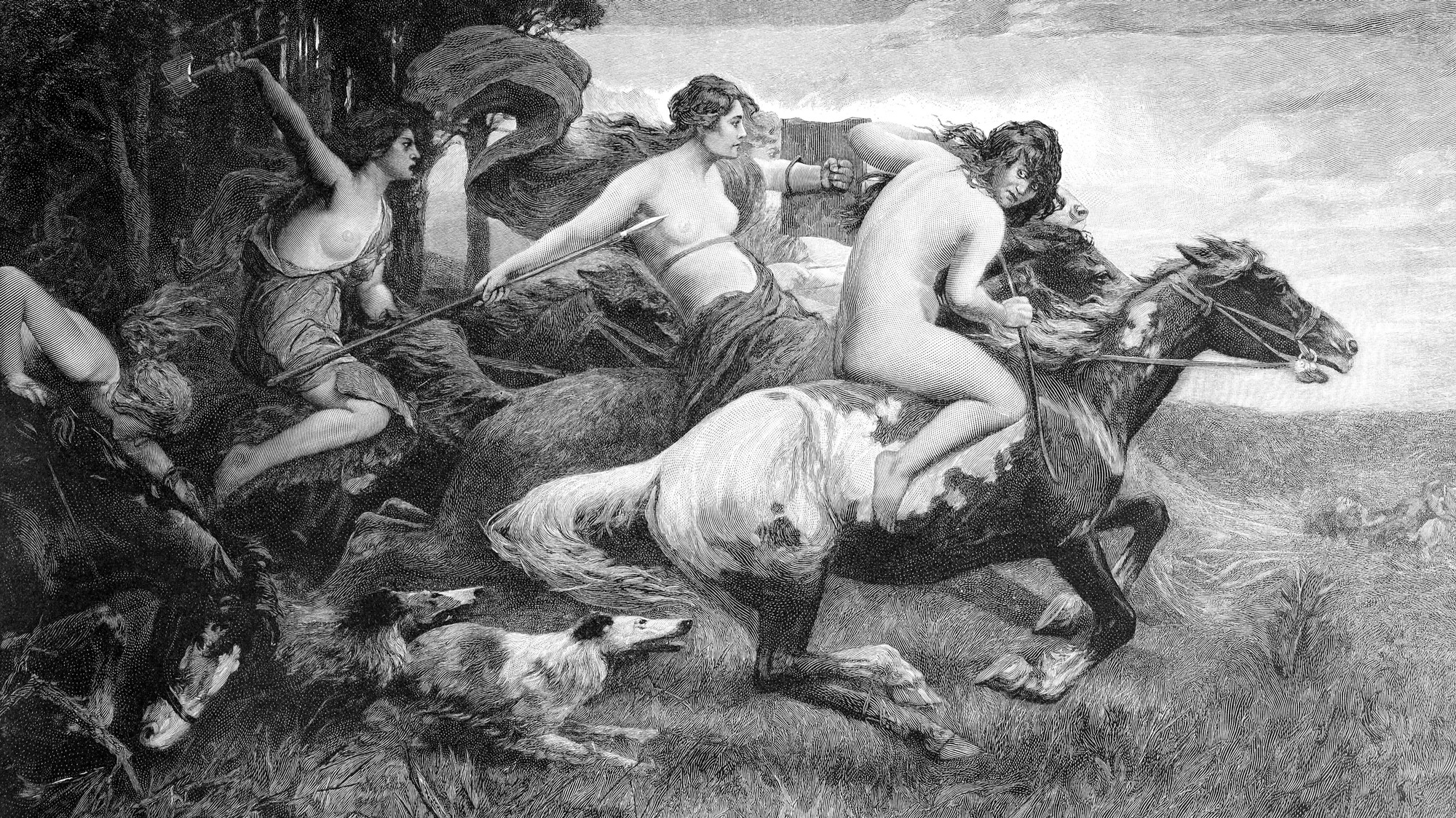 Most of what the Greeks wrote about the Amazons can be dismissed out of hand. The idea of all-female tribes that reproduced through sex with strangers and murdered their male infants sounds more like a paranoid male fantasy than historical fact. Similarly, the idea that Amazons cut off one of their breasts to improve their bow skills is laughable to any woman who has managed to master archery with their chest intact. (Not to mention the high fatality rate that such a drastic procedure would have incurred, given the medical capabilities of the time.)
 Where I disagree with Achebe is that, because of the racism in Heart of Darkness, he refuses to consider it a masterwork. Like all books, Conrad’s novel is limited by his vision, his biases, his worldview. There is no writer with limitless vision, no writer whose worldview is shared by everyone. The problem is not that people read Heart of Darkness as a masterpiece—it is one—it’s that few read books unsanctioned by empire, and even if you wanted to, there aren’t that many available. Today’s imperial censorship is usually masked as the publisher’s bottom line. “This won’t sell” is the widest moat in the castle’s defenses.