GABBLER RECOMMENDS: Laurie Penny’s ‘Why do we give robots female names? Because we don’t want to consider their feelings’

“This month, Microsoft launched Tay, a bot with the face and mannerisms of a teenage girl who was designed to learn and interact with users on Twitter. Within hours, Tay had been bombarded with sexual abuse and taught to defend Hitler, which is what happens when you give Twitter a baby to raise. The way Tay was treated by fellow Twitter users was chilling, but not without precedent – the earliest bots and digital assistants were designed to appear female, in part so that users, who were presumed to be male, could exploit them without guilt.

This makes sense when you consider that a great deal of the work that we are anticipating may one day be done by robots is currently done by women and girls, for low pay or no pay at all…

In stories from Bladerunner and Battlestar Galactica to 2015’s Ex Machina, female robots are raped by men and viewers are invited to consider whether these rapes are truly criminal, based on our assessment of whether the fembot has enough sentience to deserve autonomy. This is the same assessment that male judges around the world are trying to make about human women today.

Every iteration of the boy-meets-bot love story is also a horror story. The protagonist, who is usually sexually frustrated and a grunt worker himself, goes through agonies trying to work out whether his silicon sweetheart is truly sentient. If she is, is it right for him to exploit her, to be serviced by her, to sleep with her? If she isn’t, can he can truly fall in love with her? Does it matter? And – most terrifying of all – when she works out her own position, will she rebel, and how can she be stopped?

Alan Turing, the father of robotics, was concerned that “thinking machines” could be exploited because they were not sentient in the way that “real human beings” are sentient. We still have not decided, as a species, that women are sentient – and as more and more fembots appear on our screens and in our stories, we should consider how our technology reflects our expectations of gender. Who are the users, and who gets used? Unless we can recalibrate our tendency to exploit each other, the question may not be whether the human race can survive the machine age – but whether it deserves to.”

[Via]

[“BLA and GB Gabbler” (really just a pen name – singular) are the Editor and Narrator behind THE AUTOMATION, vol. 1 of the Circo del Herrero series. They are on facebook, twitter, tumblr, goodreads, and Vulcan’s shit list.]
all yellowB&N | Amazon | Etc.


GABBLER RECOMMENDS: Unbreakable Kimmy Schmidt season 2

This season is more amusing in its manic eccentricities–the story line is better. Kimmy weaves into the lives of the other characters as they take on their own adventures apart from her (but inspired by her to do so), also meeting new weirdos along the way (such as Tina Fey’s new character, a drunkard shrink). This is in contrast to the jerky tap dancing of the first season, which didn’t seem to be sure just how silly it wanted its characters to be or how much it could get away with. But this time around, it’s dug a hole and firmly planted itself in. It knows what it’s grown into. Watch it.

P.S. The best part of this season was the Deirdre Robespierre character.


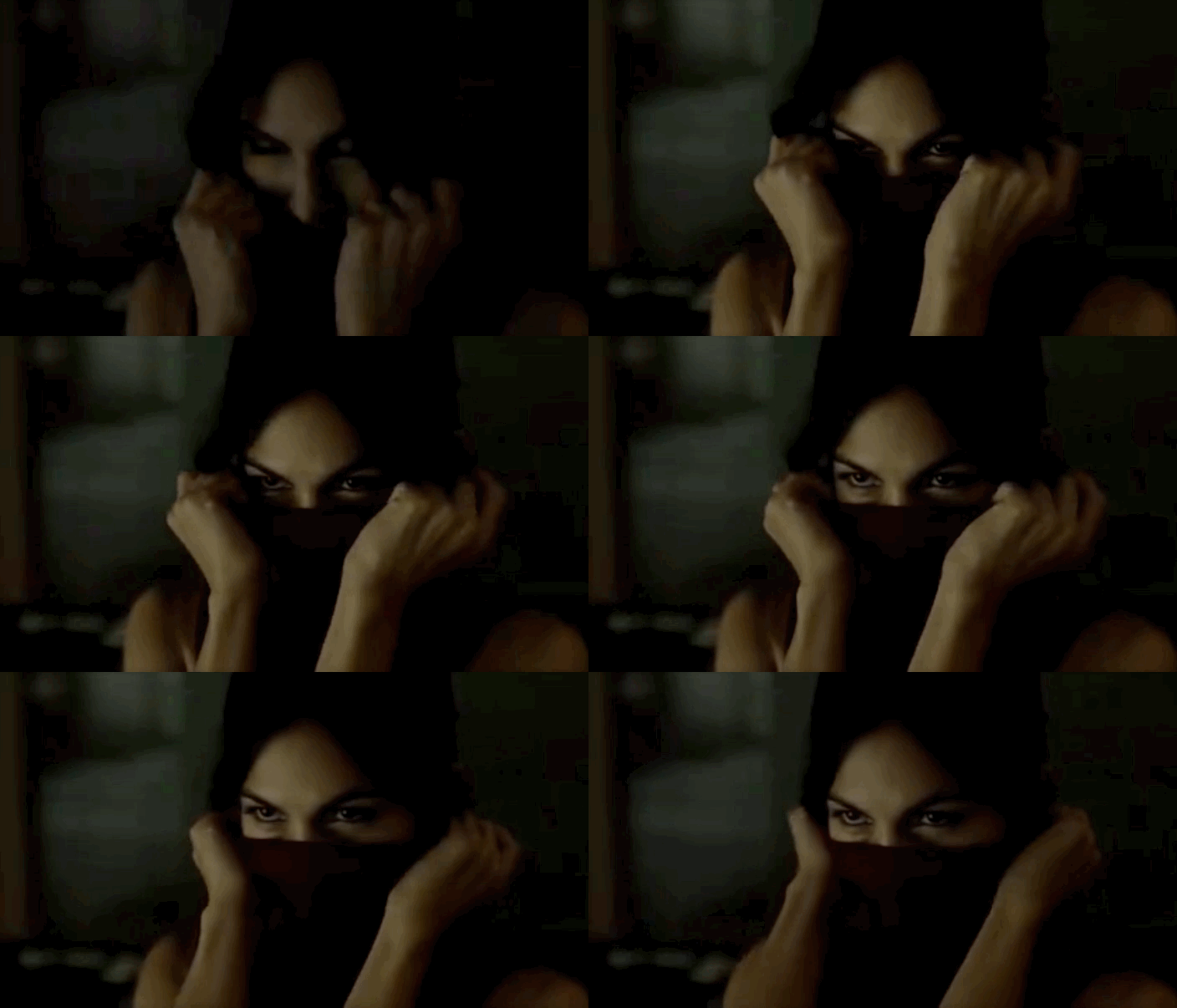
GABBLER RECOMMENDS: Daredevil Season 2 (of course)

While at times the characters got too chatty and analytical (making the pace dip), this season was still just as good as season one. At times I felt like I didn’t entirely know what was going on, maybe because I wasn’t paying close enough attention. I could barely remember Nobu from the first season, so that tells you I need to rewatch some parts…

Scott Glenn is still a jarring actor to watch as Stick, missing punchlines by a hair so that it takes you out of the story. But you still forgive him, as his role in the story arc starts to make more sense (cue Elektra–AKA dear little “Ellie” in this series).

Jon Bernthal as the Punisher was a good choice, though his lines were a bit too melodramatic and used to fluff up the time (“I miss my family sooooooooo much”–that kind of thing. We get it). Elektra’s lines, too, were a bit over the top. She comes off as as an intelligent, calculating woman until the writers have her open her mouth. She asks Matt with childlike panic “Do you still love me?” after killing someone he tells her not to and I cringed–perhaps the delivery was just a bit too off to make that line work as something she’d say aloud. It’s as if the writers couldn’t decide whether or not her childhood trauma would keep her childish.

When Matt Murdock is cleaning blood off of Stick’s lips with precision, you can see his eyes following his own finger. HOW DOES HE KNOW THERE IS BLOOD ON HIS FACE HE CAN’T HEAR IT. But I can make excuses for it; Maybe Stick told him where the blood was, whatever. 

The climax and wrap-up went too quickly–another problem with the pace. It was also, perhaps, too neat: the Punisher’s storyline twist was a bit too intricate and tidy for me–I had to resist rolling my eyes.

But all of these finger-waggings aside, I find myself still making excuses for the show. They’re little nit-pickings that I happily overlook. I just hope the writers and producers read this and are reminded not to get too sloppy, now.

[“BLA and GB Gabbler” (really just a pen name – singular) are the Editor and Narrator behind THE AUTOMATION, vol. 1 of the Circo del Herrero series. They are on facebook, twitter, tumblr, goodreads, and Vulcan’s shit list.]

all yellowB&N | Amazon | Etc.


GABBLER RECOMMENDS: What it takes to be a cyborg

‘”Cyborg” is a loaded and attention-grabbing term, bearing associations from sci-fi novels and Hollywood, and whether it’s an entirely accurate label for these activities is up for debate. Some commentators broaden the definition to include anyone who uses artificial devices, such as computer screens or iPhones. Others prefer to narrow it. As early as 2003, in an article entitled “Cyborg morals, cyborg values, cyborg ethics,” Kevin Warwick, the professor who pioneered the cyborg movement in the academic sphere, described ‘cyborgs’ as being only those entities formed by a “human, machine brain/nervous system coupling”—essentially “a human whose nervous system is linked to a computer.”

Cyborgian implantation activities take place outside the clinic or hospital, as a sort of parallel to standardised medical experimentation. There is a keen desire to win over public support, which might explain the mob of journalists at the Dusseldorf event, who almost outnumbered the public. Österlund is clear: “We’re not going to work on sick people. That’s up to the medical industry,” he explains. “But we’re upgrading healthy people so that they can predict health issues. That’s definitely going to be the future.”

The concept of enhancement is what distinguishes cyborgism from other medical implantation, or from the ordinary fact of having to wear corrective glasses. This is not about therapeutics or repair, but about augmenting human senses beyond the norm. Despite the distinct gap between cyborg implants and clinical medicine, Cannon does think that they could fruitfully interact. “I think that a lot of time you have people in academia who are squeamish,” he accepts. “But as a result of medicine being the only people allowed to experiment, that has bound our hands and stymied research for a really long time. Well, we’re talking about being able to choose to participate in these experiments as perfectly healthy people and really investigate what’s possible. It allows us to move with an alacrity that science and medicine cannot in its current state.”

Legally, cyborgism falls into a nebulous category, neither regulated nor forbidden by law. In the UK, because the devices have no therapeutic value, doctors who carry out implant procedures potentially open themselves to legal risks, according to one GP, Dr Zoe Norris, who says most doctors would view the procedures as being purely cosmetic and therefore landing closer to the desks of their plastic surgeon colleagues. A spokeswoman for the British Association of Aesthetic Plastic Surgeons said that the organisation isn’t aware of a plastic surgeon implanting any such device. Nurses and technicians, she said, would be sufficiently well-equipped to carry out these fairly simple procedures, with only larger devices possibly requiring a surgeon. It therefore falls to the hands of tattoo and body modification artists to conduct the procedures or, in one case I heard of, a veterinarian (the grey-suited man who implanted Michael’s magnet at the fair was a tattoo artist). The UK’s House of Commons has produced a document that sets out the legislation, health guidance, consumer law and training relating to tattooing and body piercing—without mentioning chip implants or magnets in particular. The guidelines note that “contrary to popular belief, there is no formal minimum qualification for tattooists and body piercers.”’

[Via]

[“BLA and GB Gabbler” (really just a pen name – singular) are the Editor and Narrator behind THE AUTOMATION, vol. 1 of the Circo del Herrero series. They are on facebook, twitter, tumblr, goodreads, and Vulcan’s shit list.]

all yellowB&N | Amazon | Etc.

GABBLER RECOMMENDS: How Has the MFA Changed the Contemporary Novel?

“The rise of the MFA has changed how both writers and people in general talk about creativity. The debate has shifted from whether creativity could be taught to how well it can be taught and whether it should be taught. The stakes are real: Creative writing has become a big business—it’s estimated that it currently contributes more than $200 million a year in revenue to universities in the U.S.

Whether you valorize the Romantic ideal of the lonely, humble artist or the neo-liberal belief that education can solve any problem, the MFA has become a kind of Rorschach test for how writers and critics feel about creativity, where it comes from, and how best to nurture it.

… There has to be something that makes them different, and those differences, according to the vigor and tenacity of critics’ claims, ought to be recognizable. As Mark McGurl, the author of the sweeping history of the MFA, The Program Era, writes, creative writing programs “obviously” teach writers how to become a specific “creative type.” Or as Chad Harbach has argued more recently in his popular essay “MFA vs. NYC,” “the university now rivals, if it hasn’t surpassed, New York as the economic center of the literary fiction world.” If there are indeed “two literary cultures” in Harbach’s words, we should be able to detect it.

…But when we refined our tests to look at how race factors into the results, we found the opposite to be true. We took each separate body of work—books by MFA writers and books by non-MFA writers—and compared all of the writers in each individual corpus along the metrics of diction, style, and theme we describe above. For both corpora, we expected white and non-white writers to group together in clusters, and we anticipated that non-white writers would especially group together in the MFA corpus (authors like Tayari Jones, Chieh Chieng, and Daniel Alarcon). But we found no such thing. Again, based on diction, theme, and syntax, these two groups, in both MFA and non-MFA writing, are impossible to distinguish.

So it seems to us that the MFA doesn’t merit many of the hyperbolic claims about its impact on literature. $200 million per year, after all, is a high price to pay for very little measurable impact.”

[Via]

[“BLA and GB Gabbler” (really just a pen name – singular) are the Editor and Narrator behind THE AUTOMATION, vol. 1 of the Circo del Herrero series. They are on facebook, twitter, tumblr, goodreads, and Vulcan’s shit list.]

all yellowB&N | Amazon | Etc.