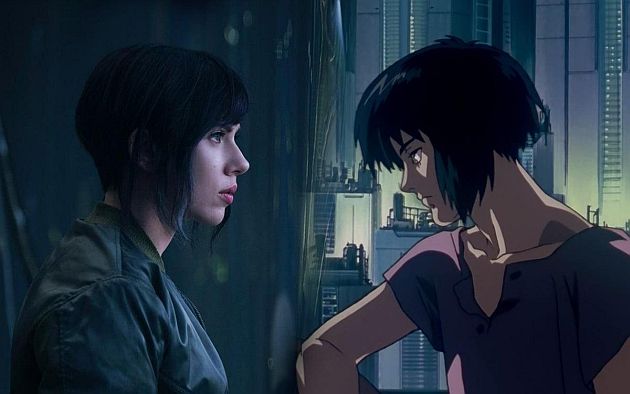
“The biggest problem – the one you already know about, thanks to the countless thinkpieces about it spewed forth from our left-leaning media cycle – is the racial one. Again, there’s an excuse: the film offers its multiracial cast, who occupy roles that are disconnected from their ethnicity, as a depiction of so-called “transhumanism” (a troubling phrase to begin with), which is supposed to tie into the big twist reveal about The Major and where she came from before all this cybernetic stuff happened. But, again, this excuse is as flimsy as wet paper – it’s obvious to anyone that Paramount (and affiliated Chinese production companies Huahua Media and Shanghai Film Group) needed to cast the biggest female star they could in order to sell their film, and the biggest star just so happened to be white. As a result of this decision, which was already artistically bankrupt, the story of the original Ghost in the Shell was rewritten to focus not on its ontological ideas about identity and consciousness, but on a hackneyed amnesia plot in which The Major – whose name is now “Mira Killian” – must discover her true identity as a Japanese girl named Motoko Kusanagi.
I don’t even know where to start with that.
Casting a white actor as a Japanese character would be troublesome enough. Changing that Japanese character into a white character in response is even more problematic. Revealing that that white character was actually a Japanese character all along is… well, “batshit insane” springs to mind.
This isn’t the remake’s only problem, but it’s surely the most damning one. It’s emblematic of a general disregard by all involved in the film for crucial sociopolitical issues that, in 2017, have been brought tooth and nail to the surface, by the bravery of those actually facing these issues daily. Marvel’s Iron Fist is one thing; that character was actually originally written as white. The rest is wishful thinking, no matter how well-intentioned (and correct, in my opinion) the fan-casting might be. This is beyond the pale, and it would utterly invalidate the film if it wasn’t already so busy doing that to itself by other means.
It’s undoubtedly a colourful, well-composed, striking-looking movie, but that’s about where its virtues end. Its depictions of a glittering cyberpunk future – a far cry from the gritty, overwhelmingly dense setting of the original – are stunning, but nearly masturbatory in their effect, as the same flyover shots are used again and again to show us the same amazing building-sized holographic advertisements we’ve seen before. It’s Blade Runner, if Blade Runner had no restraint or sense of visual purpose. Even within this fantastical future world, where nothing looks real, many of the film’s visual effects still manage to look artificial and dated. The action sequences are dull, with unfocused editing and no sense of impact, and far too infrequently placed in a film whose dialogue scenes leave much to be desired. The banter between characters is painful even in comparison to the 1995 film, whose obviousness was an issue – here the ideas are just as vapid as the dialogue used to express them. The general story structure is a latticework of bad ideas, from the clumsy way that old elements are redone (like the garbage man controlled by the hacker antagonist, or the hacker antagonist himself) to the inept way that new elements are introduced (like Killian’s mother-figure, the unscrupulous-then-scrupulous Dr. Ouelet, or Beat Takeshi’s Section 9 boss Chief Aramaki, who graduates from a technical strategist in the original to yakuza executioner here). The simplest way to describe it is to say that it’s a film whose only new ideas are bad ones, and whose execution on the old ideas is bumbling and inelegant.”
[Via]