Author: blablablaandgabbler
[BLA and GB GABBLER are two halves of the pen name behind the CIRCO DEL HERRERO series. Vol. 2, THE PRE-PROGRAMMING out now!]
#BLAThoughtOfTheDay: Was Anomalisa a good movie?
We saw this back in January, and it was surprisingly better than I thought it was going to be.
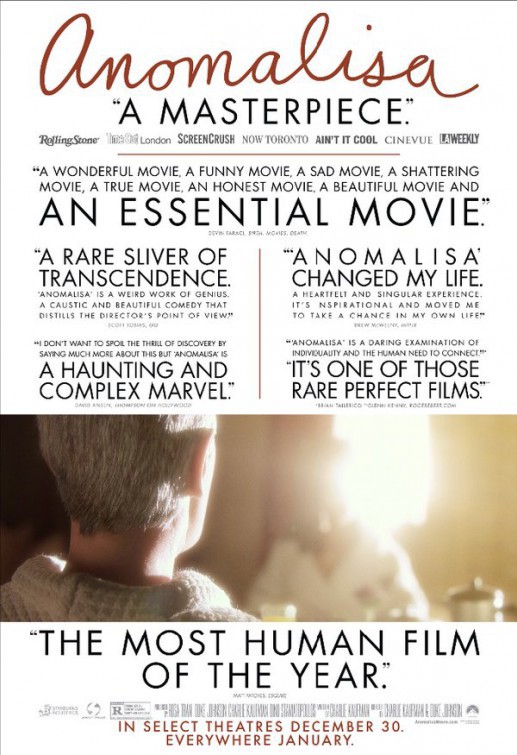
But, here is the thought(s)/questions I’m left wondering [spoilers]:
1. Was the Japanese automaton a symbol for the woman he truly wants? The automaton’s voice at the end was the only distinct non-Tom Noonan voice left. Was the automaton the only true Anomalisa? Or maybe the anomalisa was himself–that he can never find someone as original as his own person?

2. Was the glitchy dream really necessary? Indeed, are any dream sequences necessary? While it reminded the audience that they were dealing with puppet-dolls (which is ironic because part of the plot centers around said puppets dealing with an antique sex doll/automaton), did this add anything to the greater theme other than irony? It tired the point, for sure.

3. Also, it bothered us that all the characters were white, even though, yes, they were supposed to have the same face. Adding diversity of skin tone probably would have made it harder to notice they were all the same (which was kind of hard to notice as purposeful to begin with). But I’m sure something else could have been done to drive home that point that didn’t involve whitewashing every human being alive.

If you’ve got some thoughts on this movie, please tell us below!
[“BLA and GB Gabbler” (really just a pen name – singular) are the Editor and Narrator behind THE AUTOMATION, vol. 1 of the Circo del Herrero series. They are on facebook, twitter, tumblr, goodreads, and Vulcan’s shit list.]
GABBLER RECOMMENDS: What it takes to be a cyborg
‘”Cyborg” is a loaded and attention-grabbing term, bearing associations from sci-fi novels and Hollywood, and whether it’s an entirely accurate label for these activities is up for debate. Some commentators broaden the definition to include anyone who uses artificial devices, such as computer screens or iPhones. Others prefer to narrow it. As early as 2003, in an article entitled “Cyborg morals, cyborg values, cyborg ethics,” Kevin Warwick, the professor who pioneered the cyborg movement in the academic sphere, described ‘cyborgs’ as being only those entities formed by a “human, machine brain/nervous system coupling”—essentially “a human whose nervous system is linked to a computer.”
…
Cyborgian implantation activities take place outside the clinic or hospital, as a sort of parallel to standardised medical experimentation. There is a keen desire to win over public support, which might explain the mob of journalists at the Dusseldorf event, who almost outnumbered the public. Österlund is clear: “We’re not going to work on sick people. That’s up to the medical industry,” he explains. “But we’re upgrading healthy people so that they can predict health issues. That’s definitely going to be the future.”
The concept of enhancement is what distinguishes cyborgism from other medical implantation, or from the ordinary fact of having to wear corrective glasses. This is not about therapeutics or repair, but about augmenting human senses beyond the norm. Despite the distinct gap between cyborg implants and clinical medicine, Cannon does think that they could fruitfully interact. “I think that a lot of time you have people in academia who are squeamish,” he accepts. “But as a result of medicine being the only people allowed to experiment, that has bound our hands and stymied research for a really long time. Well, we’re talking about being able to choose to participate in these experiments as perfectly healthy people and really investigate what’s possible. It allows us to move with an alacrity that science and medicine cannot in its current state.”
…
Legally, cyborgism falls into a nebulous category, neither regulated nor forbidden by law. In the UK, because the devices have no therapeutic value, doctors who carry out implant procedures potentially open themselves to legal risks, according to one GP, Dr Zoe Norris, who says most doctors would view the procedures as being purely cosmetic and therefore landing closer to the desks of their plastic surgeon colleagues. A spokeswoman for the British Association of Aesthetic Plastic Surgeons said that the organisation isn’t aware of a plastic surgeon implanting any such device. Nurses and technicians, she said, would be sufficiently well-equipped to carry out these fairly simple procedures, with only larger devices possibly requiring a surgeon. It therefore falls to the hands of tattoo and body modification artists to conduct the procedures or, in one case I heard of, a veterinarian (the grey-suited man who implanted Michael’s magnet at the fair was a tattoo artist). The UK’s House of Commons has produced a document that sets out the legislation, health guidance, consumer law and training relating to tattooing and body piercing—without mentioning chip implants or magnets in particular. The guidelines note that “contrary to popular belief, there is no formal minimum qualification for tattooists and body piercers.”’
[Via]
[“BLA and GB Gabbler” (really just a pen name – singular) are the Editor and Narrator behind THE AUTOMATION, vol. 1 of the Circo del Herrero series. They are on facebook, twitter, tumblr, goodreads, and Vulcan’s shit list.]
The Ugly Truth of Publishing & How BEST to Support Writers
Read it.

 Original Image via Flickr Creative Commons, courtesy of Anurag Agnihotri
Well, I figure I have one more day to drunkenly torch my platform. Sad thing is I don’t drink. I am apparently this stupid when sober 😛 . Actually I am writing this as a follow up for my rant from the day before yesterday, because knowledge is power.
Writers need this. Your friends and families need this. Readers need this. The more people get how this industry works, the more everyone can start working together for everyone’s benefit.
In my book Rise of the Machines—Human Authors in a Digital World, I go into a LOT more detail and I highly recommend you get a copy if you don’t have one. I spend the first chapters of the book explaining how the various forms of publishing work so you can make an educated decision.
All types of publishing have corresponding…
View original post 3,294 more words
GABBLER RECOMMENDS: How Has the MFA Changed the Contemporary Novel?
“The rise of the MFA has changed how both writers and people in general talk about creativity. The debate has shifted from whether creativity could be taught to how well it can be taught and whether it should be taught. The stakes are real: Creative writing has become a big business—it’s estimated that it currently contributes more than $200 million a year in revenue to universities in the U.S.
…
Whether you valorize the Romantic ideal of the lonely, humble artist or the neo-liberal belief that education can solve any problem, the MFA has become a kind of Rorschach test for how writers and critics feel about creativity, where it comes from, and how best to nurture it.
… There has to be something that makes them different, and those differences, according to the vigor and tenacity of critics’ claims, ought to be recognizable. As Mark McGurl, the author of the sweeping history of the MFA, The Program Era, writes, creative writing programs “obviously” teach writers how to become a specific “creative type.” Or as Chad Harbach has argued more recently in his popular essay “MFA vs. NYC,” “the university now rivals, if it hasn’t surpassed, New York as the economic center of the literary fiction world.” If there are indeed “two literary cultures” in Harbach’s words, we should be able to detect it.
…But when we refined our tests to look at how race factors into the results, we found the opposite to be true. We took each separate body of work—books by MFA writers and books by non-MFA writers—and compared all of the writers in each individual corpus along the metrics of diction, style, and theme we describe above. For both corpora, we expected white and non-white writers to group together in clusters, and we anticipated that non-white writers would especially group together in the MFA corpus (authors like Tayari Jones, Chieh Chieng, and Daniel Alarcon). But we found no such thing. Again, based on diction, theme, and syntax, these two groups, in both MFA and non-MFA writing, are impossible to distinguish.
…
So it seems to us that the MFA doesn’t merit many of the hyperbolic claims about its impact on literature. $200 million per year, after all, is a high price to pay for very little measurable impact.”
[Via]
[“BLA and GB Gabbler” (really just a pen name – singular) are the Editor and Narrator behind THE AUTOMATION, vol. 1 of the Circo del Herrero series. They are on facebook, twitter, tumblr, goodreads, and Vulcan’s shit list.]