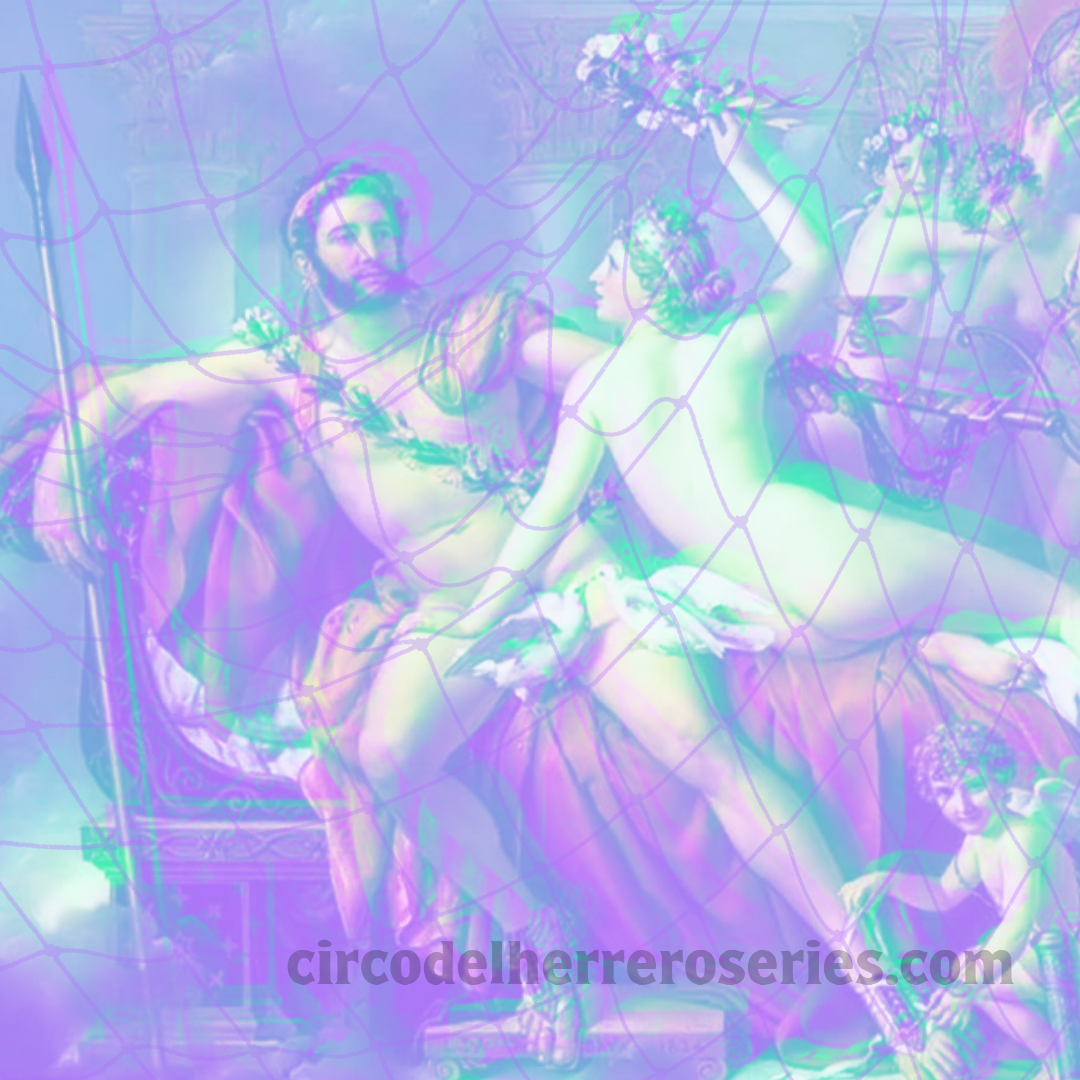
‘At the king’s word the herald [Demodocus] sprang to his feet
and ran to fetch the vibrant lyre from the house.
And stewards rose, nine in all, picked from the realm
to set the stage for contests: masters-at-arms who
leveled the dancing-floor to make a fine broad ring.
The herald returned and placed the ringing lyre now
in Demodocus’ hands, and the bard moved toward the center,
flanked by boys in the flush of youth, skilled dancers
who stamped the ground with marvelous pulsing steps
as Odysseus gazed at their flying, flashing feet, his heart aglow with wonder.
A rippling prelude—
now the bard struck up an irresistible song:
The Love of Ares and Aphrodite Crowned with Flowers…
how the two had first made love in Hephaestus’ mansion,
all in secret. Ares had showered her with gifts
and showered Hephaestus’ marriage bed with shame
but a messenger ran to tell the god of fire—
Helios, lord of the sun, who’d spied the couple
lost in each other’s arms and making love.
Hephaestus, hearing the heart-wounding story,
bustled toward his forge, brooding on his revenge—
planted the huge anvil on its block and beat out chains,
not to be slipped or broken, all to pin the lovers on the spot.
This snare the Firegod forged, ablaze with his rage at War,
then limped to the room where the bed of love stood firm
and round the posts he poured the chains in a sweeping net
with streams of others flowing down from the roofbeam,
gossamer-fine as spider webs no man could see,
not even a blissful god—
the Smith had forged a masterwork of guile.
Once he’d spun that cunning trap around his bed
he feigned a trip to the well-built town of Lemnos,
dearest to him by far of all the towns on earth.
But the god of battle kept no blind man’s watch.
As soon as he saw the Master Craftsman leave
he plied his golden reins and arrived at once
and entered the famous god of fire’s mansion,
chafing with lust for Aphrodite crowned with flowers.
She’d just returned from her father’s palace, mighty Zeus,
and now she sat in her rooms as Ares strode right in
and grasped her hand with a warm, seductive urging:
“Quick, my darling, come, let’s go to bed
and lose ourselves in love! Your husband’s away—
by now he must be off in the wilds of Lemnos,
consorting with his raucous Sintian friends.”
So he pressed
and her heart raced with joy to sleep with War
and off they went to bed and down they lay—
and down around them came those cunning chains
of the crafty god of fire, showering down now
till the couple could not move a limb or lift a finger—
then they knew at last: there was no way out, not now.
But now the glorious crippled Smith was drawing near…
he’d turned around, miles short of the Lemnos coast,
for the Sungod kept his watch and told Hephaestus all,
so back he rushed to his house, his heart consumed with anguish.
Halting there at the gates, seized with savage rage
he howled a terrible cry, imploring all the gods,
“Father Zeus, look here—
the rest of you happy gods who live forever—
here is a sight to make you laugh, revolt you too!
Just because I am crippled, Zeus’s daughter Aphrodite
will always spurn me and love that devastating Ares,
just because of his striking looks and racer’s legs
while I am a weakling, lame from birth, and who’s to blame?
Both my parents-who else? If only they’d never bred me!
Just look at the two lovers . . . crawled inside my bed,
locked in each other’s arms-the sight makes me burn!
But I doubt they’ll want to lie that way much longer,
not a moment more-mad as they are for each other.
No, they’ll soon tire of bedding down together,
but then my cunning chains will bind them fast 360
till our Father pays my bride-gifts back in full,
all I handed him lor that shameless bitch his daughter,
irresistible beauty-all unbridled too!”
So Hephaestus wailed
as the gods came crowding up to his bronze-floored house,
Poseidon god of the earthquake came, and Hermes came,
the running god of luck, and the Archer, lord Apollo,
while modesty kept each goddess to her mansion.
The immortals, givers of all good things, stood at the gates,
and uncontrollable laughter burst from the happy gods
when they saw the god of fire’s subtle, cunning work.
One would glance at his neighbor, laughing out,
“A bad day for adultery Slow outstrips the Swift.”
“Look how limping Hephaestus conquers War,
the quickest of all the gods who rule Olympus!,,
“The cripple wins by craft.”
“The adulterer,
he will pay the price!”
So the gods would banter
among themselves but lord Apollo goaded Hermes on:
“Tell me, Quicksilver, giver of all good things—
even with those unwieldy shackles wrapped around you,
how would you like to bed the golden Aphrodite?”
“Oh Apollo, if only!” the giant-killer cried.
“Archer, bind me down with triple those endless chains!
Let all you gods look on, and all you goddesses too—
how I’d love to bed that golden Aphrodite!”
A peal of laughter broke from the deathless ones
but not Poseidon, not a smile from him; he kept on
begging the famous Smith to loose the god of war,
pleading, his words flying, “Let him go!
I guarantee you Ares will pay the price,
whatever you ask, Hephaestus,
whatever’s right in the eyes of all the gods.”
But the famous crippled Smith appealed in turn,
“God of the earthquake, please don’t urge this on me.
A pledge for a worthless man is a worthless pledge indeed.
What if he slips out of his chains-his debts as well?
How could I shackle you while all the gods look on?”
But the god of earthquakes reassured the Smith,
“Look, Hephaestus, if Ares scuttles off and away,
squirming out of his debt, I’ll pay the fine myself.”
And the famous crippled Smith complied at last:
“Now there’s an offer I really can’t refuse!”
With all his force the god of fire loosed the chains
and the two lovers, free of the bonds that overwhelmed them so,
sprang up and away at once, and the Wargod sped to Thrace
while Love with her telltale laughter sped to Paphos,
Cyprus Isle, where her grove and scented altar stand.
There the Graces bathed and anointed her with oil,
ambrosial oil, the bloom that clings to the gods
who never die, and swathed her round in gowns
to stop the heart…an ecstasy—a vision.
That was the song the famous harper sang
and Odysseus relished every note as the islanders,
the lords of the long oars and master mariners rejoiced.’
