TBR: The Chemical Wedding

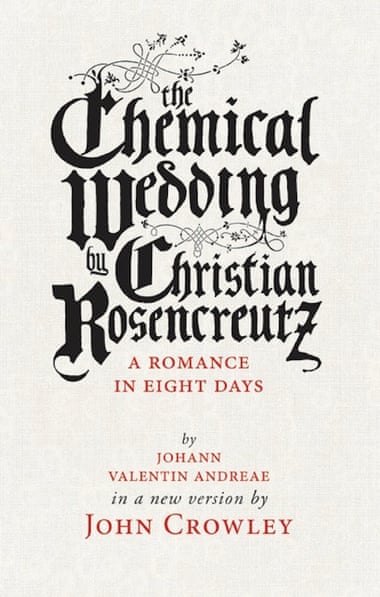
‘Published in 1616, The Chemical Wedding predates Johannes Kepler’s novel Somnium, which was written in 1608 but not published until 1634 and “which usually gets the nod” as the first science fiction story. But as Crowley writes in his introduction to The Chemical Wedding, Somnium “is more of an illustrated example or thought-experiment than a real story,” and while “the astronomy underlying it is new … it doesn’t carry the thrill of wild but just-around-the-corner possibilities that SF ought to”.

He says that the science of The Chemical Wedding “is late Renaissance alchemy, which had the same fascination for readers of the time as the scientific possibilities of classic SF did in its last-century heyday”. Crowley admits that “alchemy is not science if by science we mean only what is now included in that accretion of tested knowledge that still holds up as true even if primitive or inadequate”. Nonetheless, he argues, “alchemy is science … in the sense that it had a general picture of the material world and a rational scheme for formulating hypotheses and proceeding with investigations of it”.

“So that’s why The Chemical Wedding is the first science fiction novel: unlike other contenders, it’s fiction; it’s about the possibilities of a science; and it’s a novel, a marvellous adventure rather than simply a parable or an allegory or a skit or a thought experiment,” writes the author, adding that “like SF, it probably appealed to a self-selected readership of geeks and enthusiasts”.

Experts in the field were delighted at the news of the book’s reissue – but are not entirely convinced by Crowley’s claim. “If the modern novel as such is 17th century and is a ‘thing’, then it cannot qualify as the first SF novel. If, on the other hand, any lengthy tale is a novel, surely Utopia [published in 1516] is the first SF novel,” said professor Farah Mendlesohn, a science fiction academic. “But that doesn’t mean it’s not fascinating.”’

[Via]


[“BLA and GB Gabbler” (really just a pen name – singular) are the Editor and Narrator behind THE AUTOMATION, vol. 1 of the Circo del Herrero series. They are on facebook, twitter, tumblr, goodreads, and Vulcan’s shit list.]

all yellowB&N | Amazon | Etc.

The Alchemyst’s Clocktower Automaton [video]:

[“BLA and GB Gabbler” (really just a pen name) are the Editor and Narrator behind THE AUTOMATION, vol. 1 of the Circo del Herrero series. They are on facebook, twitter, tumblr, and goodreads.]

When her finger left, it was no longer just a plastic, black ashtray. It was a golden ashtray.

The midas touch.
The midas touch.

“Listen, Odys, if I say you don’t need something, you don’t. I can’t lie to you. Let me show you why you don’t need a job.”

She retracted her hand and raised an inveigling forefinger. Her eyes searched around the room, pinpointing his hallowed ashtray. “Observe, please.” She gestured to the somewhat-filthy thing. She placed her finger on the dimpled rim and traced it. When her finger left, it was no longer just a plastic, black ashtray. It was a golden ashtray.

“Solid as can be,” she added, handing it to him for corroboration. He took it, his hand falling from the unexpected weight. His jaw dropped. He didn’t even care about the butts falling to his lap.

She shrugged it off as if to say, Meh, it pays the bills. “Every atom—molecule—whatever-the-hell—equivalently changed. Don’t ask me how it works. Moreover, don’t expect me to always be able to do it. I have to use energy for this sort of thing—like forming clothes. Just look at me, panting. Also, when we pawn it they’ll ask where you got it. If they don’t the first time, they will the second. I can turn things into any metal you like, but selling the stuff can get tricky. But don’t worry, we’ll find ways. Welders love my work.” She watched Odys place the tray back on the coffee table, as if it was an explosive device. “Just be thankful I didn’t turn the couch solid gold, Odys. Would’ve fallen through the floor.”

From THE AUTOMATION

[“BLA and GB Gabbler” (really just a pen name) are the Editor and Narrator behind THE AUTOMATION, vol. 1 of the Circo del Herrero series. They are on facebook, twitter, tumblr, and goodreads.]

Jason Kehe on Lev Grossman’s THE MAGICIANS:

“A comparison to Tolkien is inevitable for any fantasy writer—as is a comparison to C. S. Lewis, J. K. Rowling, and just about every other fantasist who ever was (T. H. White, Le Guin, Feist, Pratchett, Pullman, Alan Moore, and so on, as well as some notable non-fantasists, like the great Evelyn Waugh). But with Grossman, the comparison is even more unavoidable than usual. If the references to a school for magic and a mystical land didn’t already tip you off, Grossman’s trilogy plays as an epic riff on the entire genre. And just in case you still don’t get it, he drops allusions to these works throughout, from specific (Rowling’s “muggles,” for instance) to structural (boy-wizard trope, Lewis’s Narnia). The goal, it seems, is to be so derivative, so plagiaristic in its parts, that their sum somehow circles back in an Ouroboros of meta-magic and achieves a kind of renewed originality. The entirety of protagonist Quentin Coldwater’s journey is supposed to transcend the familiarity of its particulars. “

Read the rest.

By Lev Grossman

Our EPIC background:

ThethetheTHEAUTO2
Vol. 1 of the Circo del Herrero series