Zeus Grants Stupid Wishes: A No-Bullshit Guide to World Mythology by Cory O’Brien
My rating: 5 of 5 stars
One of the most hilarious things I have ever read.
[a website for the Editor and Narrator of the Circo del Herrero series]
Zeus Grants Stupid Wishes: A No-Bullshit Guide to World Mythology by Cory O’Brien
My rating: 5 of 5 stars
One of the most hilarious things I have ever read.
“The fact is that if you attend college, you end up spending quite a lot of time alone with footnotes, and you may eventually start to notice that footnotes are–consistently–the wittiest and most enjoyable parts of hefty texts. (For instance, I am a huge fan of the footnotes in a book called Islamization and Native Religion in the Golden Horde, which incidentally is a fantastic book if you are into that kind of thing.) And so it is inevitable that the reasonably well-educated person falls in love with footnotes, and starts thinking about what footnotes could do and be. It’s perfectly plausible to believe that all fourteen million writers who use footnotes in their books just came up with the idea independently when they noticed how footnotes can allow you to create a kind of secret second narrative, which is important if, say, you’re writing a book about what a story is and whether stories are significant…
I’ve had this crackpot theory for a long time that the real progenitor of many contemporary YA novels isn’t Catcher in the Rye or A Separate Peace or Annie Get Your Gun or Forever or any of that, but instead David Foster Wallace’s 1100 page (and massively footnoted) second novel Infinite Jest,. I know for a fact that E. and I have read IJ. Infinite Jest IS a coming-of-age story, or at least it contains a coming-of-age story, but I would never argue that it is itself a book for teenagers. It’s just that literary young adult writers have adopted–whether directly or indirectly–a host of techniques from the book, including weird and largely inexplicable abbreviations (henceforeth WALIAs), a breathless narrative voice that isn’t quite stream-of-consciousness, repetition of the word and, and footnotes. Infinite Jest is a major book, certainly, and it’s been influential in the world of adult literature, too. But if you’ve read, say, 100 ‘literary’ ya novels, and then you read Infinite Jest, I feel like it’s hard not to be struck by how many of those 100 books owe something in some way to DFW that they would not otherwise have. So nothing against Mr. Stroud, but I think when we’re talking WALIAs or footnotes, we have David Foster Wallace to thank (well, if thanks are to be given. I really believe that footnotes are pretty great if done well, and if you disagree with me then I hope we can have a fight about it in the comment section, which is basically the blog equivalent of footnotes).”
– John Green, from a rant on his blog, dated 2006.
We are huge fans of his rants and his vlogs. …But, we attempted to read The Fault in Our Stars and disliked the odd insertion of Anne Frank into a Cancer story (probably only put there because he got a grant from some Amsterdam foundation and felt obligated). But apparently his book An Abundance of Katherines uses footnotes (and this just might be a reason to give him a second shot, novel-wise. Because footnotes are awesome). Have you read it? Tell us your thoughts. Otherwise, we’re forced to keep believing John Green is in love with his editor and legacy publishing (loved that podcast!).
[“BLA and GB Gabbler” (really just a pen name – singular) are the Editor and Narrator behind THE AUTOMATION, vol. 1 of the Circo del Herrero series. They are on facebook, twitter, tumblr, goodreads, and Vulcan’s shit list.]

So, our favorite part of Saga Vol. 2 was the part where Alana tries to get her so-called “Work Friend” to read a novel so that they can both talk about it. Alana tries to sell the novel as: “They mostly just hang out and play board games, except sometimes they leave their apartment to eat…” As seen in exhibit A:

After work-friend’s resting bitch-face, this happened:
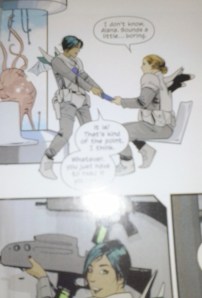
“I don’t know Alana. Sounds a little…boring.”
“It is! That’s kind of the point, I think!”
We need more novels that are a little boring. A little boring with a point.
Ugh, and please don’t comment on the crappy phone pics of the pages. They’re just there to give you a general idea. Don’t get your panties in a wad. We’re writers, not photographers. Geez.
See also: Chekov and the setting of simplicity.
“Today’s fantasy writers feel as though the fictional worlds they create have to be full-scale working models. People talk a lot about the ecology of [George R. R. Martin’s] Westeros, for instance—how do the seasons work? What are the climate patterns? How does it function as an ecosphere? You have to think about the economy, too—have I got a working feudal model? It’s gotten so extreme that when characters do magic, it’s very common to see fantasy writers talk about thermodynamics—okay, he’s lighting a candle with magic, can he draw the heat from somewhere else in the room so that equilibrium gets preserved?
This is the school of thought that extends from Tolkien, and his scrupulously-crafted Middle Earth. Lewis was of a different school from that. Magic, to him, was a much wilder, stranger thing. It was much less domesticated. And when I re-read The Lion, the Witch, and the Wardrobe, I feel as though we’ve wandered too far from the true magic, the kind Lewis wrote. Maybe we want to worry less about thermodynamics and work harder to get that sense of wonder he achieves with such apparent effortlessness.”
Read the rest at The Atlantic.
[“BLA and GB Gabbler” (really just a pen name – singular) are the Editor and Narrator behind THE AUTOMATION, vol. 1 of the Circo del Herrero series. They are on facebook, twitter, tumblr, goodreads, and Vulcan’s shit list.]
Want a free copy of THE AUTOMATION for review?* Send us your blog link and something about yourself to contact @ circodelherreroseries.com [no spaces, of course]. We even want reviewers just starting out!

*Can be print or ebooks