GABBLER RECOMMENDS: “The first great works of digital literature are already being written”

“And let’s not even get on to the people who say things like “data is a story”, “products are a story”, “your robo-vacuum cleaner has a story to tell you”. No it isn’t, no they’re not, and no – unless artificial intelligence has come on much faster than anticipated – it doesn’t.

But more aggravating even than this are the forums, summits, breakout sessions and seminars on “digital literature” run by exceedingly well-meaning arts people who can talk for hours about what the future might be for storytelling in this new technological age – whether we might produce hyperlinked or interactive or multi-stranded novels and poems – without apparently noticing that video games exist. And they don’t just exist! They’re the most lucrative, fastest-growing medium of our age. Your experimental technological literature is already here; it’s the noise you’re trying to get your children to turn down while you pen your thoughts about the future of location-based storytelling. 

When I bring this up with arts and literary types, I often get the sort of “oh come, come” response that can only emerge from someone who has no familiarity whatsoever with what video games are, have been, and can be. “You can’t claim that Grand Theft Auto has literary merit,” they say. Maybe you can – plenty of people have – but no, I wouldn’t cite GTA as fascinating experimental literature any more than I’d cite robo-Godzilla-fighting blockbuster Pacific Rim as an example of avant-garde film-making (it’s fun though).

But are there video games experimenting with more interesting storytelling than any “digital literature” project I’ve seen? Yes, certainly. And if you want to think of yourself as well read, or well cultured, you need to engage with them.

But we can’t afford that kind of thinking any more. Being culturally educated about video games is as important as going to museums or learning about opera.Games often manage to be both great art and an economic powerhouse; we’re doing ourselves and the next generation a disservice if we don’t take that seriously.”

[Via]
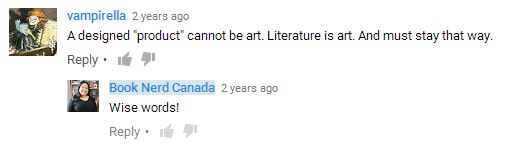
BookTuber Tuesday – On Book Packagers and Art and Honesty

Comments from the video on YouTube:

comments

comments

[High art vs. low art argument aside, book packagers’ bottom line is to deceive readers into thinking inspiration wasn’t packaged like processed meat. Instead of allowing cheating in the “system,” perhaps authors and readers should note why cheating was considered in the first place and what this says about their culture and the “art” it produces (or lack thereof).]

Check out other book vlogs we’ve featured here.

Have a book vlog video you want us to check out? Submit a link below in the comments and it could make the CIRCO blog.

[“BLA and GB Gabbler” (really just a pen name – singular) are the Editor and Narrator behind THE AUTOMATION, vol. 1 of the Circo del Herrero series. They are on facebook, twitter, tumblr, goodreads, and Vulcan’s shit list.]

all yellowB&N | Amazon | Etc.

On authors guilt tripping the reader:

“Around this time last year I argued that readers have no obligation to support a publisher’s flawed business model, and today I would like to extend that premise to include authors.

If an author doesn’t like the terms of a contract, negotiate a better contract. Or get a new publisher. Or self-publish.

But what authors don’t get to do is demand that readers fix the problems that the authors helped create. It’s not the reader’s fault, and it’s not the reader’s responsibility to fix.”

[Via]

On books and books on shelves:

‘I asked writers about their relationships to their personal libraries to glean what I could of the self-making properties of these collections. Urban fantasy author Daniel José Olderrecently tweeted about his appreciation of e-books as both a practical and environmentally friendly alternative to hard copies. Older told me that, despite poking good-natured fun at those who wax poetic about hard copies of books, he loves books too and would miss having the large collection that he and his wife do have if it were to disappear. But he is less concerned about what books are contained within.I think, at some point, I rid myself of the notion that there are books I should have read,” says Older. “I’m not going to sit here and measure my literary canon dick with somebody else. I read great books and they made me the writer I am.”

Haley Mlotek says that her book collection is first and foremost, about her own love of books. “I’ve always wanted a library that I could show off, sure… but I’m the one who likes looking at it, likes thinking about the books I have read and the books I haven’t and having them within arms reach no matter what apartment or sublet or space I’m in,” Mlotek says. “More than my clothes or my dishes, my books feel like they can be the most consistent part of what makes my apartment my home.” Because she dropped out of college early, her book collection has come “to represent the learning I’ve just done or am yet to do.” In this way, books function as a promise to herself and stand in a sort of defiance to the idea that universities are the only tools by which we can acquire an education.

Writer Kyle Chayka tells me that the most important books in his life are on a shelf in his room, away from most visitors’ views but prominent in his own. “Looking at them, not even reading them, is a kind of meditation, I think, and a reminder of what the books mean to you, or what arguments they’re making. So displaying them is a continuation of a kind of intellectual dialogue,” says Chayka.

From speaking with these writers and more, I understand that this knowledge signaling that books perform is not inherently a sign of ego. There can be something vulnerable and communal in displaying your books. James Baldwin said, “You think your pain and your heartbreak are unprecedented in the history of the world, but then you read. It was books that taught me that the things that tormented me most were the very things that connected me with all the people who were alive, or who had ever been alive.” To come into a stranger’s home and see a beloved book on their shelf creates the bond of a shared memory. “You and I have traveled to the same places and with the same friends,” it tells us. “We were pursued by the same enemy and we emerged alive.” I do not begrudge anyone the desire to keep their books as vessels of memory and potential connection with others, conversation pieces more ripe for discussion than a coffee table or an antique lamp.’

[Via]

Theodora Goss on why she writes:

“This movement to separate fantasy and reality, but also realism and fairy tale, continued into the nineteenth century, and by the end of the century it was very clear that there were the respectable novel and short story, and the considerably less respectable forms of fairy tale, myth, romance (in the old sense of an adventure story), ghost story, etc. By the twentieth century, they occupied different publishing niches, different shelves in the bookstore. As they still do….

Here’s the thing: talking about conservation will not save the badgers of England. If anything will save them, it will be the way people feel about Mr. Badger. We are human beings, and we make decisions based not on logic or rationality, however much we may think we do (deluded as we are about ourselves), but on emotion. And what creates emotion? Story.”

[Via]