“Confessions of a Viral AI Writer”

BUT WHAT IF I, the writer, don’t matter? I joined a Slack channel for people using Sudowrite and scrolled through the comments. One caught my eye, posted by a mother who didn’t like the bookstore options for stories to read to her little boy. She was using the product to compose her own adventure tale for him. Maybe, I realized, these products that are supposedly built for writers will actually be of more interest to readers.

I can imagine a world in which many of the people employed as authors, people like me, limit their use of AI or decline to use it altogether. I can also imagine a world—and maybe we’re already in it—in which a new generation of readers begins using AI to produce the stories they want. If this type of literature satisfies readers, the question of whether it can match human-produced writing might well be judged irrelevant.

When I told Sims about this mother, he mentioned Roland Barthes’ influential essay “The Death of the Author.” In it, Barthes lays out an argument for favoring readers’ interpretations of a piece of writing over whatever meaning the author might have intended. Sims proposed a sort of supercharged version of Barthes’ argument in which a reader, able to produce not only a text’s meaning but the text itself, takes on an even more powerful cultural role.

Sims thought AI would let any literature lover generate the narrative they want—specifying the plot, the characters, even the writing style—instead of hoping someone else will.

Sims’ prediction made sense to me on an intellectual level, but I wondered how many people would actually want to cocreate their own literature. Then, a week later, I opened WhatsApp and saw a message from my dad, who grows mangoes in his yard in the coastal Florida town of Merritt Island. It was a picture he’d taken of his computer screen, with these words:

Sweet golden mango,
Merritt Island’s delight,
Juice drips, pure delight.

Next to this was ChatGPT’s logo and, underneath, a note: “My Haiku poem!”

The poem belonged to my dad in two senses: He had brought it into existence and was in possession of it. I stared at it for a while, trying to assess whether it was a good haiku—whether the doubling of the word “delight” was ungainly or subversive. I couldn’t decide. But then, my opinion didn’t matter. The literary relationship was a closed loop between my dad and himself.

In the days after the Sudowrite pile-on, those who had been helping to test its novel generator—hobbyists, fan fiction writers, and a handful of published genre authors—huddled on the Sudowrite Slack, feeling attacked. The outrage by published authors struck them as classist and exclusionary, maybe even ableist. Elizabeth Ann West, an author on Sudowrite’s payroll at the time who also makes a living writing Pride and Prejudice spinoffs, wrote, “Well I am PROUD to be a criminal against the arts if it means now everyone, of all abilities, can write the book they’ve always dreamed of writing.”

It reminded me of something Sims had told me. “Storytelling is really important,” he’d said. “This is an opportunity for us all to become storytellers.” The words had stuck with me. They suggested a democratization of creative freedom. There was something genuinely exciting about that prospect. But this line of reasoning obscured something fundamental about AI’s creation.

As much as technologists might be driven by an intellectual and creative curiosity similar to that of writers—and I don’t doubt this of Sims and others—the difference between them and us is that their work is expensive. The existence of language-generating AI depends on huge amounts of computational power and special hardware that only the world’s wealthiest people and institutions can afford. Whatever the creative goals of technologists, their research depends on that funding.

The language of empowerment, in that context, starts to sound familiar. It’s not unlike Facebook’s mission to “give people the power to build community and bring the world closer together,” or Google’s vision of making the world’s information “universally accessible and useful.” If AI constitutes a dramatic technical leap—and I believe it does—then, judging from history, it will also constitute a dramatic leap in corporate capture of human existence. Big Tech has already transmuted some of the most ancient pillars of human relationships—friendship, community, influence—for its own profit. Now it’s coming after language itself.

A thought experiment occurred to me at some point, a way to disentangle AI’s creative potential from its commercial potential: What if a band of diverse, anti-capitalist writers and developers got together and created their own language model, trained only on words provided with the explicit consent of the authors for the sole purpose of using the model as a creative tool?

That is, what if you could build an AI model that elegantly sidestepped all the ethical problems that seem inherent to AI: the lack of consent in training, the reinforcement of bias, the poorly paid gig workforce supporting it, the cheapening of artists’ labor? I imagined how rich and beautiful a model like this could be. I fantasized about the emergence of new forms of communal creative expression through human interaction with this model.

[Via]
GABBLER RECOMMENDS: “Chuck Palahniuk Is Not Who You Think He Is”

“And then I age into this culture,” he continues, “where if you aren’t completely out in every aspect of your public life and personal life, then you’re somehow damaged and shameful and raw. So within my lifetime I’m supposed to transition from being a person that has really created this whole guardedness not just for my own protection, but for the protection of the people I love and for my family who are still in that small town. Then I’m expected to automatically step out of that into a kind of joyous, flag-waving outness that is completely at odds with the entire way I’ve been raised, where that was my shell and my armor. You don’t just give that up. You don’t give that up overnight. And people say if you don’t give that up overnight, then you’re self-hating, all these wrong things. So I’m fucked either way. I’m just trying to be one person and live a life. And I’m sorry: I’m just not ready to be completely out and just put it all out there.”

[Via]

Against Narrative, works from 2023:

1)  The Tyranny of the Tale by By Parul Sehgal: ‘Anyone in my line has every incentive to fall in step, to proclaim the supremacy of narrative, and then, modestly, to propose herself, as one professionally steeped in story, to be of some small use. Blame it on the cortisol, though: there’s no stanching the skepticism. How inconspicuously narrative winds around us, soft as fog; how efficiently it enables us to forget to look up and ask: What is it that story does not allow us to see?

Return to storytelling’s primal scene: Scheherazade telling tales in order to live to see another dawn. Before it is anything else, a story is a way we can speak to one another without necessarily being ourselves; that is its risk and relief, its portable privacy. The fact that children ask for stories at night is used to defend the notion of storytelling as natural, deeply human—a defense against the dark. But Margaret Wise Brown, the author of “Goodnight Moon,” was convinced that children didn’t care much about plot; it was their parents who did. When children ask for stories, what they’re asking for is the presence of the adult. One wonders just whom Scheherazade was regaling in that room. When did her gaze shift from the king to the children, as it must have? What kind of armor did she think she was providing them?

It is also a strange, inadvertent echo of Peter Pan. Peter cannot grow up, he tells Wendy, because he was never told stories: “None of the lost boys know any stories.” Without being imparted a sense of narrative, he cannot establish his own.’ [Via]

2) Letting the Story Go: Field Notes from a Brutal Time by Janet Steen: ‘I gave up on the basic elements of storytelling. Setting, plot, character, theme. When I applied them to my brother’s life, I couldn’t get things to line up. What exactly was the “rising action”? What was the beginning of the denouement? What were the salient details? “I wanted to know more about the main character,” people always say in writing workshops. Yes, I wanted to know more about the main character. I had assumed I would have years and years to learn more about him. …

Stories were a way to freeze time. And time was an illusion anyway, my various guides were telling me. And everything was constantly changing, constantly becoming something else we couldn’t possibly imagine or predict. Memories were essentially old stories. The present moment was the only place where the memories and fantasies ceased.

This change in view felt both liberating and destructive. Who are you if you aren’t your conditioning, if you’re not the product of your past? What exactly is under there?

The most radical part of this process was finding out that I could withstand an enormous amount of emotional pain. Rupert Spira’s teachings especially helped with this, or maybe I was just partial to his gentle, deeply intelligent explanations in the YouTube videos I found and devoured. He was in the nondual tradition stemming from Advaita Vedanta, and what he calls the direct path. The direct path led you straight to your essential nature, which was pure awareness and devoid of, or beyond, thought or emotional content or objective experience.

But he also talked about the tantric approach, which was about bringing feelings close, so close that it was just the raw experience—not the story, not the thought, but “the raw experience in the body.” So instead of the separate self going into flight from the experience, you were absolutely up against it, feeling it as sensation.

I tried this. I went up against the grief, the longing, the missing, the keening, the despair. I touched into it, withdrew, touched into it again. I stayed there with it for as long as I could.

If something shocking and terrible happens, you might feel that you’re going to be consumed by the feelings about it. The intensity of them threatens absolutely everything and, naturally, you don’t want to go near them. But then you do. And in doing so there is some kind of distillation. It is nothing other than what it is in its purest form. And then, although I didn’t know this for quite some time, there begins to be an alchemical change.

In good moments I make him into a character, a mythic figure, because I can. Who is to stop me? It’s a creative act. I can make him into what I want and need him to be. He’s not a ghost. He’s a guide, a teacher, showing me the way out of darkness. He’s a doorway leading me out of a closed room.’ [Via]

3) The Movie James Franco Doesn’t Want You To See by Lola Sebastian:

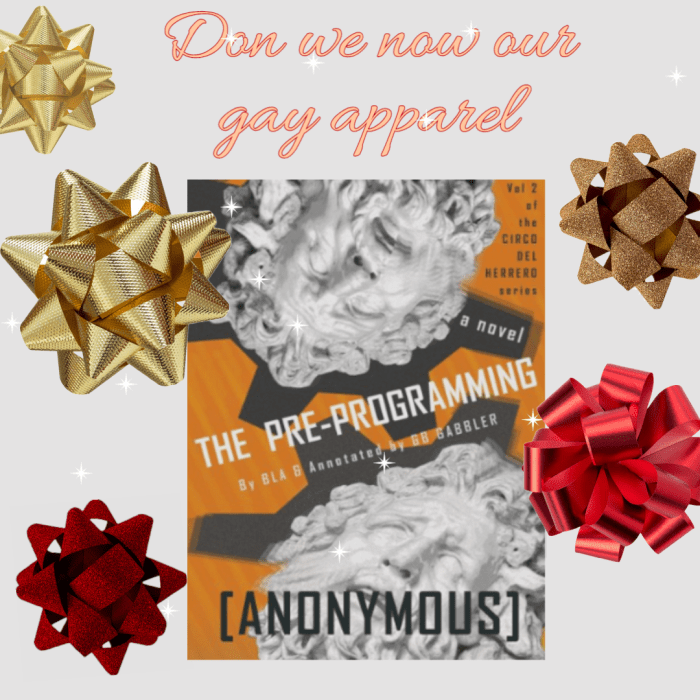
Tomorrow! Free ebook download of The Pre-programming (a mythpunk novel).

GABBLER RECOMMENDS: The Hero’s Journey is BULL#$&@