And, of course, we have The Jungle Book itself. The Jungle Book is just as drenched with racism and colonialism as anything else Kipling wrote on the subject. The thread running throughout the stories is that Mowgli is superior to the animals that raised him by virtue of being man, not beast. That’s a neat parallel to Britain and India. There’s a fun little story in The Second Jungle Book about a superstitious Indian village that worships a horrible old crocodile, only for a British man to blow it to pieces. Because they are more rational, you see.
I’m not saying that Kipling should be censored, but I am saying that he cannot be presented without context. There are messages in The Jungle Book that are very hard to remove. Hell, Disney managed to add to the problems in the 1960s when it added a character called King Louie, who is widely seen as a racist caricature of black people. (Kipling’s book has monkeys, which are the worst of the animal lot, being incapable of having government and only able to mimic others without a decent culture of their own.)
[“BLA and GB Gabbler” (really just a pen name – singular) are the Editor and Narrator behind THE AUTOMATION, vol. 1 of the Circo del Herrero series. They are on facebook, twitter, tumblr, goodreads, and Vulcan’s shit list.]
In Neil Gaiman’s American Gods, the gods need more believers. They are shadows of their once-selves. And new gods are forming—gods of the Media and the Internet—simply because humans pay more attention to them. This puts a lot of power in the unknowing hands (or heads) of mortal humans.
This plot point is what’s called “The gods need prayer badly” and it occurs so often in mythology stories that it’s become a trope on TVtropes.
In the 2010 reboot of Clash of the Titans, humans need to be reminded of “the order of things” because the gods can “feel their power draining”—as if their existence depends on humans in the first place (never mind that the gods created THEM). See deleted scene:
TVtropes even comments on the sequel:
“In the sequel Wrath of the Titans, prayers have dwindled so much that the gods have all lost their immortality and many have died before the movie even started. They still have most of their powers, but they are fading. Thus, the Titans are breaking free. On a Fridge Logic note, why are the Titans still around? The gods fuel their immortality with worship, what do the Titans use? And before there were humans to empower them, the gods took down the Titans, didn’t they?”
I could continue to list where else this lazy trope shows up, but I think you get the point. It simply doesn’t make sense and it cheats the audience out of an honest look at why myths exist. I’ll explore the following reasons:
If gods exist because you believe in them, then how are they said to create man and other worldly things/creation itself? When talking about creation myths, it’s not a “chicken before the egg” dilemma. If using myth-based facts, then MEN CAME AFTER GODS. The very thought “gods exist based on human worship” (Read: American Gods) is stocked full of more hubris than the idea you’re just as powerful or as good as them (Read: Andromeda’s beauty in Clash of the Titans). HOWEVER, I will admit that the plot of “humans overthrowing their creators” (paralleled to robots vs. humans, Zeus vs. Cronus) is entirely legitimate. See number three.
It’s one thing to say that the gods require worship and sacrifice for attention or foradditional power. It’s entirely another to say it’s what sustains them.The gods don’t need you. You need them. That’s why you keep them happy. At most, they need you like a human needs a pet. How does prayer/worship/sacrifice legitimately feed them? Sure, it might fuel them. Their egos. But it’s not what keeps them alive. What were they “eating” before humans came along? Instead of them somehow farming humans as a concocted food immortality supply, it’s a much stronger plot point to suggest that gods created humankind out of boredom—out of wanting someone to play with—loneliness—to give themselves purpose. Thus, when that purpose is threatened, of course they’d be upset. Every parent or authority figure wants to be respected.
Man may be responsible for creating out of belief, but that doesn’t mean he can kill out of disbelief. Just like believing in Santa Claus doesn’t make him real (sorry kiddos–and what the hell are you doing reading this blog?), disbelieving in gravity, that the earth is round, in global warming doesn’t make it less real. No, I’m not going to dissect Nietzsche‘s “God is dead” argument for you (in fact, Gabbler told me not to—told me to focus only on the literary points, not the philosophy), but sure, let’s go ahead and pretend that we are a threat to gods. But what kind of a threat—on what level? At the basic level, our disbelief threatens our need of them. We become self-reliant. But that could hardly be seen as an entirely bad thing for ALL the gods (for example: some of the “good” gods having to clean up our messes like 1) wars and 2) general human horribleness must get tiring). Gods only “need” us in so much as as we fight their wars for them, hurt others for them, are entertainment for them. We may not need them, but we cannot kill them from it. Sure, there may be a constant fear within every creator that they will be overthrown or overshadowed by their successors. But even when Cronus overthrew Uranus, did he really die? Indeed, in some accounts he was was merely castrated. Changed. Overthrown does not mean death.
“Gods need prayer badly” is wearing thin—to the point of ignoring entire historical cultures and tradition. Not only is it a lazy excuse for why the gods don’t get involved in our affairs anymore (i.e. because they’re dead or weak), but it assumes that these “old gods” have lost their inspirational powers. Which isn’t so. Otherwise, we’d stop talking about them in our stories so much.
By BLA. Edited for curse words and self-righteousness by GBG (without a single footnote!).
[“BLA and GB Gabbler” (really just a pen name – singular) are the Editor and Narrator behind THE AUTOMATION, vol. 1 of the Circo del Herrero series. They are on facebook, twitter, tumblr, goodreads, and Vulcan’s shit list.]
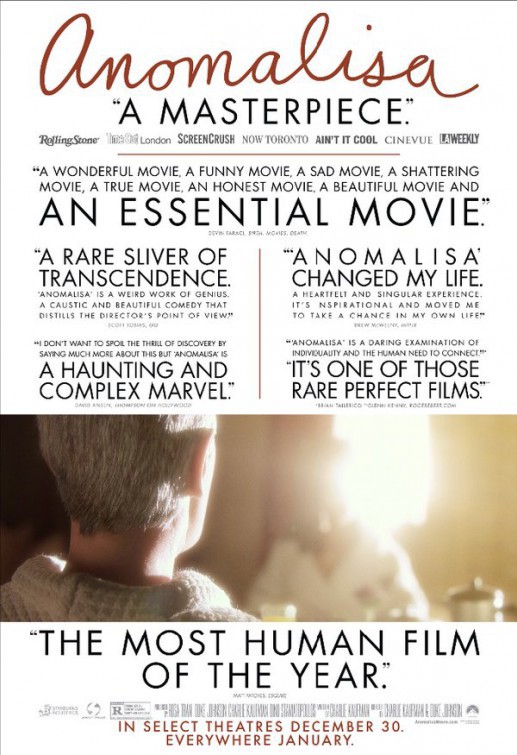
We saw this back in January, and it was surprisingly better than I thought it was going to be.
But, here is the thought(s)/questions I’m left wondering [spoilers]:
1. Was the Japanese automaton a symbol for the woman he truly wants? The automaton’s voice at the end was the only distinct non-Tom Noonan voice left. Was the automaton the only true Anomalisa? Or maybe the anomalisa was himself–that he can never find someone as original as his own person?
2. Was the glitchy dream really necessary? Indeed, are any dream sequences necessary? While it reminded the audience that they were dealing with puppet-dolls (which is ironic because part of the plot centers around said puppets dealing with an antique sex doll/automaton), did this add anything to the greater theme other than irony? It tired the point, for sure.
3. Also, it bothered us that all the characters were white, even though, yes, they were supposed to have the same face. Adding diversity of skin tone probably would have made it harder to notice they were all the same (which was kind of hard to notice as purposeful to begin with). But I’m sure something else could have been done to drive home that point that didn’t involve whitewashing every human being alive.
If you’ve got some thoughts on this movie, please tell us below!
[“BLA and GB Gabbler” (really just a pen name – singular) are the Editor and Narrator behind THE AUTOMATION, vol. 1 of the Circo del Herrero series. They are on facebook, twitter, tumblr, goodreads, and Vulcan’s shit list.]
While the movie based on the book (which I’ve not read), was overall good fun despite being terrible, I just wanted to point out the questionable morals of the story.
Spoilers.
When Darcy gives brains to the barely-zombies who have been subsisting on brains of other animals (in some weird Twilight-ian way), I found myself upset. Now, I don’t know if it was handled better in the book (because hell, the story barely made sense as it was), but I would almost rather side with the zombies who were trying so hard to be good and not kill anyone. Darcy took away their free will and therefore their right to life. This was one multi-layered moral conundrum for me.
Can someone tell me if the film left out something that the book explained? Everything else about the stupid thing was hilarious. This just disturbs me that it was so glazed over in the film. Is this was pop culture mashups have become? Next time, use more brains.
[“BLA and GB Gabbler” (really just a pen name – singular) are the Editor and Narrator behind THE AUTOMATION, vol. 1 of the Circo del Herrero series. They are on facebook, twitter, tumblr, goodreads, and Vulcan’s shit list.]
[“BLA and GB Gabbler” (really just a pen name – singular) are the Editor and Narrator behind THE AUTOMATION, vol. 1 of the Circo del Herrero series. They are on facebook, twitter, tumblr, goodreads, and Vulcan’s shit list.]



 While the movie based on the book (which I’ve not read), was overall good fun despite being terrible, I just wanted to point out the questionable morals of the story.