GABBLER RECOMMENDS: FIVE MINUTES WITH G.B. GABBLER on Ginger Nuts of Horror

The Autoation, volume 1 of the Circo del Herrero series, book cover banner made by Genger Nuts of Horror

Gabbler was recently interviewed on Ginger Nuts of Horror. Take a peek:

To many writers, the characters they write become like children, who is your favourite child, and who is your least favourite to write for and why?

My favorite character is the cat in our novel. Cats and gods and Automata get along quite nicely, as you’ll see.

Least favorite is a character named Mecca. Mecca is a little turd of a character that only served as a vehicle for our Narrator to explore Peter Pan Syndrome. I wanted to cut him out, but B.L.A. would not let me. I still don’t understand it.

Do you have a favorite line or passage from your work, and would you like to share it with us?

“Leeland doesn’t kill people. They kill themselves. They triggered their own fate.” That’s a passage from B.L.A., there. It’s about a man who is too moral to kill people, yet they find ways of ending up dead all the same.

Can you tell us about your last book, and can you tell us about what you are working on next?

The Pre-Programming is volume número 2 of the CIRCO series. It picks up right where The Automation left off. It’s sprinkled with just as many exploding heads—yet with a dash of suicidal cannibal, possessed young girl, and gladiator sport.

[Via]

GABBLER RECOMMENDS: Dear Stephenie Meyer

Too good to wait for a BookTuber Tuesday post.

BookTuber Tuesday – Altered Carbon by Richard K. Morgan

Got a YouTube video that should be featured? Send us a link below.

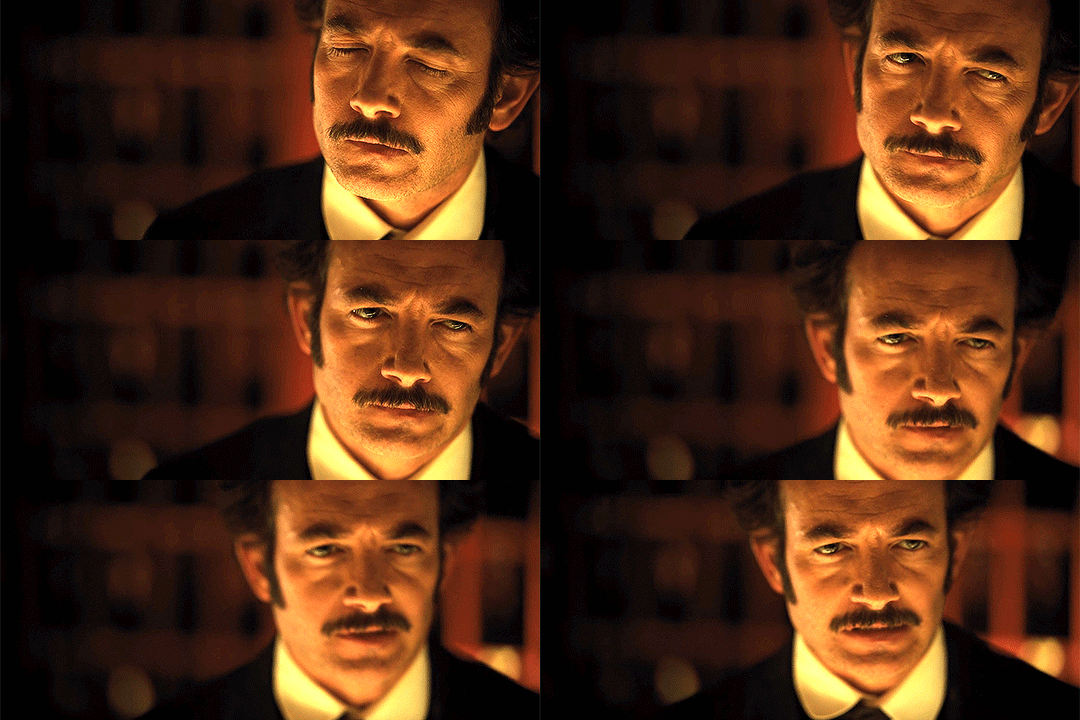
GABBLER RECOMMENDS: Netflix’s Altered Carbon

What people are saying:

Morgan traces the genesis of Altered Carbon to an argument he had with a Buddhist at a party. “We got talking about karma and the idea that if you’re suffering in this life it’s because in a previous life you did something shitty. I’ve got a lot of time for Buddhism. Among the predominant faiths, it’s the one that’s the least full of bullshit. But I pressed him: ‘So I’m suffering and I can’t remember what I did to earn this suffering? That’s not right, is it, because I’m not that person?’ And he said: ‘It’s the same soul.’ I said: ‘It doesn’t fucking matter. What matters is whether you, as an experiential being, remember it. Otherwise I’m being punished and I don’t know why. That’s the height of injustice.’”

The everything-plus-the-kitchen-sink approach also extends to the show’s dizzyingly convoluted mystery plot, though critic Beth Elderkin points out that the show is actually easier to follow than its source material, the novel Altered Carbon by Richard K. Morgan. “If you can believe it, some character stories were combined into single characters,” she says. “So it’s even more convoluted when you’re reading it in the book.”

But the show certainly has its defenders. As a science fiction author himself, Daniel H. Wilson found the show’s excesses oddly encouraging.

“It gives me hope,” he says, “because all the science fiction I write has too much stuff going on, too much exposition. So I hope this does well, because it gives me hope that you can create a really complex world and tell a cool story and get away with it.”

As a bleak dystopia, “Altered Carbon” cops flak for being a lesser “Blade Runner”. But on the diversity front, Lachman thinks “Altered Carbon” is superior.

“In ‘Blade Runner’, there’s sanskrit and Japanese and Chinese writing on all the buttons and everything, and not one person who looked like they could read it.”

GABBLER RECOMMENDS: Gods Taking Selfies Tumblr