Talos was said to have been created by Hephaestus, killed by Medea’s knowledge. She knew to take out a bolt at his foot, causing him to die similarly to Achilles (the killing machine of The Iliad). 
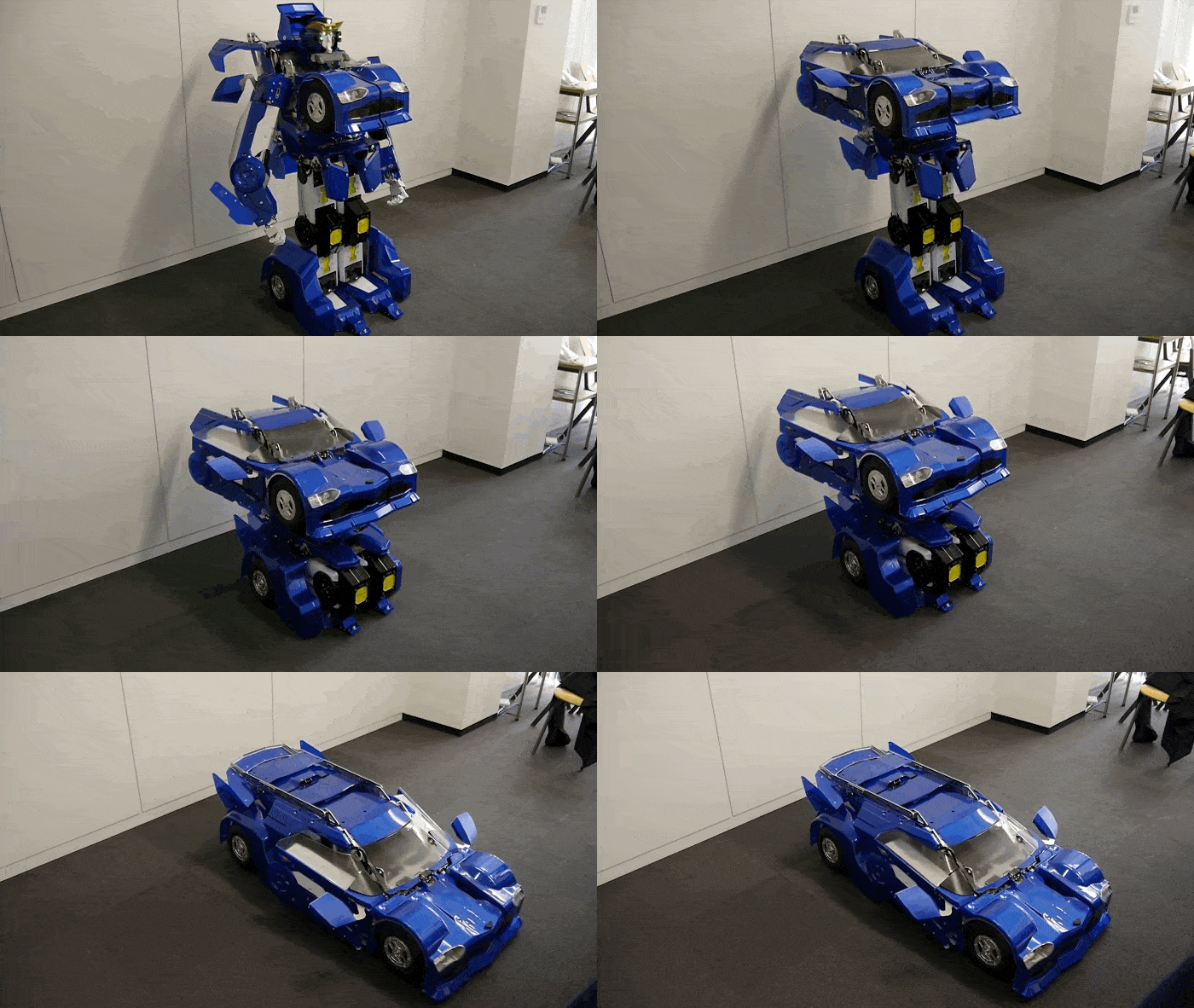
One account claims that Talos was actually a bull and not a humanoid figure, but, if we know anything about robots, it is that they can sometimes transform (so we won’t hold that as discrepancy):
On Talos, Adrienne Mayor, author of Gods and Robots, has this to say:
‘The “imaginary significance” of automata like Talos ‘in the premodern period had little to do with mechanistic ideas,” asserts Kang, who claims that Talos was “not a mechanical being but very much a living creature.” But ancient sources describe Talos as “made, not Born.” As we saw, Talos’s internal anatomy and movements were explained through mechanistic concepts, and this was echoed in ancient artistic depictions: What living creature has a metallic body and nonblood circulatory system sealed with a bolt? Moreover, the mythic accounts and fifth-century BC artworks illustrating the destruction of Talos show that his demised required technology, specifically the removal of the bolt.’ – Adrienne Mayor, “The Robot and the Witch.”
We have been asked in the past why Talos isn’t one of the Automata in the Circo del Herrero / The Blacksmith’s Circus Series. We had attempted to answer it here, but want to note that just like new phones, even “made, not-borns” can get an upgrade. Not all technology serves the same purpose or is powered the same. The Automata in The Automation do not have bolts in their ankles that can spill “nonblood.” They’ve a much sleeker design. They are an exclusive line of tech for a specific purpose that does not disregard previous iterations, but improves upon them.
Talos’s purpose was to protect Europa, throwing stones at any who came near. Zeus, in the form of a bull, kidnapped her and gave her Talos, so it is fitting that the robot would also have a bull form. If I had written the myth, perhaps it would have been Talos who kidnapped her for Zeus and held her captive. Anyone doing Zeus’s bidding would be an extension/avatar of Zeus himself, so not much recorded myth would be undermined except the fact the bull was said to be white. But what is color when the Greeks didn’t even have blue?
This would not be the only example of a bull being used “in stead” of someone else. It is a common motif. Daedalus’s bull for Pasiphae, mother of the Minotaur (through bestiality) is one, the Brazen Bull, perhaps, another.

What’s most interesting to me about Talos is how he is depicted in imagery. In the two most famous of his images, he has genitals. The Automation’s Automata do not so much have full genitals (read: sex), but they do have gender. Infertile they may be, I wonder if Talos was? Or are gentials, here, merely an expression of gender for the ancients (clothes lacking as indicators – pun intended)? Better yet, what if they are a symbol that reproduction can mean more than biological offspring? Aren’t all robots replicable in theory? That hardly seems unproductive to me.


By G.B. Gabbler
 ‘With a few exceptions, in the myths as they have survived from antiquity, the inner workings and power sources of automata are not described but left to our imagination. In effect, this nontransparency renders the divinely crafted contrivances analogous to what we call “black box” technology, machines whose interior working are mysterious. Arthur C. Clarke’s famous dictum comes to mind: the more advanced the technology, the more it seems like magic. Ironically, in modern technolculture, most people are at a loss to explain how the appliances of their daily life, fro smartphones and laptops to automobiles, actually work, not to mention nuclear submarines or rockets. We know these are manufactured artifacts, designed by ingenious inventors and assembled in factories, but they might as well be magic. It is often remarked that human intelligence itself is kin of a black box. And we are now entering a new level of pervasive black box technology: machine learning soon will allow Artificial Intelligence entities to amass, select, and interpret massive sets of data to make decisions and act on their own, with no human oversight or understanding go the process… In a way, we will come full circle to the earliest myths about awesome, inscrutable artificial life and biotechne.’ – Adriene Mayor, “Made, Not Born.”
 The dream of building minds is an old one. How old? You may be surprised to learn that the ancient Greeks had myths about robots. In “Gods and Robots,” Stanford science historian Adrienne Mayor describes how, more than 2,500 years before the modern computer, people told tales of autonomous machines that could labor, entertain, kill and seduce.
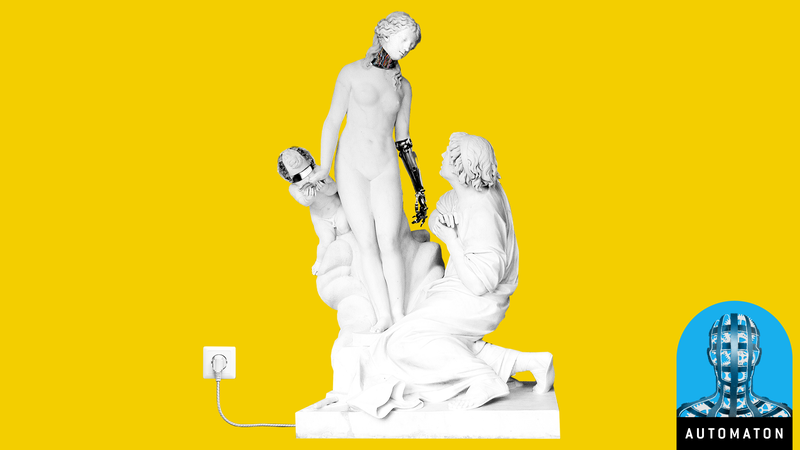 Although the Pygmalion myth is often presented in modern times as a romantic love story, the tale is an unsettling description of one of the first female android sex partners in Western history. It is not clear that Pygmalion’s passive, nameless living doll possesses consciousness, a voice, or agency, despite her “blushes.” Has Aphrodite transformed the perfect female statue into a real live woman, with her own independent mind—or is she now “just a better simulation?” The statue is described as an idealized woman, more perfect than any real female. So Pygmalion’s replica “surpasses human limits,” much like the sex replicants in the Blade Runner films that are advertised as “more human than human.” Ovid, notably, does not describe her skin and body as feeling lifelike. Instead Ovid compares her flesh to wax that becomes warm, soft, and malleable the more it is handled—in his words, her body “becomes useful by being used.”