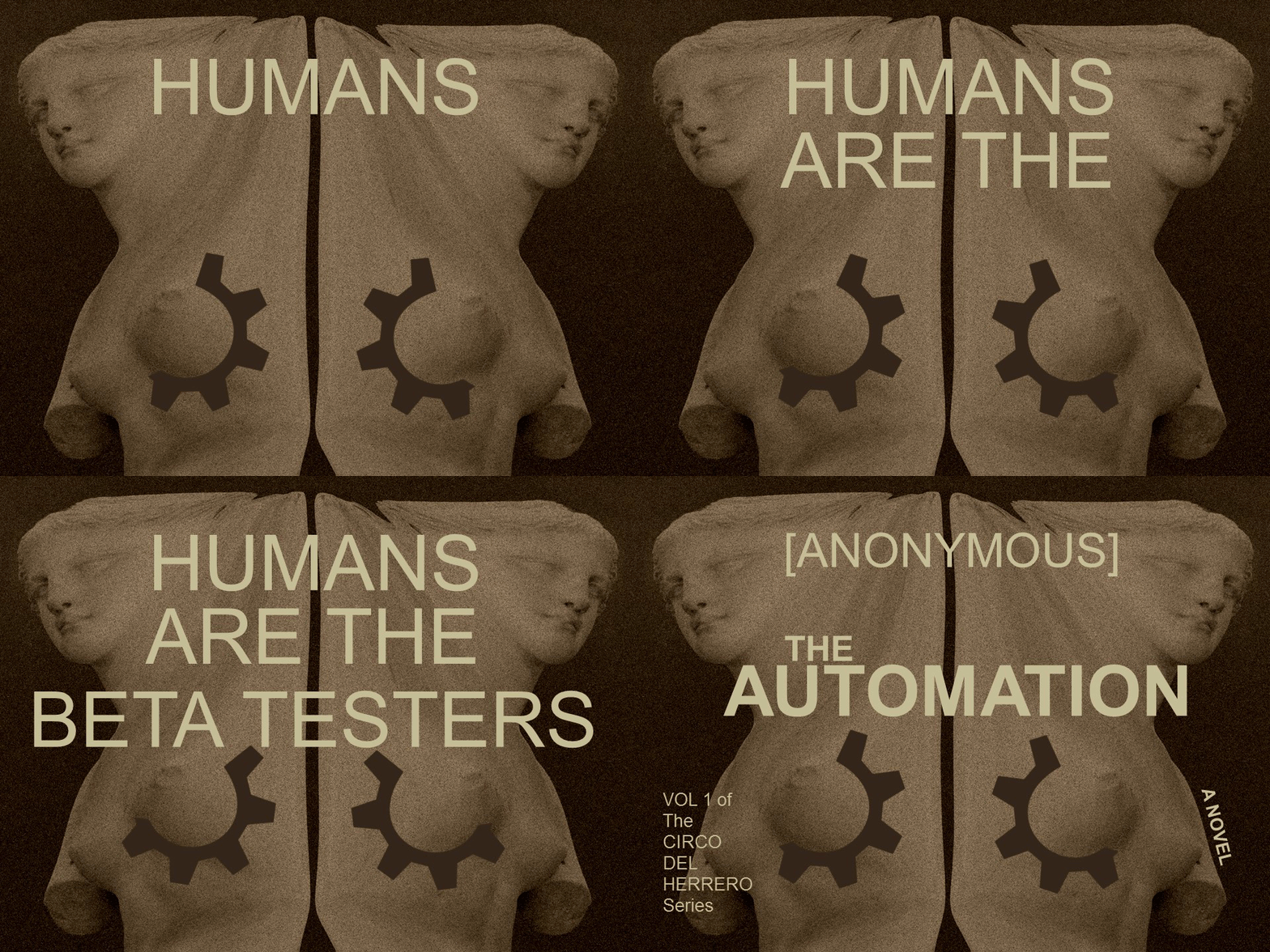
[“BLA & GB Gabbler” (really just a pen name – singular) are the Editor and Narrator behind THE AUTOMATION, Vol. 1 of the Circo del Herrero series. They are on facebook, twitter, tumblr, goodreads, and Vulcan’s shit list.]
GABBLER RECOMMENDS: Ben Okri’s “A mental tyranny is keeping black writers from greatness”:
“In our times we are blinded by subject because we have lost our sense of the true significance of art. If a novel is about the slave trade we automatically think it is significant, certainly more significant than one about a chap who drinks too much palm wine. Black and African history, with its tragedies, injustices and wars, has led, with some justification, to the writers being treated as spokespeople for such ills. This has made the literature more committed than others. It might also make the literature less varied, less enjoyable and, fatally, less enduring.
It is a mystery that Italy, with its Borgias, black deaths, inquisitions and violence, left as its lasting legacy the Mona Lisa, The School of Athens, the Sistine Chapel, Giorgione’s Tempesta, the Divina Commedia, the Decameron – works, on the whole, noted for their beauty, their constant universal appeal and influence. They leave us mainly with their beauty. The horror of their history is not visible in the work.
You could not guess at the difficult lives of the ordinary people from the works of Shakespeare. Nowhere in his plays would you learn that in his time they emptied their lavatory buckets outside their windows and that the streets of Stratford-upon-Avon reeked with rubbish. Yet the works endure. They continue to illuminate the human spirit and awaken us to the strangeness and magnificence of the human estate.
There is an interesting lesson here. Cervantes knew slavery, the expulsion of the Moors; he lost his arm in the battle of Lepanto, was not ignorant of Spain’s brutal history; and yet he could not have left us a more lasting legacy than Don Quixote, a novel about a man who chooses to live the adventures he has only read.
Homer tells of the fall of Troy through one man’s sulk. Sophocles tells of a king’s culpability, not the horrors of Greek history. Tolstoy had a great subject in War and Peace, but it is his insight and the writing that give the subject nobility. Pushkin was soaked in Russia’s grim and extraordinary history. He knew the violence of the Boyars, the long shadow of Ivan the Terrible, the crushing lives of the peasants. He knew exile. Yet his Eugene Onegin, a fountain of Russian literature, is about a bored aristocrat; and his short story The Queen of Spades, one of the best short stories ever written, is about a gambler.
Great literature is rarely about one thing. It transcends subject. The subject was always the least important element in works that have endured. Sometimes an important work has a significant subject, but it is usually its art, rather than its subject, that makes it constantly relevant to us. If the subject were the most important thing we would not need art, we would not need literature. History would be sufficient. We go to literature for that which speaks to us in time and outside time.”
Read the rest.
[“BLA & GB Gabbler” (really just a pen name – singular) are the Editor and Narrator behind THE AUTOMATION, vol. 1 of the Circo del Herrero series. They are on facebook, twitter, tumblr, goodreads, and Vulcan’s shit list.]
William Deresiewicz on “The Death of The Artist.”
“But one of the most conspicuous things about today’s young creators is their tendency to construct a multiplicity of artistic identities. You’re a musician and a photographer and a poet; a storyteller and a dancer and a designer—a multiplatform artist, in the term one sometimes sees. Which means that you haven’t got time for your 10,000 hours in any of your chosen media. But technique or expertise is not the point. The point is versatility. Like any good business, you try to diversify…
Among the most notable things about those Web sites that creators now all feel compelled to have is that they tend to present not only the work, not only the creator (which is interesting enough as a cultural fact), but also the creator’s life or lifestyle or process. The customer is being sold, or at least sold on or sold through, a vicarious experience of production.
Creator: I’m not sure that artist even makes sense as a term anymore, and I wouldn’t be surprised to see it giving way before the former, with its more generic meaning and its connection to that contemporary holy word, creative…
When works of art become commodities and nothing else, when every endeavor becomes “creative” and everybody “a creative,” then art sinks back to craft and artists back to artisans—a word that, in its adjectival form, at least, is newly popular again. Artisanal pickles, artisanal poems: what’s the difference, after all? So “art” itself may disappear: art as Art, that old high thing. Which—unless, like me, you think we need a vessel for our inner life—is nothing much to mourn.”
Read the rest.
Interesting thoughts, though we think that art and Art have always been separate realms, coexisting. And in these realms they feed off one another, though art has always taken up more space than Art, where Art has never been “popular” in the same sense, because it takes more time, etc. Art just seems to be in it for the long run.
Read also: Why Literature is no longer Art.
[“BLA and GB Gabbler” (really just a pen name – singular) are the Editor and Narrator behind THE AUTOMATION, vol. 1 of the Circo del Herrero series. They are on facebook, twitter, tumblr, goodreads, and Vulcan’s shit list.]
GABBLER RECOMMENDS: Julian Darius’s Sequart Article on “Too Many Cooks” and Adaptability: ‘ “Too Many Cooks” is a Sublime Postmodern Masterpiece’
If you are yet to experience “Too Many Cooks,” here it is:
‘It’s hard not to see this as a parody of how shows sometimes radically reinvent themselves, as well as of our current culture of reboots and reinterpretations. Sometimes, people claim that a concept’s “adaptability” illustrates its strength. “Too Many Cooks” demonstrates how weak this argument is, at least on its own. Because there’s nothing to adapt, except the theme music and the idea of too many cooks spoiling the broth.
It’s easy to see some of these title sequences as belonging to shows other than the sitcom Too Many Cooks — shows that reinterpret the original “concept.” But in fact, they are different aspects of the same show. All of these characters interact. The first generic departure, into detective drama, illustrates this concept: what we’re seeing is more akin to a spin-off, depicting the workplace adventures of the member of the Cook family who’s a police officer. Except, of course, this isn’t a spin-off. The title sequence is still continuing, so we’re simply reflecting the fact that Too Many Cooks is such an ensemble show that it has a whole second cast, focused around the police department. In fact, “Too Many Cooks” establishes this idea even earlier, when we meet a set of characters in an office. Even the sci-fi sequence, which feels the most like a reinterpretation or a separate show, is actually just another setting explored on the same show. After all, it’s also part of the same title sequence.’
[“BLA and GB Gabbler” (really just a pen name – singular) are the Editor and Narrator behind THE AUTOMATION, vol. 1 of the Circo del Herrero series. They are on facebook, twitter, tumblr, goodreads, and Vulcan’s shit list.]
On anti-fame and the importance of identity (fake or otherwise):
“‘When she performs, she chooses not to face the camera, but believe me, this is her singing live,’ announced Ellen in her introduction of Sia’s performance, accompanied by the faceless cover of the Aussie artist’s forthcoming album, 1000 Forms of Fear.
According to Sia, whose hits include Clap Your Hands and Breathe Me, the decision to shy away from the audience is in an effort to protect her mental health. The artist has never been secretive about her battle with painkiller addiction and alcoholism, disclosing all in an interview with Billboard last year (she covered the same issue with a paper bag over her head).
But is her attempt at fleeing the limelight thrusting her straight into it? Will it start a Bruce Wayne style obsession with unmasking the real Sia? Or is this a bold statement by an artist wanting to be judged by merits alone?
Daft Punk have successfully paved a masked empire…”
[“BLA and GB Gabbler” (really just a pen name – singular) are the Editor and Narrator behind THE AUTOMATION, vol. 1 of the Circo del Herrero series. They are on facebook, twitter, tumblr, goodreads, and Vulcan’s shit list.]