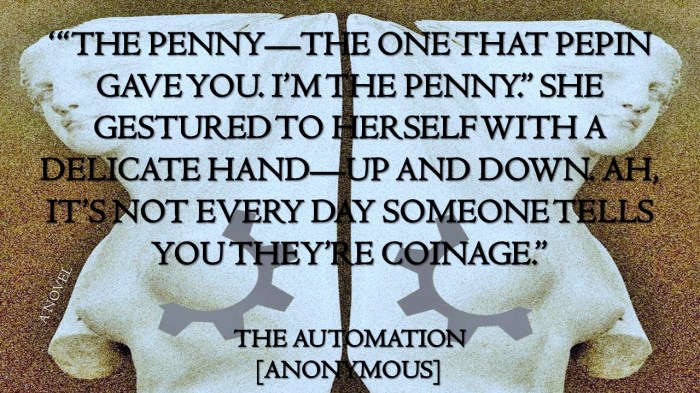
Anthropomorphic Coins — Minted by Hephaestus! [Excerpt from Chapter the Third of THE AUTOMATION]

“How the hell did you get into this apartment?”

She straightened her posture. He’d already asked that. The girl—almost angrily—bit her lip. “I told you, Odys. You let me in.”

His brow furrowed. “Why don’t I remember?”

She stared at him with those huge eyes—eyes with irises like tiny, glinting pennies at the bottom of two wide, clear wells. “I’m not lying to you. I can’t lie—not to you. There’s a difference, you know, between being invited in and being let in. I was let in, but not necessarily invited. Do listen, Odys, for I’m enervated too.” She put a sensitive hand upon her chest—that bursting chest was the only thing the tiny girl-woman filled in Odissa’s dress.

“How—how did I ‘let’ you in?”

“Well, plainly stated,” she paused. “I was in your pocket.”

He laughed. “What now?”

“The penny—the one that Pepin gave you. I’m the penny.” She gestured to herself with her delicate hand—up and down. Ah, it’s not every day someone tells you they’re coinage. “Your cat tried to eat me, back there. Frisky little thing doesn’t know how to it play cool. I swear, I’ve nothing against cats, as long as they don’t swallow. I’ve been swallowed before—by a dog, see. Not a very pretty way to pass the time, I tell you. Can’t turn humanoid in a dog, no. Not unless you want the damn animal to explode.”

Odys shook his head, trying to understand—a cold sweat formed upon his wrinkled brow—his hair stuck to his face—he couldn’t keep up with her. So he decided to slow her down: “Who—who’s Pepin?”

“Oh, come! I know you’re smarter than that, Odys. He made it very obvious for you. Pepin! Pepin—the man with the umbrella. Pepin—the man whose head exploded. Pepin—the man who set all this”—she gestured to Odys and herself—“up. I suppose he arranged it very nicely, every detail perfect. I should know. He made me enact parts of it, no doubt. It’s always hard to remember first off. I’m still getting used to you. I’m too busy to remember my own past—if I can remember it at all. God only knows what Pepin made me do. And what he made me forget.”

She rubbed her forehead. Her gaze didn’t meet his, though the twinkling eyes noted his reaction.

Odys slouched lower on the door, legs about to give way. This young girl—probably somewhere between seventeen and twenty—was rambling on about things he’d rather not hear. The sad part was that he felt he could believe every word.

Odys looked up through his brown hair. “Why’d his head explode? Was it a bomb? It wasn’t some sort of—of murder was it?”

[“BLA and GB Gabbler” (really just a pen name – singular) are the Editor and Narrator behind THE AUTOMATION, vol. 1 of the Circo del Herrero series. They are on facebook, twitter, tumblr, goodreads, and Vulcan’s shit list.]
all yellow B&N | Amazon | Etc.

On the preface:

“Books should stand on their own feet, my argument was (and I think it is a sound one). If they need shoring up by a preface here, an introduction there, they have no more right to exist than a table that needs a wad of paper under one leg in order to stand steady.” – Virgina Woolf, “Memories of a Working Women’s Guild.”

[“BLA and GB Gabbler” (really just a pen name – singular) are the Editor and Narrator behind THE AUTOMATION, vol. 1 of the Circo del Herrero series. They are on facebook, twitter, tumblr, goodreads, and Vulcan’s shit list.]

all yellow B&N | Amazon | Etc.

GABBLER RECOMMENDS: Ben Okri’s “A mental tyranny is keeping black writers from greatness”:

“In our times we are blinded by subject because we have lost our sense of the true significance of art. If a novel is about the slave trade we automatically think it is significant, certainly more significant than one about a chap who drinks too much palm wine. Black and African history, with its tragedies, injustices and wars, has led, with some justification, to the writers being treated as spokespeople for such ills. This has made the literature more committed than others. It might also make the literature less varied, less enjoyable and, fatally, less enduring.

It is a mystery that Italy, with its Borgias, black deaths, inquisitions and violence, left as its lasting legacy the Mona Lisa, The School of Athens, the Sistine Chapel, Giorgione’s Tempesta, the Divina Commedia, the Decameron – works, on the whole, noted for their beauty, their constant universal appeal and influence. They leave us mainly with their beauty. The horror of their history is not visible in the work.

You could not guess at the difficult lives of the ordinary people from the works of Shakespeare. Nowhere in his plays would you learn that in his time they emptied their lavatory buckets outside their windows and that the streets of Stratford-upon-Avon reeked with rubbish. Yet the works endure. They continue to illuminate the human spirit and awaken us to the strangeness and magnificence of the human estate.

There is an interesting lesson here. Cervantes knew slavery, the expulsion of the Moors; he lost his arm in the battle of Lepanto, was not ignorant of Spain’s brutal history; and yet he could not have left us a more lasting legacy than Don Quixote, a novel about a man who chooses to live the adventures he has only read.

Homer tells of the fall of Troy through one man’s sulk. Sophocles tells of a king’s culpability, not the horrors of Greek history. Tolstoy had a great subject in War and Peace, but it is his insight and the writing that give the subject nobility. Pushkin was soaked in Russia’s grim and extraordinary history. He knew the violence of the Boyars, the long shadow of Ivan the Terrible, the crushing lives of the peasants. He knew exile. Yet his Eugene Onegin, a fountain of Russian literature, is about a bored aristocrat; and his short story The Queen of Spades, one of the best short stories ever written, is about a gambler.

Great literature is rarely about one thing. It transcends subject. The subject was always the least important element in works that have endured. Sometimes an important work has a significant subject, but it is usually its art, rather than its subject, that makes it constantly relevant to us. If the subject were the most important thing we would not need art, we would not need literature. History would be sufficient. We go to literature for that which speaks to us in time and outside time.”

Read the rest.

[“BLA & GB Gabbler” (really just a pen name – singular) are the Editor and Narrator behind THE AUTOMATION, vol. 1 of the Circo del Herrero series. They are on facebook, twitter, tumblr, goodreads, and Vulcan’s shit list.]

all yellow B&N | Amazon | Etc.

Tweets of the week:

In case you missed them, here are our best tweets.

That’s really all you need to know. (…Is this is why you don’t follow us on twitter?!)

[“BLA and GB Gabbler” (really just a pen name – singular) are the Editor and Narrator behind THE AUTOMATION, vol. 1 of the Circo del Herrero series. They are on facebook, twitter, tumblr, goodreads, and Vulcan’s shit list.]

all yellow B&N | Amazon | Etc.

William Deresiewicz on “The Death of The Artist.”

“But one of the most conspicuous things about today’s young creators is their tendency to construct a multiplicity of artistic identities. You’re a musician and a photographer and a poet; a storyteller and a dancer and a designer—a multiplatform artist, in the term one sometimes sees. Which means that you haven’t got time for your 10,000 hours in any of your chosen media. But technique or expertise is not the point. The point is versatility. Like any good business, you try to diversify…

Among the most notable things about those Web sites that creators now all feel compelled to have is that they tend to present not only the work, not only the creator (which is interesting enough as a cultural fact), but also the creator’s life or lifestyle or process. The customer is being sold, or at least sold on or sold through, a vicarious experience of production.

Creator: I’m not sure that artist even makes sense as a term anymore, and I wouldn’t be surprised to see it giving way before the former, with its more generic meaning and its connection to that contemporary holy word, creative

When works of art become commodities and nothing else, when every endeavor becomes “creative” and everybody “a creative,” then art sinks back to craft and artists back to artisans—a word that, in its adjectival form, at least, is newly popular again. Artisanal pickles, artisanal poems: what’s the difference, after all? So “art” itself may disappear: art as Art, that old high thing. Which—unless, like me, you think we need a vessel for our inner life—is nothing much to mourn.”

Read the rest.

Interesting thoughts, though we think that art and Art have always been separate realms, coexisting. And in these realms they feed off one another, though art has always taken up more space than Art, where Art has never been “popular” in the same sense, because it takes more time, etc. Art just seems to be in it for the long run.

Read also: Why Literature is no longer Art.

[“BLA and GB Gabbler” (really just a pen name – singular) are the Editor and Narrator behind THE AUTOMATION, vol. 1 of the Circo del Herrero series. They are on facebook, twitter, tumblr, goodreads, and Vulcan’s shit list.]

all yellow B&N | Amazon | Etc.