Me and My MFA

More thoughts on the Ryan Boudinot post:

aahabershaw's avatarAuston Habershaw

I earned an MFA in Creative Writing at Emerson College in 2005. It was three years of non-stop workshops in screenplay, novel, and short fiction as well as literature classes, teaching pedagogy, and a smattering of other stuff. I don’t talk about it much, really. I’ve been taught, through gradual experience, that nobody really wants to hear about it.

When you get an MFA, you find yourself situated with a foot in two very different, very adversarial worlds. On the one hand, you are a “writer” among many other people who are also writers and many of whom chose not to spend the money and time to get an MFA. I’ve found, generally to my surprise, that when I mention that I have an MFA among writers, the response (more often than not) is prickly defensiveness. They, more often than not, look at me like this:
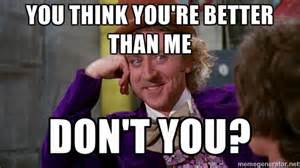
I promise you that I don't. Really. I promise you that…

View original post 1,891 more words

Wading through the elitist BS

‘You know who else never read The Great Gatsby? Charles Dickens. William Shakespeare. Oscar Wilde. William Blake. Lord Byron. True, those are all famous authors and poets who died before Fitzgerald wrote Gatsby, but my point is that you can’t claim someone is incapable of becoming a writer if they haven’t read any one specific book. You also can’t deride them for thinking of “the classics” as a single monolithic thing out of one side of your mouth, then deride everyone who hasn’t read and enjoyed the exact same books as you out of the other.’

fontfolly's avatarFont Folly

One of my favorite news sites posted an article by Ryan Boudinot, an ex-MFA (Master of Fine Arts) teacher, about writing students. The article is an incredibly good example of both clickbait and elitist BS. And the writing blogs have reacted in a manner which is just increasing the traffic to the article, making it likely the site will put up more of the same. If you haven’t seen it, yet, here’s a link using the excellent Donotlink.com service: Things I Can Say About MFA Writing Programs Now That I No Longer Teach in One – The Stranger, which will get you to the article without increasing its search stats.

A lot of people have posted rebuttals, I provide regular links to some of the best at the end of this post. The point I most disagree with is Boudinot’s definition of “serious reader.”

View original post 823 more words

Ursula K. Le Guin Schools Kazuo Ishiguro on Fantasy

We saw this a few days ago and wanted to catalog it here:

Ursula K. Le Guin.

‘Mr Ishiguro said to the interviewer, “Will readers follow me into this? Will they understand what I’m trying to do, or will they be prejudiced against the surface elements? Are they going to say this is fantasy?”

Well, yes, they probably will. Why not?

It appears that the author takes the word for an insult.

To me that is so insulting, it reflects such thoughtless prejudice, that I had to write this piece in response.

Fantasy is probably the oldest literary device for talking about reality.

‘Surface elements,’ by which I take it he means ogres, dragons, Arthurian knights, mysterious boatmen, etc., which occur in certain works of great literary merit such as Beowulf, the Morte d’Arthur, and The Lord of the Rings, are also much imitated in contemporary commercial hackwork. Their presence or absence is not what constitutes a fantasy. Literary fantasy is the result of a vivid, powerful, coherent imagination drawing plausible impossibilities together into a vivid, powerful and coherent story, such as those mentioned, or The Odyssey, or Alice in Wonderland.’

Read the rest.


[“BLA and GB Gabbler” (really just a pen name – singular) are the Editor and Narrator behind THE AUTOMATION, vol. 1 of the Circo del Herrero series. They are on facebook, twitter, tumblr, goodreads, and Vulcan’s shit list.]

all yellow B&N | Amazon | Etc.

“Publishing” — John Steinbeck

Oh, Steinbeck.

Biblioklept's avatarBiblioklept

“Publishing”

by

John Steinbeck

from his 1969 “interview” in The Paris Review

EDITOR

The book is out of balance. The reader expects one thing and you give him something else. You have written two books and stuck them together. The reader will not understand.

WRITER

No, sir. It goes together. I have written about one family and used stories about another family as—well, as counterpoint, as rest, as contrast in pace and color.

EDITOR

The reader won’t understand. What you call counterpoint only slows the book.

WRITER

It has to be slowed—else how would you know when it goes fast?

EDITOR

You have stopped the book and gone into discussions of God knows what.

WRITER

Yes, I have. I don’t know why. Just wanted to. Perhaps I was wrong.

SALES DEPARTMENT

The book’s too long. Costs are up. We’ll have to charge five dollars for it. People won’t pay five dollars…

View original post 319 more words

On the prophetic:

“In the last lines of the Metamorphoses, Ovid boldly claims that he too will become immortal through the eternal fame of his poem. After two millennia, in a changed world that even Ovid could not have imagined, his boast turns out to have been prophetic.”

-Sara Myers on Ovid’s Metamorphoses.

[“BLA and GB Gabbler” (really just a pen name – singular) are the Editor and Narrator behind THE AUTOMATION, vol. 1 of the Circo del Herrero series. They are on facebook, twitter, tumblr, goodreads, and Vulcan’s shit list.]

all yellow B&N | Amazon | Etc.