On the Automatons in THE AUTOMATION

In ancient mythology, Hephaestus/Vulcan created robotic helpmates of animal, human, and monster form. Daedalus created some too, but they were never as dope-ass divine, probably. Probably.

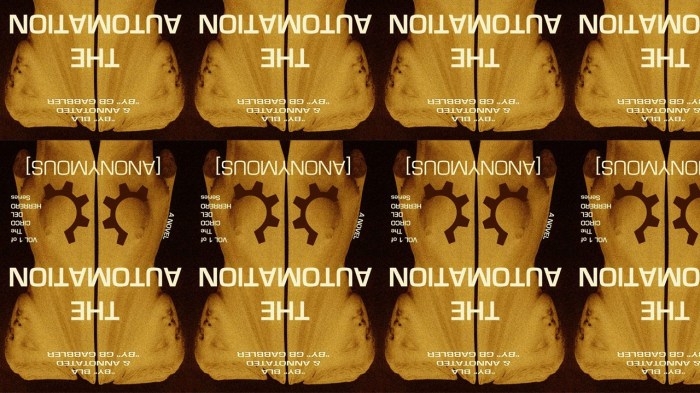
Anyways, there were a few – about ten – of such god-forged creations that didn’t make it into classical mythology (they’re old, but not THAT old). That’s why there’s a new modern epic devoted to them here:
2

2

[“BLA and GB Gabbler” (really just a pen name) are the Editor and Narrator behind THE AUTOMATION, vol. 1 of the Circo del Herrero series. They are on facebook, twitter, tumblr, and goodreads.]

Should you Self-Publish or go Traditional? Infographic:

Self-Publishing or Traditional Publishing: Which Should You Choose?
Courtesy of: The Write Life

Woolf: “The attempt to conciliate, or more naturally to outrage, public opinion is equally a waste of energy and sin against art.”

“Even so late as the mid-Victorian days George Eliot was accused of ‘coarseness and immorality’ in her attempt ‘to familiarize the minds of our young women in the middle and higher ranks with matters on which their fathers and brothers would never venture to speak in their presence.’

The effect of those repressions is still clearly to be traced in women’s work, and the effect is wholly to the bad. The problem of art is sufficiently difficult in itself without having to respect the ignorance of young women’s minds or to consider whether the public will think that the standard of moral purity displayed in your work is such as they have a right to expect from your sex. The attempt to conciliate, or more naturally to outrage, public opinion is equally a waste of energy and sin against art. It may have been not only with a view to obtaining impartial criticism that George Eliot and Miss Brontë adopted male pseudonyms but in order to free their own consciousness as they wrote from the tyranny of what was expected from their sex. No more than men, however, could they free themselves from a more fundamental tyranny – the tyranny of sex itself. The effort to free themselves, or rather to enjoy what appears, perhaps erroneously, to be the comparative freedom of the male sex from that tyranny, is another influence which has told disastrously upon the writing of women.”

-Virginia Woolf, Killing the Angel in the House.

[“BLA and GB Gabbler” (really just a pen name) are the Editor and Narrator behind THE AUTOMATION, vol. 1 of the Circo del Herrero series. They are on facebook, twitter, tumblr, and goodreads.]

Greek Mythology 201: What the Movies Miss

This. SO this.

achaeanpunk's avatarAchaean Punk

If you’re anything like me, you’ve likely noticed this by now. Flashy visuals, postmodern takes on how god (or in this case the gods) don’t care/may as well be dead, trying to be hyper historical without a sense of what makes the story what it is, extreme fashion choices or drab all-white ensembles that look like they came directly out of Party City, and twenty new takes on Zeus that all seem to ignore one of the most fundamental (and disturbing and thus understandingly ignorable) pieces of his character.

The Greek Myth movie.

Between every strange, well-meaning, or outright deviating interpretation, Hollywood has hit the books again and again with entirely mixed results. I hesitate to say that there have been any interpretations of film myth that have really hit the mark, but there are things heading in the right direction, and things I wish we’d avoided entirely.

So…

View original post 1,548 more words

On C.S. Lewis being an “Old Western Man”

“If we look at the various creative impulses that went into Lewis’ fantasies, we will see how they all come together in Perelandra. We can start with Lewis the self-confessed ‘dinosaur.’ As we have seen, he disliked modernity and its ‘goods’ – in particular the glorification of technology, the social ideal of equality and the liberalism of present-day theology – and turned, like his friend Tolkien, toward medieval cultural values; his description of William’s theology as ‘Nicene, hierarchical, severe,’ might equally apply to his own. He was particularly alienated from the humanist character of contemporary literature and criticism; and most of his own literary criticism is concerned rather with allegory or myth than the novel. In his inaugural lecture, De Descriptione Temporum, as Professor of Medieval and Renaissance English literature at Cambridge in 1954, he described himself as an ‘Old Western’ man, by which he meant that by preference he belonged to a culture which (as far as he was concerned) ended about 1830.”

From Modern Fantasy by C.N. Manlove.

[“BLA and GB Gabbler” (really just a pen name) are the Editor and Narrator behind THE AUTOMATION, vol. 1 of the Circo del Herrero series. They are on facebook, twitter, tumblr, and goodreads.]