[“BLA and GB Gabbler” (really just a pen name – singular) are the Editor and Narrator behind THE AUTOMATION, vol. 1 of the Circo del Herrero series. They are on facebook, twitter, tumblr, goodreads, and Vulcan’s shit list.]
[a website for the Editor and Narrator of the Circo del Herrero series]
 “In the history of European clock technology, the monk is an early and very rare example of a self-acting automaton, one whose mechanism is wholly contained and hidden within its body. Its uncanny presence separates it immediately from later automata: it is not charming, it is not a toy, it is “fearfully and wonderfully made,” and it engages even the twentieth-century viewer in a complicated and urgent way. It has duende, the dark spirit Federico García Lorca described. Myself a sculptor, negotiating competing ways of representing human substance and spirit, I wanted to know more about this hypnotic object, and the legend connected to it…
How was the monk used once it was made, who operated it and who would have seen it? Above all, how was it seen, and what beliefs might have been crucial to its effect on spectators? This essay narrates the chronology of my search for answers to these questions. I am not a historian, and I have preferred to let the search itself be visible as a part of my subject. Driven as much by the physical presence of the monk as by the legend of the bedside promise, this work is ultimately an artist’s homage to the human attempt to model an act of the spirit…
The monk is, like all automata, a recording, a kind of artificial memory. What can he tell us?
…In 1980, the Smithsonian changed the name of its National Museum of History and Technology. It would now be called the National Museum of American History. And some changes started to take place, subtle ones at first, but in recent years there have been shifts in institutional priority that have alarmed many historians and scholars. For one thing, the monk, as of December 1997, is now removed from view. The old instrument and timekeeping displays have been redesigned with a new theme in mind: the meaning of time to Americans and its influence on American life. But it isn’t just politics as usual: not only is the monk unAmerican, he slips through all kinds of identification parameters. He isn’t a clock, he isn’t a calculator, he isn’t a sculpture, he isn’t an icon, he isn’t a plaything: he doesn’t fit anywhere! We still don’t know how to look at him. And he troubles us.”

Doctor Strange, the best Marvel movie of the year (hell, the best superhero movie of the year), was a pleasant surprise. The worst part about it was the final end credits scene (the second one, not the first), where one of the “good guys” reveals the setup of his Leeland-like rampage to destroy all of his “kind”…without proper motivation or reasoning. Makes me want to see if the comic books gave him better motivation (I’ve never read them). Otherwise, it seems like it was out of character. He goes from walking away from it all ambivalently to I’m actively going to stop this overall ambivalence. However, this is forgivable, as such set up can be smoothed over in a full-scale movie. It’s only supposed to be a tease.
But the film itself explores major themes like “Making a deal with the devil” and “Choosing the lesser of two evils” and “There is no such thing as pure good.” Hell yes, please!
As I mentioned before, one of the “good guys” in the final final scene, in his quest for purity, does some evil things. This is in contrast to Dr. Strange refusing to kill to maintain said purity, yet making his “deals with the devil” just like his master (it’s so hard for me not to want to capitalize the M right now, you guys). Thus, no character is “without sin” despite their fight for good. Paradox upon paradox.
And the best character? The cloak.

Hilarious without being cheesy, it’s the best comic relief. Sorry, Wong.

You’re still funny.
Excellent pacing, imagery, and plot.
Suck it, Doctor Who.
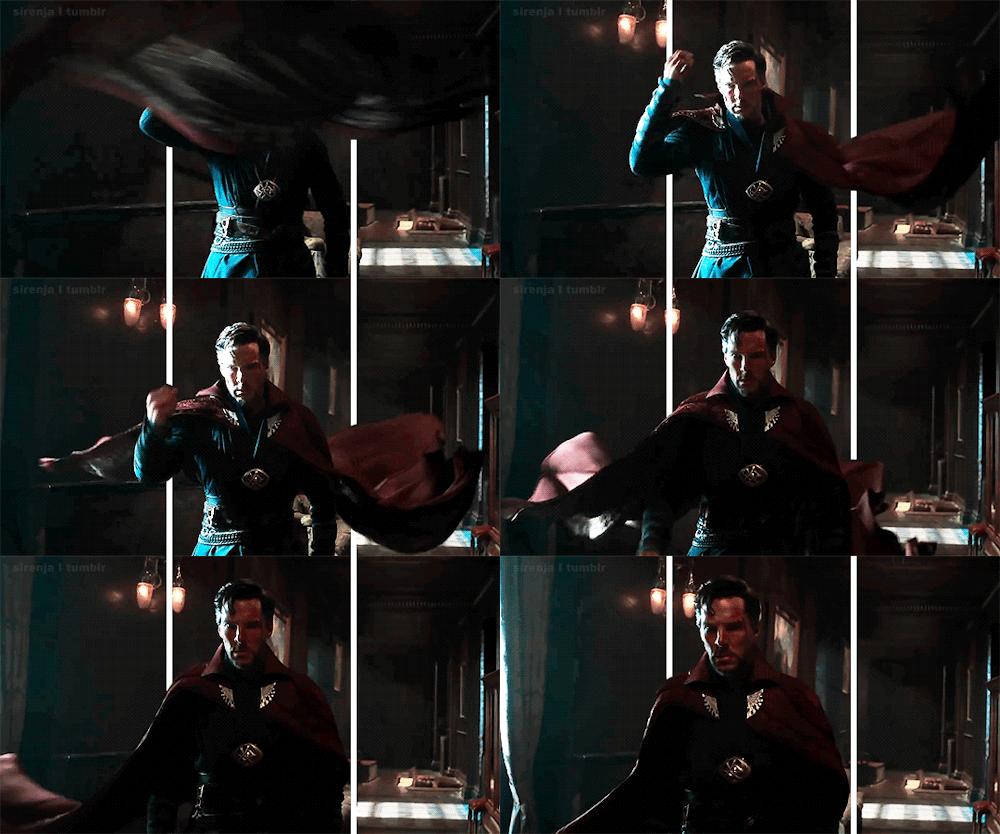
That time we explained the Automatons in THE AUTOMATION, 2014.
“In ancient mythology, Hephaestus/Vulcan created robotic helpmates of animal, human, and monster form. Daedalus created some too, but they were never as dope-ass divine, probably. Probably.
Anyways, there were a few – about ten – of such god-forged creations that didn’t make it into classical mythology (they’re old, but not THAT old). That’s why there’s a new modern epic devoted to them here“.
“Writing can only work through traumas as traces revisited as hauntings. They can never fully retrieve experiences or tell the full story — fill in all the gaps….There is something always lost in translation…It was because it was too much that trauma repeats itself as lack.”