 ‘There is a whole taxonomy of authorial falsification, from ghostwriters and noms de plume to plagiarism and forgery, and within each species there are moral boundaries. No one feels betrayed by the revelation that the mystery writer Ellery Queen was really two people, neither of whom was named Queen, or that Franklin W. Dixon, whose name is on the cover of the Hardy Boys detective stories, did not exist, and that the books were written by a series of contract writers. (Well, as an early devotee and binge reader of the Hardy Boys books, I was a little crushed when I learned this.) Pen names are accepted in genre fiction: Saki, O. Henry, Amanda Cross. They are understood to belong to the package, to be part of the entertainment. Readers are not being tricked.
Mary Anne Evans was trying to trick readers by pretending to be a male author named George Eliot. But many women writers have adopted male names, and some still do, or use initials to go gender-neutral. It’s an accepted convention. J. K. Rowling’s publishers thought that she would sell more books to boys if they did not know her name was Joanne. On the other hand, people were upset when, in 2015, a writer named Michael Derrick Hudson got poems accepted for inclusion in “The Best American Poetry” under the name Yi-Fen Chou.
Hoaxes have played a role in literary history. Probably the most famous hoax in English literature is an epic cycle about a warrior named Fingal, published in the seventeen-sixties. This was advertised as translations of poems written by a third-century Gaelic bard named Ossian. In fact, the poems were fakes, cooked up by a Scottish writer named James Macpherson. Although a few people—Samuel Johnson was one—had suspicions, Ossian’s work was read and admired in Europe and America and translated into many languages, and his fake poems are considered a major influence on Romanticism—a literary movement that made authenticity a supreme value. If you were editing an anthology of English literature, would it be right or wrong to include something by “Ossian”?
A hoax with consequences closer to home is “Go Ask Alice.” The book was published in 1971, and purported to be the diary of a fifteen-year-old girl who starts taking LSD, gets sucked into the drug underworld, and ends up dead. Miller says it may have sold five million copies. The real author has not been conclusively established, but the copyright belonged to a Mormon therapist who claimed that she had merely edited a real Alice’s diary, which was under lock and key at the publisher’s. Which is a strange alibi. “Why did someone not ask for it to be ‘unlocked’?” as Miller inquires. He suggests that the scare story in “Go Ask Alice” contributed to the launching of the war on drugs, which led to the crackdown on recreational-drug sales and produced a wave of incarcerations.
Miller’s particular subject is literary hoaxes—that is, books that are deliberate, flat-out violations of the pact. The name on the cover is not that of the person who wrote the contents—the name on the cover is deliberately misleading—and the reader has no way of knowing it. Miller examines several types of hoaxes. There are literary impersonations, in which the author assumes the racial or ethnic identity of someone else. These are usually memoirs, autofictions, or books that pretend to speak for the group to which the fake author is assumed to belong. Miller calls these intercultural hoaxes. There are hoaxes designed to insinuate a subversive message through a benign-seeming work, a wolf-in-sheep’s-clothing text. Miller calls these Trojan Horses. And there are hoaxes aimed at exposing the poor judgment of editors, critics, or readers. He calls these time bombs.
…
After you know, of course, the deception can seem blatant. But, as Miller says, you can’t unring the bell: you can’t ever read the text again in its pre-exposed state. “Famous All Over Town” no longer seems especially Chicano. It seems, in fact, like what it is: a fictional re-creation of life in East L.A. by a sympathetic writer with a mainstream education. But Daniel James surely knew that such a book would not have received an excited review in the Times.
…
Are hoaxes unethical? Of course they are. At a minimum, a book is being marketed under false pretenses. And some hoaxes, like the Ern Malley hoax, are intended to damage the reputations of other people. Are hoaxes illegal? Not per se, but a cloud of lawsuits does hang over the phenomenon. James Frey’s publisher agreed to refund buyers who felt cheated, and set aside more than two million dollars for the purpose. (Not many wanted their money back: the total refunds came to less than thirty thousand dollars—a victory for the higher-truth defense.) On the other hand, Misha Defonseca, the author of “Misha: A Mémoire of the Holocaust Years,” a hoax published with a blurb from Elie Wiesel, sued her publisher for withholding royalties, which, you have to admit, was pretty chutzpadik. A judge awarded her and a collaborator thirty-two million dollars. (The award was set aside after it emerged that Defonseca was a Belgian Catholic who spent the war years in school.)
Exposed hoaxes often have a lucrative zombie afterlife. If the books are popular, it is often in everyone’s interest to continue pretending they’re genuine. They just go on being published. You can go into a bookstore in Paris today and buy a novel by Paul Smaïl. The University of New Mexico Press, the publisher of “The Education of Little Tree,” advertises the book on its Web site as “a classic of its era, and an enduring book for all ages.” You can go on Amazon and order James Frey’s “A Million Little Pieces,” described as the “acclaimed account of his six weeks in rehab.” “Go Ask Alice,” by Anonymous, is sold on Amazon as “a classic diary by an anonymous, addicted teen.
…
Does this mean it’s all a game? Yes, in a sense. Literature is a game with language, and hoaxing alerts us to the fact that the rules are not written down anywhere—in the same way that someone who goes barefoot to a wedding alerts us to the fact that there are actually no regulations governing these things. Those acts draw our attention to the thinness of the social fabric by tearing a little piece of it. Literary hoaxes appeal to critics and theorists because they expose the fragility of the norms of reading.
If it is a game, then, does it really matter who wrote it? The old literature-professor response was that authorship, like identity, is a construction, and so it doesn’t. The response of what Miller calls “the new identitarians” is that we should not accept representations of experiences that the author could not have known, and so it does. Both arguments are provocations. They should get us thinking about what we mean by things like authenticity and identity. What they should not do is prevent us from reading.’
The dream of building minds is an old one. How old? You may be surprised to learn that the ancient Greeks had myths about robots. In “Gods and Robots,” Stanford science historian Adrienne Mayor describes how, more than 2,500 years before the modern computer, people told tales of autonomous machines that could labor, entertain, kill and seduce.
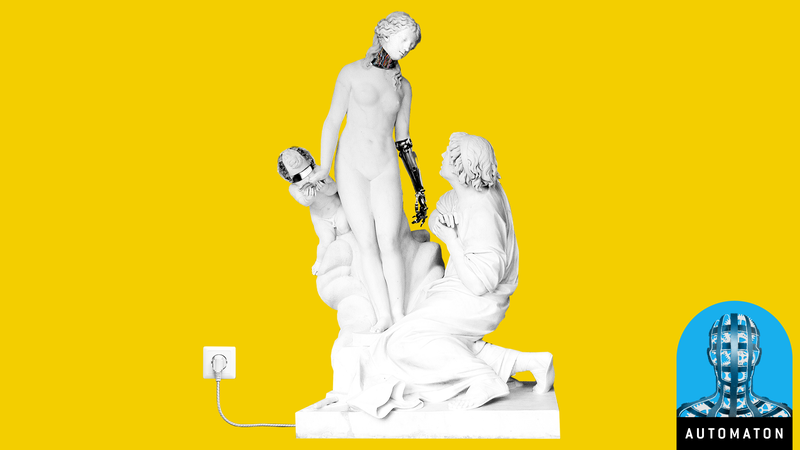 Although the Pygmalion myth is often presented in modern times as a romantic love story, the tale is an unsettling description of one of the first female android sex partners in Western history. It is not clear that Pygmalion’s passive, nameless living doll possesses consciousness, a voice, or agency, despite her “blushes.” Has Aphrodite transformed the perfect female statue into a real live woman, with her own independent mind—or is she now “just a better simulation?” The statue is described as an idealized woman, more perfect than any real female. So Pygmalion’s replica “surpasses human limits,” much like the sex replicants in the Blade Runner films that are advertised as “more human than human.” Ovid, notably, does not describe her skin and body as feeling lifelike. Instead Ovid compares her flesh to wax that becomes warm, soft, and malleable the more it is handled—in his words, her body “becomes useful by being used.”