Two book
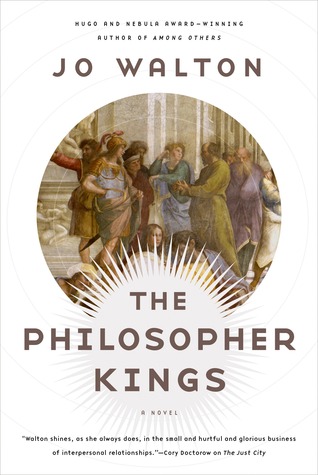 predictions for the number two book in the Thessaly series:
If you haven’t read THE JUST CITY, then don’t read these SPOILERS underlying my predictions for THE PHILOSOPHER KINGS (out June 30, 2015). Disclaimer: I have not received an advanced copy and these are just guesses (but I would gladly check myself before I wreck myself, dear publisher Tor. SEND ME A COPY). Though, I have read the first chapter online for free.
Prediction #1: Athena (AKA Athene) will be redeemed in some way. She kind of came off as an irrational jerk in the last one. Aaaand, she also — shall we say — fudged the data in her “experiment,” which made her seem like a cheater who was more guilty than clever. My guess is Athena will admit to wanting the experiment to fail. Maybe so far as for the purpose of teaching her brother an elaborate lesson. Give Athena some credit, I mean. She’s the motherf*cking goddess of wisdom, man. Only she could have pulled off such an elaborate scam — and get the god Apollo to fall for it. And let’s be honest. Apollo raped someone. IN THE BEGINNING OF THE BOOK. Won’t say he wouldn’t deserve it.
Prediction #2: Pytheas/Apollo will sacrifice himself. He is an incarnation, after all. It’s bound to happen. What kind of a god would waste a perfectly good body on old age? (Cough, cough).

So, there you have it. If you’ve read the first book, what are your predictions? If you’ve got your hands on an ARC copy of the second, shut up and give it to me.
[BLA and GB Gabbler (really just a pen name – singular) are the Editor and Narrator behind THE AUTOMATION, vol. 1 of the Circo del Herrero series. They are on facebook, twitter, tumblr, goodreads, and Vulcan’s shit list.]
 B&N | Amazon | Etc.

 “So the only reason why an A.I. would actually need to have a gender is to interact with humans — in fact, a gender presentation might appear to be a kind of user interface or plug-in for an artificial intelligence. To perform a particular gender is, in a sense, to compile a program in the physical world.”
