Author Spotlight: The Automation by B.L.A. and G.B. Gabbler

DJ (@Bookworm M.D.)'s avatarMyLifeMyBooksMyEscape

KindleCover

About the Book:

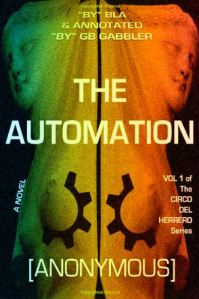
The capital-A Automatons of Greco-Roman myth aren’t clockwork. Their design is much more divine. They’re more intricate than robots or androids or anything else mortal humans could invent. Their windup keys are their human Masters. They aren’t mindless; they have infinite storage space. And, because they have more than one form, they’re more versatile and portable than, say, your cell phone—and much more useful too. The only thing these god-forged beings share in common with those lowercase-A automatons is their pre-programmed existence. They have a function—a function their creator put into place—a function that was questionable from the start…

Odys (no, not short for Odysseus, thank you) finds his hermetic lifestyle falling apart after a stranger commits suicide to free his soul-attached Automaton slave. The humanoid Automaton uses Odys’s soul to “reactivate” herself. Odys must learn to accept that the female Automaton is an extension of his body—that…

View original post 158 more words

BookTuber Tuesday! #IndieBooksBeSeen

“Let’s Talk Indie Books.”

Have a book vlog video you want us to check out? Submit a link below and it could make the CIRCO blog.

[“BLA and GB Gabbler” (really just a pen name – singular) are the Editor and Narrator behind THE AUTOMATION, vol. 1 of the Circo del Herrero series. They are on facebook, twitter, tumblr, goodreads, and Vulcan’s shit list.]
all yellowB&N | Amazon | Etc.

GABBLER RECOMMENDS: Ethics of Reviewing BY NATALIE LUHRS

“Which is more challenging for both reviewers and authors to deal with. Reviewers must be honest about problems they find in books and while the intent may not have been to offend or upset, authors need to accept that once a book is out in the world you cannot—and you should not—control how they’re going to react. You cannot control the conversation that reviewers and readers are going to have about your book and it’s futile to even try.

So that brings me to another ethical issue: that of authors publicly responding to reviews. This is another place where the power differential must be explored and understood. I feel that in most cases, responding to a review—particularly a negative one—is not a good idea. Stating that the reviewer is interrogating the text from the wrong perspective is a recipe for hilarity, not one where everyone will suddenly bow to your superior authority as Author. The text is, in many ways, a joint creation of both author and reader, and once a book is with the reader, I believe that your job as a creator is complete. I don’t want to say that any and all reactions to a book are right: I do not believe reviewers or readers should threaten bodily harm to authors, not even in grossly hyperbolic terms. But I also believe that there must be space for reviews which are negative and which call out racism, sexism, and other oppressions for what they are.

Negative reviews are critically important to our community, in a very real sense they help us to define the boundaries of what we find acceptable in our entertainments. To uncritically accept rape scenes or persistent racial microaggressions is to be smaller and less inclusive than we are capable of being and it is the marginalized among us who are often most sensitive to these issues and best placed to speak about them. It would be unethical to use one’s greater power to attempt to silence those voices and that is often what it appears that authors are attempting to do when they respond to negative reviews. Once the work is out in the world, you are no longer in control and it is important that authors accept that.

I believe that this is a conversation that we, as a community, must have: for better or for worse, people are going to have opinions about the stories they read or watch or play and some of those people are going to want to share. Power differentials are shifting in ways they haven’t in the past and an off–hand comment can go viral astonishingly quickly—I’ve seen it happen more than once, in all sorts of directions.”

Read the rest.

Sometimes, you have enough hobbies.

Excerpt from: How is it possible that we’re still telling diverse stories through the white male lens?

“As a number of critics have already noted, Mad Max is a deeply feminist film. Though the title puts Max Rockatansky (Tom Hardy) front and center, it is Charlize Theron’s Imperator Furiosa who truly defines the film, with Max literally being taken along for the ride. Yet even though the film truly belongs to Furiosa—and honestly bears only the loosest resemblance to the original Mel Gibson trilogy–it is still (white, male) Max who serves as the anchor, receives top billing, and acts as the audience’s entry point into this world of women.

There’s nothing particularly new about the trope of “relatable” (read: white and male) characters serving as a bridge for stories that take audiences into less familiar terrain. Long before Mad Max: Fury Road, The Wire’s Jimmy McNulty was guiding audiences through the streets of predominantly black Baltimore.

Today we occupy an entertainment landscape in which shows like Black-ish, Fresh Off the Boat, and Jane the Virgin have all found success. It’s been proven, time and again, that shows need not forefront a white male (or even just white) viewpoint in order to be “relatable.” So it’s troubling to see that the creators of shows about women and people of color still seem to believe they need a white male interpreter to keep audiences from getting disoriented.

But perhaps there’s a more optimistic way of looking at the issue. Perhaps we should see the Max Rockatanskys and Steven Universes of film and TV as the last vestiges of a fading era of white male dominance.”

Read the rest.