GABBLER RECOMMENDS: Daniel José Older, on why diversity in publishing is not enough.

“By blaming an intangible force, the publishing industry absolves itself of any responsibility, when in fact it is very much in the business of manipulating The Market to its ends. “Those conversations happen without acknowledging that there’s a huge disparity in how books are marketed and publicized,” Sarah McCarry tells me. McCarry worked publishing on and off for a decade, most recently at a New York literary agency. “That money and attention overwhelmingly goes to what the industry has already decided is ‘marketable’—heterosexual narratives featuring white characters. A book has very little chance of doing well if there’s no marketing push behind it.”

Lee and Low Publishers convened a panel last year and asked agents what they could do to help shift the troubling lack of diversity in publishing. “I think the change is going to have to come from within those who are affected,” one agent responded, “just like any underrepresented group in any profession. But since the return on the investment for the author is so low, I don’t know how many people of color are going to have the desire to climb the mountain to publication that every new author faces, or have the luxury of dedicating the time it takes to master the craft.”

Another agent, when asked why less than 1% of her submissions were from people of color, captured what seems to be the publishing industry’s general attitude in just 10 words: “This seems like a question for an author to answer.”

This is the language of privilege – the audacity of standing at the top of a mountain you made on the backs of others and then yelling at people for being at the bottom. If it’s not the intangible Market that’s to blame, it’s the writers of color, who maybe don’t have what it takes and don’t submit enough anyway. Read the subtextual coding here – the agent first places the onus of change on the folks with the least institutional power to effect it, then suggests we probably won’t be able to find the time (i.e., lazy) to master the craft.

So we are wary. The publishing industry looks a lot like one of these best-selling teenage dystopias: white and full of people destroying each other to survive.

But let’s go back to this: “It’s not for you to relate to!” Write that in the sky. And it’s true – often, as writers of color, to portray our stories in all their vibrant authenticity, all their difficult truth means we’re not writing for editors and agents, we’re writing past them. We’re writing for us, for each other. And it’s not just a question of characters of color, it’s not a numbers game. It’s about voice, about narrative flow. Because of who we are and what we’ve lived, our stories often contain implicit critiques of white supremacy, critiques that we know stand little chance of surviving the gauntlet of the majority white publishing industry. We see diverse futures, laden with the tangled past of oppression and we re-envision models of empowerment and survival. But only a few of us make it through. There is a filter and the filter is white culture.

Ultimately, editors and agents hold exactly the same amount of responsibility that writers do in making literature more diverse. The difference is, editors and agents have inordinately more power and access in the industry than writers do.

Diversity is not enough.

We’re right to push for diversity, we have to, but it is only step one of a long journey. Lack of racial diversity is a symptom. The underlying illness is institutional racism. It walks hand in hand with sexism, cissexism, homophobia, and classism. To go beyond this same conversation we keep having, again and again, beyond tokens and quick fixes, requires us to look the illness in the face and destroy it. This is work for white people and people of color to do, sometimes together, sometimes apart. It’s work for writers, agents, editors, artists, fans, executives, interns, directors, and publicists. It’s work for reviewers, educators, administrators. It means taking courageous, real-world steps, not just changing mission statements or submissions guidelines.”

[Via]

See also: Black Authors and Self-Publishing. And Self-publishing Offers Hope for Diverse Authors Shut Out by Traditional Publishing.


[“BLA and GB Gabbler” (really just a pen name – singular) are the Editor and Narrator behind THE AUTOMATION, vol. 1 of the Circo del Herrero series. They are on facebook, twitter, tumblr, goodreads, and Vulcan’s shit list.]

all yellowB&N | Amazon | Etc.

BookTuber Tuesday – Jennifer Garner Reads ‘Go the F*ck to Sleep’ (late post)

It may be Wednesday, but it’s always Tuesday for a booktuber…

Check out other book vlogs we’ve featured here.

Have a book vlog video you want us to check out? Submit a link below in the comments and it could make the CIRCO blog.

[“BLA and GB Gabbler” (really just a pen name – singular) are the Editor and Narrator behind THE AUTOMATION, vol. 1 of the Circo del Herrero series. They are on facebook, twitter, tumblr, goodreads, and Vulcan’s shit list.]
all yellowB&N | Amazon | Etc.

Tweets of the Week: Chicken Scratch

GABBLER RECOMMENDS: Laurie Penny’s ‘Why do we give robots female names? Because we don’t want to consider their feelings’

“This month, Microsoft launched Tay, a bot with the face and mannerisms of a teenage girl who was designed to learn and interact with users on Twitter. Within hours, Tay had been bombarded with sexual abuse and taught to defend Hitler, which is what happens when you give Twitter a baby to raise. The way Tay was treated by fellow Twitter users was chilling, but not without precedent – the earliest bots and digital assistants were designed to appear female, in part so that users, who were presumed to be male, could exploit them without guilt.

This makes sense when you consider that a great deal of the work that we are anticipating may one day be done by robots is currently done by women and girls, for low pay or no pay at all…

In stories from Bladerunner and Battlestar Galactica to 2015’s Ex Machina, female robots are raped by men and viewers are invited to consider whether these rapes are truly criminal, based on our assessment of whether the fembot has enough sentience to deserve autonomy. This is the same assessment that male judges around the world are trying to make about human women today.

Every iteration of the boy-meets-bot love story is also a horror story. The protagonist, who is usually sexually frustrated and a grunt worker himself, goes through agonies trying to work out whether his silicon sweetheart is truly sentient. If she is, is it right for him to exploit her, to be serviced by her, to sleep with her? If she isn’t, can he can truly fall in love with her? Does it matter? And – most terrifying of all – when she works out her own position, will she rebel, and how can she be stopped?

Alan Turing, the father of robotics, was concerned that “thinking machines” could be exploited because they were not sentient in the way that “real human beings” are sentient. We still have not decided, as a species, that women are sentient – and as more and more fembots appear on our screens and in our stories, we should consider how our technology reflects our expectations of gender. Who are the users, and who gets used? Unless we can recalibrate our tendency to exploit each other, the question may not be whether the human race can survive the machine age – but whether it deserves to.”

[Via]

[“BLA and GB Gabbler” (really just a pen name – singular) are the Editor and Narrator behind THE AUTOMATION, vol. 1 of the Circo del Herrero series. They are on facebook, twitter, tumblr, goodreads, and Vulcan’s shit list.]

all yellowB&N | Amazon | Etc.


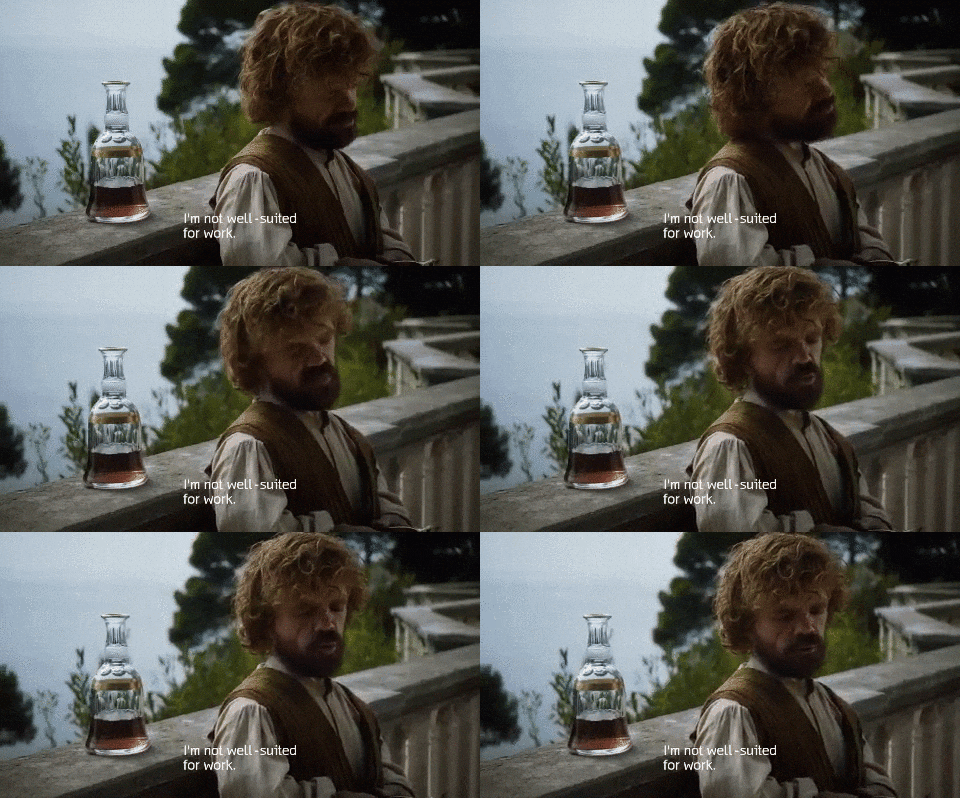
‘George R. R. Martin did a wonderful job constructing this world and these characters, but let’s face facts: He is not an efficient writer.’


George R. R Martin did a wonderful job constructing this world and these characters, but let’s face facts: He is not an efficient writer. Being an “artist” can only take you so far. At this point in his procrastination, it’s not cute and it’s not creative. He very clearly has written himself into a corner — or several. He discusses it himself with the term Meereenese Knot. “Meereenese Knot” is a clever way of saying “writer’s block.” He’s grown tired of his own story and can no longer walk the walk.

And there’s nothing wrong with that; he’s lived with these characters for over twenty years now. Of course he’s grown sick of them. But the show must go on, and he’s not willing to push them into place.

At the end of the day, if you’re a teacher, do you want to reward the slacker students, or the motivated ones who have their shit together? The Game of Thrones showrunners are getting this narrative in gear with a concrete plan and timeline. There’s something to be said for that.

Shows exceeding their books are all the rage these days

While in most cases, the source material is better than its adaptation, in the Golden Age of TV, there are more examples than ever of television blowing the book out of the water. The Leftovers delivered one of the most beautiful seasonsof recent television when it moved beyond its own book, and Outlander is doing a considerable job trimming the fat off its novels.

[Via]

[“BLA and GB Gabbler” (really just a pen name – singular) are the Editor and Narrator behind THE AUTOMATION, vol. 1 of the Circo del Herrero series. They are on facebook, twitter, tumblr, goodreads, and Vulcan’s shit list.]

all yellowB&N | Amazon | Etc.