Goodreads Book Giveaway

The Automation
by G.B. Gabbler
Giveaway ends October 12, 2014.
See the giveaway details
at Goodreads.
[a website for the Editor and Narrator of the Circo del Herrero series]
Giveaway ends October 12, 2014.
See the giveaway details
at Goodreads.
Les Yeus Sans Visage – or, The Eyes Without a Face – or, The Horror Chamber of Dr. Faustus – is perfect for your Halloween-themed viewings this month.
On the film, Susan Sontag has this to say:
‘But in science fiction films, unlike horror films, there is not much horror. Suspense, shocks, surprises are mostly abjured in favor of a steady inexorable plot. Science fiction films invite a dispassionate, aesthetic view of destruction and violence—a technological view. Things, objects, machinery play a major role in these films. A greater range of ethical values is embodied in the décor of these films than in the people. Things, rather than the helpless humans, are the locus of values because we experience them, rather than people, as the sources of power. According to science fiction films, man is naked without his artifacts. They stand for different values, they are potent, they are what gets destroyed, and they are the indispensable tools for the repulse of the alien invaders or the repair of the damaged environment.
The science fiction films are strongly moralistic. The standard message is the one about the proper, or humane, uses of science, versus the mad, obsessional use of science. This message the science fiction films share in common with the classic horror films of the 1930’s, like Frankenstein, The Mummy, The Island of Doctor Moreau, Dr. Jekyll and Mr. Hyde. (Georges Franju’s brilliant Les Yeux Sans Visage [1959], called here The Horror Chamber of Doctor Faustus, is a more recent example.) In the horror films, we have the mad or obsessed or misguided scientist who pursues his experiments against good advice to the contrary, creates a monster or monsters, and is himself destroyed—often recognizing his folly himself, and dying in the successful effort to destroy his own creation. One science fiction equivalent of this is the scientist, usually a member of a team, who defects to the planetary invaders because “their” science is more advanced than “ours.”
…The message that the scientist is one who releases forces which, if not controlled for good, could destroy man himself seems innocuous enough. One of the oldest images of the scientist is Shakespeare’s Prospero, the over-detached scholar forcibly retired from society to a desert island, only partly in control of the magic forces in which he dabbles. Equally classic is the figure of the scientist as satanist (Dr. Faustus, stories of Poe and Hawthorne). Science is magic, and man has always known that there is black magic as well as white. But it is not enough to remark that contemporary attitudes—as reflected in science fiction films—remain ambivalent, that the scientist is treated both as satanist and savior. The proportions have changed, because of the new context in which the old admiration and fear of the scientist is located. For his sphere of influence is no longer local, himself or his immediate community. It is planetary, cosmic.’
Boldface is mine. Read the rest here.
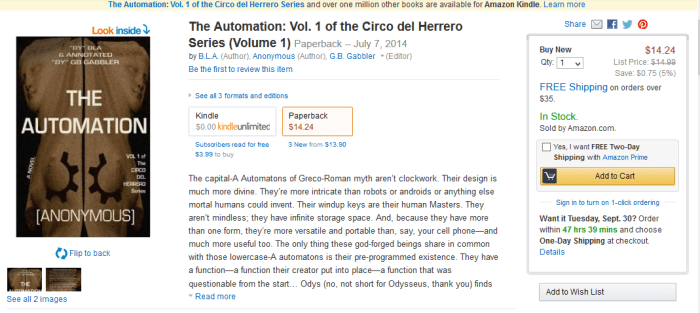
The capital-A Automatons of Greco-Roman myth aren’t clockwork. Their design is much more divine. They’re more intricate than robots or androids or anything else mortal humans could invent. Their windup keys are their human Masters. They aren’t mindless; they have infinite storage space. And, because they have more than one form, they’re more versatile and portable than, say, your cell phone—and much more useful too. The only thing these god-forged beings share in common with those lowercase-A automatons is their pre-programmed existence. They have a function—a function their creator put into place—a function that was questionable from the start…
Odys (no, not short for Odysseus, thank you) finds his hermetic lifestyle falling apart after a stranger commits suicide to free his soul-attached Automaton slave. The humanoid Automaton uses Odys’s soul to “reactivate” herself. Odys must learn to accept that the female Automaton is an extension of his body—that they are the same person—and that her creator-god is forging a new purpose for all with Automatons…
The novel calls itself a “Prose Epic,” but is otherwise a purposeful implosion of literary clichés and gimmicks: A Narrator and an Editor (named Gabbler) frame the novel. Gabbler’s pompous commentary (as footnotes) on the nameless Narrator’s story grounds the novel in reality. Gabbler is a stereotypical academic who likes the story only for its so-called “literary” qualities, but otherwise contradicts the Narrator’s claim that the story is true.
THE AUTOMATION is a this-world fantasy that reboots mythical characters and alchemical concepts. Its ideal place would be on the same bookshelf as Wilson’s ALIF THE UNSEEN and Gaiman’s AMERICAN GODS—though it wouldn’t mind bookending Homer, Virgil, and Milton, to be specific.
And, yes, “B.L.A. and G.B. Gabbler” are really just a pen name.
We knew that people hated prologues and sometimes never read them. We therefore inserted ours in the middle of our novel so it would be harder to ignore. And, at that point, we think readers are ready for a little context. They’re like, WTF is going on?!?
 There’s an ongoing debate about prologues. Do you need them? Are they superfluous? Do they set up the story, or should you cut ’em and get to chapter one already?
Plenty of opinions exist, and many opinions have to do with taste. So, before we jump on the “prologues never contribute to the story” bandwagon, I think the first step is to identify what kind of prologue one is writing and the objective of that prologue. We need to know what we’re writing and why, before we let the opinions of what’s “in vogue” influence our writing decisions.
Let’s take a look at four different kinds of prologues.
1) Future Protagonist
This prologue is written in the same voice and style as the main story and from the POV of the same protagonist. When done really well, this kind of prologue changes everything the reader thought. As the reader continues with the story…
View original post 408 more words


THE AUTOMATION is available in paperback and for DRM-free Kindle download. In all countries. Maybe. Probably. WE DON’T KNOW, OK?
[“BLA and GB Gabbler” (really just a pen name – singular) are the Editor and Narrator behind THE AUTOMATION, vol. 1 of the Circo del Herrero series. They are on facebook, twitter, tumblr, goodreads, and Vulcan’s shit list.]