BookTuber Tuesday – On Book Packagers and Art and Honesty

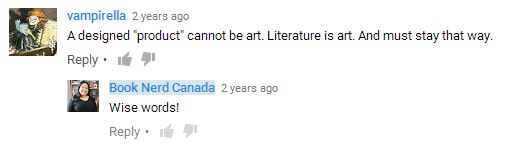
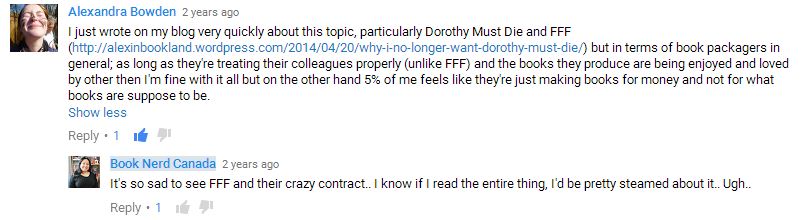
Comments from the video on YouTube:

comments

comments

[High art vs. low art argument aside, book packagers’ bottom line is to deceive readers into thinking inspiration wasn’t packaged like processed meat. Instead of allowing cheating in the “system,” perhaps authors and readers should note why cheating was considered in the first place and what this says about their culture and the “art” it produces (or lack thereof).]

Check out other book vlogs we’ve featured here.

Have a book vlog video you want us to check out? Submit a link below in the comments and it could make the CIRCO blog.

[“BLA and GB Gabbler” (really just a pen name – singular) are the Editor and Narrator behind THE AUTOMATION, vol. 1 of the Circo del Herrero series. They are on facebook, twitter, tumblr, goodreads, and Vulcan’s shit list.]

all yellowB&N | Amazon | Etc.

Tweets of the Week: Don’t fly too close to the sun

Claire Fallon’s Can We Stop Pretending The Publishing Industry Is Fair Now?

Whenever we, as members of a literary community, pat ourselves on the back for letting Toni Morrison and Chimamanda Ngozi Adichie and Ta-Nehisi Coates write and sell books, we’re eliding the huge obstacles we still fling in front of writers from marginalized groups at every turn. How many potential Morrisons and Adichies never published a single book because their queries were met with a particularly skeptical eye and brushed off with a cold dismissal?

Unlike Kevin Morris, such writers are unlikely to be rescued by a chance encounter with a powerful publisher at a book party thrown by a famous friend. Unlike “George,” they’re unlikely to be given a generous, engaged reading and the opportunity to prove they have the chops to finish a great novel.

It turns out that, just as everyone but Michael Wolff sort of suspected, white men still hold all the cards in the literary world. Kevin Morris’ White Man’s Problems, for its part, will soon have an audio book voiced by stars such as Matthew McConaughey. Of course, there’s no more pleasant position than keeping all the advantages while claiming martyrdom and marginalization. But this time, white men of literature, we definitely see what you’re up to.

Read the rest.

[“BLA and GB Gabbler” (really just a pen name – singular) are the Editor and Narrator behind THE AUTOMATION, vol. 1 of the Circo del Herrero series. They are on facebook, twitter, tumblr, goodreads, and Vulcan’s shit list.]

all yellowB&N | Amazon | Etc.

GABBLER RECOMMENDS: Writers Shouldn’t Romanticize Rejection

Time and time again, the literary establishment seizes on the story of a writer who meets inordinate obstacles, including financial struggles, crippling self-doubt, and rejection across the board, only to finally achieve the recognition and success they deserve. The halls of the literary establishment echo with tales of now-revered writers who initially faced failure, from Stephen King (whose early novel Carrie was rejected 30 times before being published), to Alex Haley (whose epic Roots was rejected 200 times in eight years). This arc is the literary equivalent of the American Dream, but like the Dream itself, the romantic narrative hides a more sinister one. Focusing on how individual artists should persist in the face of rejection obscures how the system is set up to reward only a chosen few, often in a fundamentally unmeritocratic way.

What are we meant to make of the fact that James’s manuscript was rejected 80 times? Sadly, this phenomenon isn’t that uncommon. In fact, there’s a website dedicated to bestsellers that were initially rejected. Was it lack of imagination on the part of those publishers? Was it unconscious bias against a new and unfamiliar narrative—one that they didn’t regard as “mainstream?” Or was it a complex business decision based on multiple factors? As an emerging writer of color, I’m no longer inspired by this narrative. I don’t see much cause to celebrate when writers of James’s profound talent are roundly rejected in the course of normal business.

Three years later, I remain perplexed by a system that creates the conditions by which manuscripts that will go on to be lauded are first broadly rejected. While other sectors have certainly overlooked brilliant new ideas and missed opportunities for innovation, this fact isn’t usually romanticized or celebrated. In other sectors this level of oversight would be called “a system failure,” or “inefficiency,” or “failure to innovate.” And policies and practices would be put into place to try to prevent this from happening in the future.
But I don’t see those kinds of self-critiquing evaluative discussions or major efforts to dismantle such systems in the literary world. Just last month, Publishers Weekly’s annual field survey confirmed that 89 percent of the publishing sector workforce is white–exactly the same as the year before. Instead, the focus continues to be on individual persistence against myriad, intangible barriers, rather than on the role of the system in creating and perpetuating many of those barriers, thereby putting the full burden on writers.

One of the most curious aspects of this mode of operation is that it gives rise to a secondary narrative: that of discovery. Instead of dismantling these barriers, literary power players emphasize how they “discovered” an author, even though that author was knocking at the door of the literary establishment the whole time, just waiting to be seen and let in.

Read the rest at The Atlantic. 

[“BLA and GB Gabbler” (really just a pen name – singular) are the Editor and Narrator behind THE AUTOMATION, vol. 1 of the Circo del Herrero series. They are on facebook, twitter, tumblr, goodreads, and Vulcan’s shit list.]

all yellowB&N | Amazon | Etc.

GABBLER RECOMMENDS: Traditional publication: The new vanity press?

All those traditional publishing complaints about the self-publishing/online writing slushpile rather get thrown into perspective by this development. If Lanzendorfer is correct, hopeful online writers haven’t made one bit of difference to the practices of literary journals. The MFA industry has. Time and again, writers and others involved in the book world have complained about it. And here’s one evidence of it doing actual harm and penalizing poorer writers.

There is a massive problem of felt entitlement around MFA programs, as has been chronicled at length. The problem is clearly not being helped by the fact that there’s an alternative path to writing success that MFA participants are apparently ignoring. Yes, jump into the online writing/self-publishing slush pond. You may be drowning in a pool of talentless peers, and struggling to get your head above the general level, but know what? Looks like exactly the same will apply in MFA programs these days. So much so that literary journals are effectively putting up paywalls to make you stay away. At least the internet doesn’t do that.

But it doesn’t confer an obvious qualification and other snob value brownie points either. An MFA does. Publication in an accredited literary journal, of course, also confers snob value. And this is snob value you pay for. Why wouldn’t you? It carries the Jonathan Franzen Seal of Approval.

Chris Meadows ran a couple of insightful pieces on how The Martian went from self-published surprise hit to Ridley Scott movie script. And the problem of snobbery that still lingers despite such breakout successes. The hidden, prejudiced assumption he cites there is that “self-publishing was vanity publishing.” Well, despite the work of Penguin Random House and Author Solutions, it now looks as though the equation has been turned on its head.

Snob writers from snob backgrounds are now paying snob fees for snob credentials and the snob kudos of proper publication in real literary journals. Not for them the sordid smut of a Fifty Shades-style popular success. They aspire to higher things, with real publication, on paper. After all, that’s what they paid for.

Read the rest on TeleRead.

See also: Why literature is no longer art. 

[“BLA and GB Gabbler” (really just a pen name – singular) are the Editor and Narrator behind THE AUTOMATION, vol. 1 of the Circo del Herrero series. They are on facebook, twitter, tumblr, goodreads, and Vulcan’s shit list.]

all yellowB&N | Amazon | Etc.