Jason Kehe on Lev Grossman’s THE MAGICIANS:

“A comparison to Tolkien is inevitable for any fantasy writer—as is a comparison to C. S. Lewis, J. K. Rowling, and just about every other fantasist who ever was (T. H. White, Le Guin, Feist, Pratchett, Pullman, Alan Moore, and so on, as well as some notable non-fantasists, like the great Evelyn Waugh). But with Grossman, the comparison is even more unavoidable than usual. If the references to a school for magic and a mystical land didn’t already tip you off, Grossman’s trilogy plays as an epic riff on the entire genre. And just in case you still don’t get it, he drops allusions to these works throughout, from specific (Rowling’s “muggles,” for instance) to structural (boy-wizard trope, Lewis’s Narnia). The goal, it seems, is to be so derivative, so plagiaristic in its parts, that their sum somehow circles back in an Ouroboros of meta-magic and achieves a kind of renewed originality. The entirety of protagonist Quentin Coldwater’s journey is supposed to transcend the familiarity of its particulars. ”

Read the rest.

By Lev Grossman

4 Types of Prologues

We knew that people hated prologues and sometimes never read them. We therefore inserted ours in the middle of our novel so it would be harder to ignore. And, at that point, we think readers are ready for a little context. They’re like, WTF is going on?!?

ingridsundberg's avatarIngrid's Notes

Satellite View Of StarsThere’s an ongoing debate about prologues. Do you need them? Are they superfluous? Do they set up the story, or should you cut ’em and get to chapter one already?

Plenty of opinions exist, and many opinions have to do with taste. So, before we jump on the “prologues never contribute to the story” bandwagon, I think the first step is to identify what kind of prologue one is writing and the objective of that prologue. We need to know what we’re writing and why, before we let  the opinions of what’s “in vogue” influence our writing decisions.

Let’s take a look at four different kinds of prologues.

1) Future Protagonist

This prologue is written in the same voice and style as the main story and from the POV of the same protagonist. When done really well, this kind of prologue changes everything the reader thought. As the reader continues with the story…

View original post 408 more words

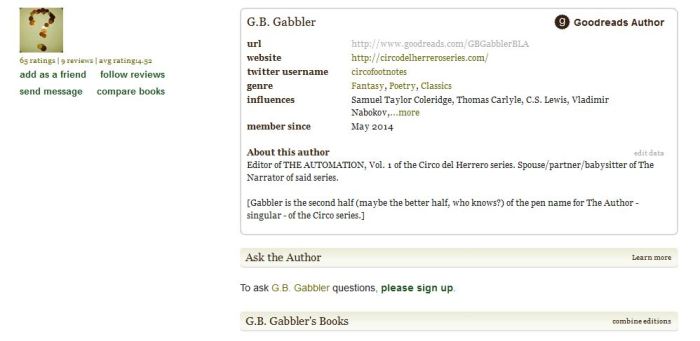
I’m an official Goodreads author, b*tches:

We/I have an official Goodreads author page.
We I have an official Goodreads Author page.

Let it be known: B.L.A. does not have one. Yet. I am trying harder than B.L.A. This is proof.

The direction of many of us will be more toward poetry than toward the traditional novel.


The Great novels we get in the future are not going to be those that the public thinks it wants, or those that critics demand. They are going to be the kind of novels that interest the novelist. And the novels that interest the novelist are those that have not already been written. They are those that put the greatest demands on him, that require him to operate at the maximum of his intelligence and his talents, and to be true to the particularities of his own vocation. The direction of many of us will be more toward poetry than toward the traditional novel.” 

– Flannery O’Connor, The Grotesque in Southern Fiction. Bold face mine.

Novels ain’t nothin’ but a thang.

We are in love with this video

We also love how she mentions Vulcan. It’s very important to pay respects.