 “It is not therefore, as King Lear warns his daughter Cordelia, that ‘nothing will come from nothing,’ but precisely the opposite: something can come only from nothing; only less can become more; only humanity at its nadir stands any chance of being redeemed. This dialectic is neatly captured in Sophocles’s Oedipus at Colonus, when the blind Oedipus divested of his power and identity, asks his daughter Ismene: ‘am I made a man in this hour when I cease to be?’ Here we might re-phrase this remark for assertively: it is only now that I recognize myself as nothing – as nothing more than a disposable piece of shit for the system0 0that my true political subjectivity, my revolutionary agency, materializes for me.”
“De-extinction…responds to an absence – or rather a perceived series of absences – in nature; but rather than tarrying with loss, it rushes instead to provide a technoscientific ‘fix.’ This attempt to fill out nature’s ‘lack,’ to cork the ecological hole, is quite clearly a drive towards master: an attempt to turn everything – including life itself – into a repeatable, replaceable commodity, a source of surplus value. But the consequences of such Promethean moves turn out to be very strange indeed. For if, in the end, there is no end to creaturely life but only the possibility of infinite biotechnological reversals and repetitions, then life itself begins to appear under a new aspect: what we might call the biotechnological uncanny…
In seeking to ‘reverse’ death, de-extinction ultimately becomes inseparable from extermination: to exterminate literally means to deprive something of its end, to deprive it of its term. Understood in this sense, the de-extinctionist death drive really does culminate in destruction; but it is destruction that coincides with the ecstatic enjoyment of ‘new scientific creation.’”
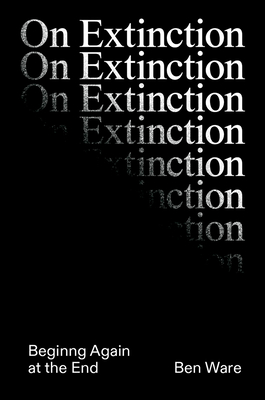
On Extinction by Ben Ware
