From ‘Robotics: Hephaestus does it again Inaugural lecture’ by Jean-Paul Laumond

“It was when I was preparing this lecture that I discovered that roboticists have a god: Hephaestus. In Greek mythology, Hephaestus was an ingenious, talented craftsman, known for the remarkable weapons he made. But he also made wheelchairs that moved about on their own (basically, mobile robots) and golden servants that helped him to move about (basically, helper robots), and he even made Pandora, a clay statue to whom Athena gave life. He had a tumultuous love life, as attested by the following passage by Apollodorus, a chronicler from the second century BCE:
Athena visited Hephaistos, wanting to fashion some arms. But Hephaistos, who had been deserted by Aphrodite, yielded to his desire for Athena and began to chase after her, while the goddess for her part tried to escape. When he caught up with her at the expense of much effort (for he was lame), he tried to make love to her. But she, being chaste and a virgin, would not permit it, and he ejaculated over the goddess’s leg. In disgust, she wiped the semen away with a piece of wool and threw it to the ground. As she was fleeing…
While Hephaestus is the god of doing, Athena, who appears here as the one who calls the tune, is the goddess of knowing or —to protect me from reprimands from the exegetes, especially in this assembly— let me consider her as such for the purpose this lecture. Hephaestus was thus seeking to possess Athena. He was unable to do so. Could the doing not aspire to the knowing? A hard blow for the roboticist.
Robotics stems from this tension. Although the myth contradicts a current tendency to confuse science and technology, it does nevertheless reflects my own experience regarding innovation —experience that I might sum up as follows: even though doing is not understanding, understanding enables one to do, but unfortunately, not always. And even though one may very well do without understanding, doing also enables one to have tools —sometimes surprising ones— for understanding.
…
Hephaestus is starting all over again with new Pandoras. They are no longer of clay, but mecatronic. And they are animated. The roboticist keeps on asking the question of autonomy: what adaptability can we hope to give these new machines? The analogy between humans and machines has to be made23; it cannot be avoided. In the end, does Hephaestus have the keys to knowledge? With his machines that adapt, that “decide” on their actions, what can he tell us about our own “functioning”? The question is both dangerous and beautiful.
…
Let us bear in mind the image of the myth —and it is only an image, for even if the roboticist can identify with Hephaestus and can shape Pandora out of clay, he is neither Athena nor Geppetto. He will never give any humanity to clay or wood. A robot is a machine controlled by a computer; nothing else. Although animated, it remains and will remain an inanimate object without a soul that becomes attached to our soul [and without] the power of lovei. Let us allow the demi-gods to talk, let us enjoy works by Fritz Lang and Mary Shelley, and let us not be afraid. But are we actually anxious? That is not so sure. In any case, our Japanese friends aren’t, they who are so different from us; they for whom union is possible.”
[Via]
BookTuber Tuesday – American Gods Complaints
Recommend a BookTuber video in the comments and it could make our Tuesday post!
[“BLA and GB Gabbler” (really just a pen name – singular) are the Editor and Narrator behind THE AUTOMATION, vol. 1 of the Circo del Herrero series. They are on facebook, twitter, tumblr, goodreads, and Vulcan’s shit list.]

On Ghost in the Shell:
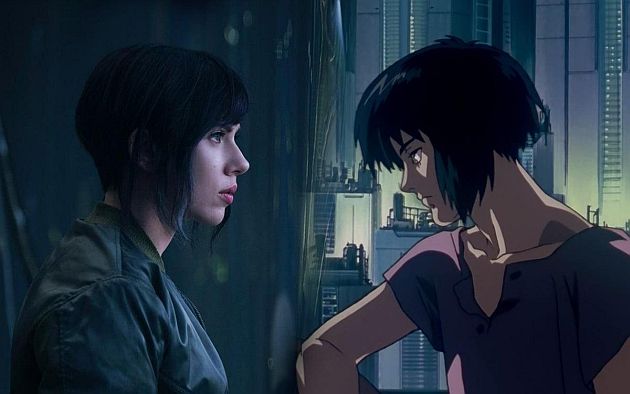
“The biggest problem – the one you already know about, thanks to the countless thinkpieces about it spewed forth from our left-leaning media cycle – is the racial one. Again, there’s an excuse: the film offers its multiracial cast, who occupy roles that are disconnected from their ethnicity, as a depiction of so-called “transhumanism” (a troubling phrase to begin with), which is supposed to tie into the big twist reveal about The Major and where she came from before all this cybernetic stuff happened. But, again, this excuse is as flimsy as wet paper – it’s obvious to anyone that Paramount (and affiliated Chinese production companies Huahua Media and Shanghai Film Group) needed to cast the biggest female star they could in order to sell their film, and the biggest star just so happened to be white. As a result of this decision, which was already artistically bankrupt, the story of the original Ghost in the Shell was rewritten to focus not on its ontological ideas about identity and consciousness, but on a hackneyed amnesia plot in which The Major – whose name is now “Mira Killian” – must discover her true identity as a Japanese girl named Motoko Kusanagi.
I don’t even know where to start with that.
Casting a white actor as a Japanese character would be troublesome enough. Changing that Japanese character into a white character in response is even more problematic. Revealing that that white character was actually a Japanese character all along is… well, “batshit insane” springs to mind.
This isn’t the remake’s only problem, but it’s surely the most damning one. It’s emblematic of a general disregard by all involved in the film for crucial sociopolitical issues that, in 2017, have been brought tooth and nail to the surface, by the bravery of those actually facing these issues daily. Marvel’s Iron Fist is one thing; that character was actually originally written as white. The rest is wishful thinking, no matter how well-intentioned (and correct, in my opinion) the fan-casting might be. This is beyond the pale, and it would utterly invalidate the film if it wasn’t already so busy doing that to itself by other means.
It’s undoubtedly a colourful, well-composed, striking-looking movie, but that’s about where its virtues end. Its depictions of a glittering cyberpunk future – a far cry from the gritty, overwhelmingly dense setting of the original – are stunning, but nearly masturbatory in their effect, as the same flyover shots are used again and again to show us the same amazing building-sized holographic advertisements we’ve seen before. It’s Blade Runner, if Blade Runner had no restraint or sense of visual purpose. Even within this fantastical future world, where nothing looks real, many of the film’s visual effects still manage to look artificial and dated. The action sequences are dull, with unfocused editing and no sense of impact, and far too infrequently placed in a film whose dialogue scenes leave much to be desired. The banter between characters is painful even in comparison to the 1995 film, whose obviousness was an issue – here the ideas are just as vapid as the dialogue used to express them. The general story structure is a latticework of bad ideas, from the clumsy way that old elements are redone (like the garbage man controlled by the hacker antagonist, or the hacker antagonist himself) to the inept way that new elements are introduced (like Killian’s mother-figure, the unscrupulous-then-scrupulous Dr. Ouelet, or Beat Takeshi’s Section 9 boss Chief Aramaki, who graduates from a technical strategist in the original to yakuza executioner here). The simplest way to describe it is to say that it’s a film whose only new ideas are bad ones, and whose execution on the old ideas is bumbling and inelegant.”
[Via]
#TBT – The Guild
That one time when YouTube had micro TV shows as well as vlogs that were worth watching. 2007.