On Reading the Talos Myth:

Talos was said to have been created by Hephaestus, killed by Medea’s knowledge. She knew to take out a bolt at his foot, causing him to die similarly to Achilles (the killing machine of The Iliad).

One account claims that Talos was actually a bull and not a humanoid figure, but, if we know anything about robots, it is that they can sometimes transform (so we won’t hold that as discrepancy):

On Talos, Adrienne Mayor, author of Gods and Robots, has this to say:

‘The “imaginary significance” of automata like Talos ‘in the premodern period had little to do with mechanistic ideas,” asserts Kang, who claims that Talos was “not a mechanical being but very much a living creature.” But ancient sources describe Talos as “made, not Born.” As we saw, Talos’s internal anatomy and movements were explained through mechanistic concepts, and this was echoed in ancient artistic depictions: What living creature has a metallic body and nonblood circulatory system sealed with a bolt? Moreover, the mythic accounts and fifth-century BC artworks illustrating the destruction of Talos show that his demised required technology, specifically the removal of the bolt.’ – Adrienne Mayor, “The Robot and the Witch.”

We have been asked in the past why Talos isn’t one of the Automata in the Circo del Herrero / The Blacksmith’s Circus Series. We had attempted to answer it here, but want to note that just like new phones, even “made, not-borns” can get an upgrade. Not all technology serves the same purpose or is powered the same. The Automata in The Automation do not have bolts in their ankles that can spill “nonblood.” They’ve a much sleeker design. They are an exclusive line of tech for a specific purpose that does not disregard previous iterations, but improves upon them.

Talos’s purpose was to protect Europa, throwing stones at any who came near. Zeus, in the form of a bull, kidnapped her and gave her Talos, so it is fitting that the robot would also have a bull form. If I had written the myth, perhaps it would have been Talos who kidnapped her for Zeus and held her captive. Anyone doing Zeus’s bidding would be an extension/avatar of Zeus himself, so not much recorded myth would be undermined except the fact the bull was said to be white. But what is color when the Greeks didn’t even have blue?

This would not be the only example of a bull being used “in stead” of someone else. It is a common motif. Daedalus’s bull for Pasiphae, mother of the Minotaur (through bestiality) is one, the Brazen Bull, perhaps, another.

What’s most interesting to me about Talos is how he is depicted in imagery. In the two most famous of his images, he has genitals. The Automation’s Automata do not so much have full genitals (read: sex), but they do have gender. Infertile they may be, I wonder if Talos was? Or are gentials, here, merely an expression of gender for the ancients (clothes lacking as indicators – pun intended)? Better yet, what if they are a symbol that reproduction can mean more than biological offspring? Aren’t all robots replicable in theory? That hardly seems unproductive to me.

By G.B. Gabbler
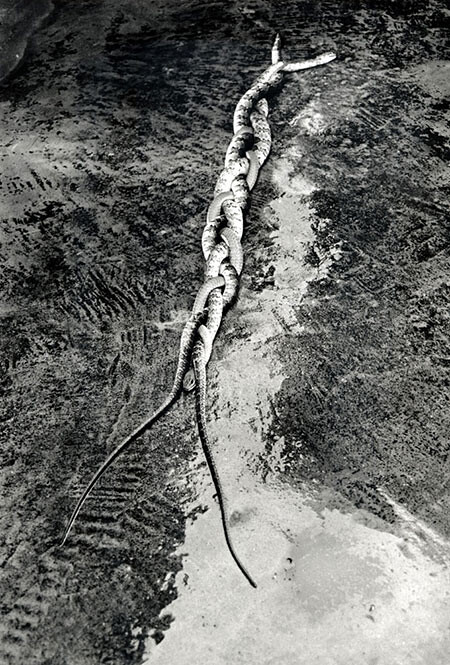
“Tentacular Thinking”

“What if the doleful doings of the Anthropocene and the unworldings of the Capitalocene are the last gasps of the sky gods, not guarantors of the finished future, game over? It matters which thoughts think thoughts.”
[Via]

GABBLER RECOMMENDS: ‘Overwhelming Silence: A Review of 99 Practical Methods of Utilizing Boiled Beef’

All of which, with the use of this smooth, clever transition sentence, leads me to my topic, 99 Practical Methods of Utilizing Boiled Beef, a book that has sweetened me on self-published books (even if it’s not technically self-published). A few years ago, when I was ready to publish my first book, the award-non-winning novel Barn Again: A Memoir, I learned, after a year of researching and querying agents and publishers, that no one else was ready for it to be published. Skip to the part where I finally say fuck it, I’ll publish the motherfucker myself and unlike certain people I’ll actually proofread it. And to mask the shame of self-publishing I put it out under a phony publisher name, Malarkey Books. And because of that this website exists and other people are even writing for it, and dozen of people have read my books, and I’m writing this review of a book that was published by another small-time publisher. The thing is, you won’t hear about it on the news or any of the big magazines or literary websites, but some of the most interesting books being published today are being self-published or released by extremely small presses that use the exact same publication method as the self-publishers, which is print-on-demand. Usually with either CreateSpace or Ingram Spark. Obviously Malarkey uses Ingram Spark because CreateSpace is owned by Amazon and Amazon is an anagram for Satan. Cow Eye Press, the publisher of Boiled Beef, also uses Ingram Spark. I asked, but I didn’t need to. You can tell. CreateSpace books are easy to spot because they have this crease near the spine on the front and back covers. You’re right, they should change their name to CreaseSpace. Ingram, once you hold a few, you can tell by the feel of the cover, also the barcode at the back of the book.

You’d have to be sort of nuts to buy this book. You’d have to be sort of nuts to publish it. I mean, it’s just a book of recipes, none of which is particularly detailed or—can’t even tell if this is the vegetarian in me or the old picky eater in me—appetizing, for cooking boiled beef. But it’s not just a book about boiled beef. It’s also a meditation on publishing and independent literature. What the good folks at Cow Eye Press have done is pluck an obscure manuscript from the public domain and turn it into a metaphor for the existence of the modern writer. The twenty-first-century update of Boiled Beef is prefaced by a note from a fictional intern, who thinks “no more than five people will read this new edition.” But it doesn’t matter how many people read it, the point of this book is that “Nobody’s gonna read a book of recipes for boiled beef” is not a critique but a formula. “Nobody’s gonna read a book of/about/for/by” + whatever category or genre doesn’t really sell. For writers and publishers outside the publishing establishment, we know this, and we do it anyway. Because we’re stubborn or vain or deluded—or because it’s worth doing, even if there ain’t a big fucking market for what we do.

“As an independent publisher,” writes Natalie Zeldner in a note at the beginning of the book,

I sometimes wonder why we even bother. It is unlikely that anyone will take note of the books we publish. No reviewer will discuss them. Bookstores will not stock them. The common reader, already drowning in a sea of heavily marketed titles, will never suspect that ours also exist. Our books will be excluded from the prominent “Best Of….” lists and literary awards that have become the last refuge for gaining editorial credibility and an external audience — but that to this day remain the privileged birthright of the publishing establishment and its legacy of patronage and prestige, of old money, of esoteric tradition, of economic expediency, of timeliness, of genre.

She still went and published this book. That’s what we do. Agents tell us no, so politely. Book reviewers ignore our emails. Bookstores charge us consignment fees. We keep writing. We keep publishing. We keep reading. Boiled Beef is more than a book, it’s an homage to those of us who work in the dark, whose publications exist and matter and are met, as Cow Eye Press put it on twitter, with overwhelming silence. For those of us in the independent publishing world, we don’t have publicists or marketing teams. We don’t have agents, managers, or brand strategists. All we have is each other.

[Via]

Hashtags as annotations in books:

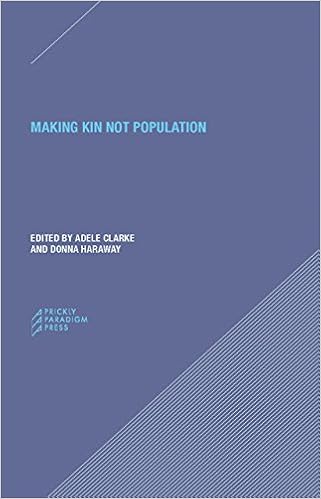
When reading Michelle Murphy’s chapter called “Against Population, Towards Alterlife” in Making Kin, Not Population, I (Gabbler) found Murphy’s particular use of hashtags inserted into the text to be fitting little asides — invitations to explore “notes” later online; annotations even the reader could contribute to. Footnotes and endnotes do not allow for such dialog or collaborative annotating. Hashtags are brilliant:

Aspiring towards decolonizing and queer alter-worlds, reproduction might be better rethought as politics of redistributing relations, possibilities and futures. #RedistributionsNotReproductions. Making redistributed relations is an extensive, ongoing endeavor, looped with imperfections, messiness, returns and futurities. I am against population and for a politics of differently distributed futures. #DifferentFutures


See also:
ON INTERSTELLAR: YOU KNOW WHO ELSE WANTED TO EXPLORE WITH THE INTENT OF INHABITING NEW LAND AND USING ITS RESOURCES? CONQUISTADORS.

WHAT WE TALK ABOUT WHEN WE TALK ABOUT POST-APOCALYPTIC STORIES; WHEN THE APOCALYPSE IS SOLVED THROUGH NATALIST TROPES 

BLA THOUGHT OF THE DAY: WHAT IF ELON MUSK’S ‘RIP HARAMBE’ WAS JUST AN ATTEMPT TO GET DONNA HARAWAY TO NOTICE HIS GIRLFRIEND GRIMES? 

BOOKTUBER TUESDAY – ‘DECOLONIAL SEX AND RELATIONS FOR A MORE SUSTAINABLE WORLD – DR. KIM TALLBEAR’

BookTuber Tuesday: New trailer for adaptation of His Dark Materials by Philip Pullman – “Pullman let us down”

Pullman let us down. This book is here because it deals with moral/political complexities with unsentimental respect for its (young adult) readers and characters. Explores freedom and social agency, and the question of using ugly means for emanicipatory ends. It raises the biggest possible questions, and doesn’t patronise us that there are easy answers. The second in the trilogy,The Subtle Knife, is a perfectly good bridging volume… and then in book three,The Amber Spyglass, something goes wrong. It has excellent bits, it is streets ahead of its competition… but there’s sentimentality, a hesitation, a formalism, which lets us down. Ah well. Northern Lights is still a masterpiece. [Via]