GABBLER RECOMMENDS: A Ghost Story film

A house is haunted. A ghost is haunted by his past. A man haunts himself.

So much was done with such a small budget. It’s poignant and laughable simultaneously. It also interweaves sheet lore and loop theory very well. Highly recommended for creativity and message. This is the kind of movie David Lowery should be making.

A Ghost Story is difficult to categorise: eerily beautiful, dreamily melancholic, earnestly sincere and patience-testingly slow (I watched it sitting next to a man who could barely contain his exasperated harrumphs). The film ranks low for scares – it’s more likely to keep you up at night fretting about the meaning of life than to make you terrified of a spirit under the bed. A recent article in this paper included it in cinema’s latest big thing: post-horror.


‘The closer your category is to the shady, vague “animal,” the less you “matter.”’

‘Caribbean scholar and cultural theorist Sylvia Wynter notes that our current conception of the human/humanity is a Eurocentric invention. Although there have been countless ways of expressing human activity throughout history, the model we take for humankind is the one devised by colonial Western Europe. On this model, there is the human (white, Western male with the ideal human counterpart: the white, Western female) and “its human Others—that is, Indians, Negroes, Natives [and, I would add, Jews and Muslims].”

What separates the “human Others” from the Ideal Human and what distinguishes the human Others from each other is their ranking on the human–animal scale. In chapter 4, I pointed out that I don’t think it’s apparent to most of us that the notions of “human” and “animal” are racially constituted. The racial hierarchy tracks not just a color descent but also a species descent. At the top of the hierarchy sits the white male human and at the bottom sits the shady and necessarily opposite figure of “the animal.” These two poles signify two contrary moral statuses—the closer your category is to the white male human, the more you “matter.” The closer your category is to the shady, vague “animal,” the less you “matter.”

Whether or not we explicitly use this language or instead use code words that coincide with it, such as “subpersons,” “nonhumans,” “inhuman,” and so on, doesn’t matter. What is relevant here is that the organizing principle for racial logic lies in the human–animal divide, wherein the human and the animal are understood to be moral opposites.

That means that what gives rise to these racial categories and racial thinking is a particular understanding of what a human being is. A human being is fundamentally opposite to animals (with “animals” here being a gross reduction of a vast plurality of species, of course). With these poles set in place—the former as extreme superiority and the latter as extreme inferiority—those who authored this system placed themselves in the former position and from there divided humanity along a spectrum that went all the way “down” to “the animal.”

This model of the human is still in use today.

So, in black reappropriation movements, activists effectively begin to disrupt the modern, imperialistic understanding of humanity. But because they leave the foundation untouched, the dismantling can never be complete. We need to go beyond the racial categories and subvert their anchor: the human–animal divide.

In short, then, what condemns us to our inferior status, even before we can speak or act is not merely our racial category but that our racial category is marked the most by animality. Its proximity to animality signals inferiority. We certainly don’t want to affirm the current conception of humanity by trying to distance ourselves from animality. And we certainly don’t want to pretend these terms don’t exist. The best strategy is to reclaim in order to disrupt, and then to de-link from the narrative altogether.’

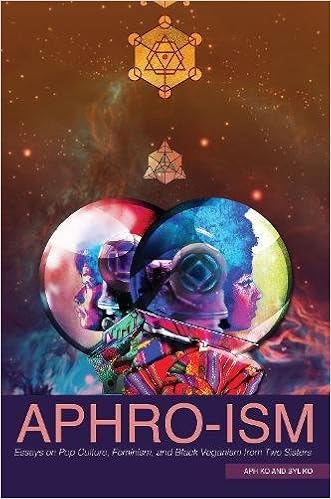
Aphro-Ism : Essays on Pop Culture, Feminism, and Black Veganism from Two Sisters. Lantern Books, 2017.

“Why do women have to be thought of as beautiful?”

‘I won’t go into the details of the indigenous people’s views, but one general, interesting fact the student presented was that there was no concept of “nature” in their language. That is, there was no sense in which we—human beings—were over here as perceiving subjects or knowers, whereas “nature” was over there, a passive object to be experienced and known. Rather, the people he encountered saw themselves in a deep relationship with the surrounding plants, animals, bodies of water, and so on, such that there was no distance that enabled any being to be only and permanently an object. This got me thinking about my culturally insensitive acquaintance’s comments. He interpreted the people’s reaction to “nature” as them not appreciating its beauty. Our mutual friend assumed instead that perhaps they were just used to it since they lived there and saw it every day. Who knows, maybe he’s right?

I have a third interpretation, in light of this new information about some peoples’ very different, non-Eurocentric conceptual resources. Since they did not put any distance between themselves and the other citizens of “nature,” since nonhuman entities were not strange, alien, passive objects to be witnessed or understood from “over here,” but instead deeply connected, continuous beings who themselves could be co-subjects with the people, this particular people considered the stuff that we call “nature” simply not the right kinds of beings/things to be thought of as essentially objects of beauty.

In a way, some feminists have similar thoughts about the mainstream’s obsession with women and beauty. For several years, films and TV shows, magazines, fashion shows, or commercials have been congratulating themselves for featuring “real” women. Instead of endorsing the ridiculously narrow standard of beauty (tall, thin, doll-faced, usually white, hyper-feminine, and sexualized), these “progressive” campaigns champion “real” women, hoping to widen the range of the beauty standard to include all women. Basically, the notion can be summed up as “all women are beautiful!”

Although some feminists are fighting to ensure all women (and not just white, thin ones), are beautiful, others—like myself—are critical of the connection between beauty and women altogether. We ask the question: Why do women have to be thought of as beautiful? That women are automatically connected with beauty is problematic in a number of ways, but I’ll only discuss the way it is relevant to the discussion I raised above regarding nature.’

–Aphro-Ism : Essays on Pop Culture, Feminism, and Black Veganism from Two Sisters. Lantern Books, 2017.

“Thanks to the postmodernists, much of the discussion of authorship in the last half century has focused on the medium of film.”

‘Thanks to the postmodernists, much of the discussion of authorship in the last half century has focused on the medium of film. This is, it would seem, largely owing to the fact that the dozens or hundreds of individuals involved in the making of a film collectively challenge the notion of films having a singular author—an auteur. More recently, this challenge has returned to other forms of art, including literature. A trend in postmodernism is to assert that each of these individuals is an author of the work in question or, alternatively, that there is as such no one who deserves the title of author. Harold Love suggests that “we need to recognize that most novels are much more like films than we are prepared to acknowledge in deserving a long roll-out of credits at the end.” Nevertheless, despite the recognition of the valuable input of others, we continue to apply the title of author and to do so very selectively.

More recently, philosophers on the analytic side of the analytic and continental divide have taken up the authorship issue with particular focus on distinguishing contributors and others from true authors, working to determine what makes two or more contributors to a given work joint or co-authors and leaving others to be, at best, acknowledged for their helpful input….

… An author is one with the ultimate responsibility for the form and content of the work, including its artistic and, where applicable, moral qualities. Put another way, we hold the author or authors responsible for the ideas being expressed and the form of that expression. This responsibility, I would suggest, arises from the author’s power to select and arrange elements as constitutive of the work.

… The difference between multiple authorship and co-authorship, I suggest, comes back to the issue of responsibility. Does an author take responsibility for just his contribution to the work or to the work as a whole? If I author an entry for the Encyclopedia of Aesthetics, for example, I do not take responsibility for anything beyond my contribution. Rather, my contribution makes up a discrete, identifiable unit of authorship and can be separated from the remainder of the Encyclopedia without serious effect upon the rest of the larger work. And this seems true even if I make a joint commitment with a body of other philosophers to build the Encyclopedia in this way. If I co-author an article with a colleague, however—as I have on a number of occasions with Craig Derksen—this is not usually the case: my contribution does not consist of a discrete unit that may be separated from my co-author’s, leaving a unified whole. As such, each he and I take responsibility for the work as a whole. Indeed, my co-author and I signal this by not identifying which elements were written by whom. In general, I think it reasonable to suggest, first, that where more than one individual can be identified as meeting the conditions for authorship of a given work, that work has more than one author. Where that work is made up of discrete, identifiable units of authorship, that work is multiply authored. And where that work is a unified whole without discrete, identifiable units of authorship, that work is co-authored.’

-Darren Hudson Hick, “Authorship, Co-Authorship, and Multiple Authorship.” Journal of Aesthetics & Art Criticism. May2014, Vol. 72 Issue 2, p147-156. 10p.

Can the Plagiarism Charges Against Emma Cline Hold Up in Court?

‘It’s important to note that Reetz-Laiolo hired Harvey Weinstein’s former law firm, Boies Schiller Flexner, and that the law firm used a trove of Cline’s personal documents — captured by the spyware program she installed on her own computer — to threaten Cline. Reetz-Laiolo’s complaint is threaded with salacious and humiliating details about Cline that are completely unrelated to any charge of plagiarism. (The complaint also alleges that Cline hacked into the email accounts of two other acquaintances, one of whom is Reetz-Laiolo’s ex-girlfriend, also named as plaintiffs in the suit.) According to The New Yorker, an earlier draft of the complaint contained even more salacious details, including naked selfies, explicit chat messages, and a section called “Cline’s History of Manipulating Older Men,” which began like this: “[E]vidence shows that Cline was not the innocent and inexperienced naïf she portrayed herself to be, and had instead for many years maintained numerous ‘relations’ with older men and others, from whom she extracted gifts and money.” TheNew Yorker also reported that after news broke that David Boies had hired private investigators to discredit an actress who accused Weinstein of rape, Boies’s name was removed from Reetz-Laiolo’s complaint.’


[Via]