Jesse Eisenberg and the footnote:

Jesse Eisenberg has a dilemma. He’s in the studio recording the audiobook for his short-story collection, Bream Gives Me Hiccups, and a particularly footnote-laden story isn’t quite working. “My Roommate Stole My Ramen,” which makes up a significant chunk of the book, follows college freshman Harper Jablonski as she writes effusive—and unwanted—letters to her high school guidance counselor. “Do you think it would work better if we didn’t say ‘footnote’ every time?” Eisenberg asks from the glass-walled booth.

Darren Vermaas, the audiobook’s director, weighs in: “To me, the repetitiveness of that is funny. But that’s one man’s opinion.”

His strength is in dialogue and monologue, and in writing miserable characters who alternately compel (like a 9-year-old from a broken home who writes restaurant reviews) and repel (like Harper, the footnote-obsessed freshman Eisenberg lovingly describes as “maladjusted”). “My only B in college was in short fiction, where I tried to describe a tablecloth for five pages,” he explains. “I don’t do that well. I’d rather describe somebody who tripped over a tablecloth and relate it back to some kind of Freudian experience.”

Harper’s story was inspired by tales of his sister’s college-roommate troubles. He suggested she write a blog called “My Roommate Stole My Ramen,” but she never did, so he took the idea back for himself. Harper’s particular writing style came to Eisenberg while he was filming the acclaimed recent biopic The End of The Tour: “I suddenly had this epiphany that she should use footnotes, because David Foster Wallace used footnotes,” he says. “I thought, ‘Oh, that’s what she is. She’s somebody who overexplains everything, and she’s full of rage and vitriol.’ Then everything poured out.” Eisenberg is uncannily good at capturing a specific breed of insincere teen girl. “The Slutnick [Harper’s roommate] is technically a nice person. Like she always says the ‘right’ things, but it feels totally fake.”

Read the rest.


[“BLA and GB Gabbler” (really just a pen name – singular) are the Editor and Narrator behind THE AUTOMATION, vol. 1 of the Circo del Herrero series. They are on facebook, twitter, tumblr, goodreads, and Vulcan’s shit list.]
all yellowB&N | Amazon | Etc.

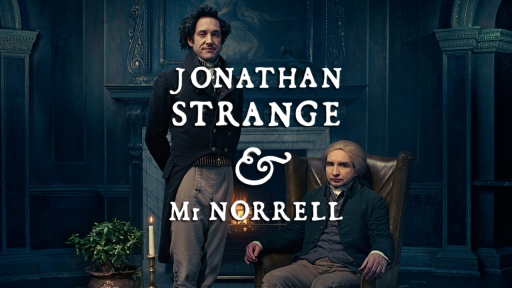
GABBLER RECOMMENDS: Jonathan Strange & Mr Norrell – BBC

My only qualms with the show? That there’s no brilliant way to incorporate the novel’s splendid footnotes and all the stylistic atmosphere therein. Waiting on episode 4! 

[“BLA and GB Gabbler” (really just a pen name – singular) are the Editor and Narrator behind THE AUTOMATION, vol. 1 of the Circo del Herrero series. They are on facebook, twitter, tumblr, goodreads, and Vulcan’s shit list.]

all yellow B&N | Amazon | Etc.

THE AUTOMATION – Now out in paperback

Available now.
Available now.

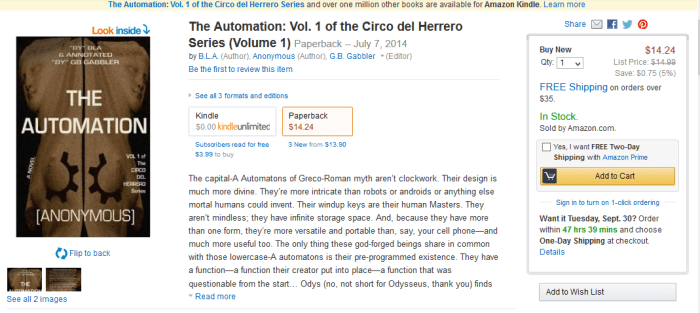
The capital-A Automatons of Greco-Roman myth aren’t clockwork. Their design is much more divine. They’re more intricate than robots or androids or anything else mortal humans could invent. Their windup keys are their human Masters. They aren’t mindless; they have infinite storage space. And, because they have more than one form, they’re more versatile and portable than, say, your cell phone—and much more useful too. The only thing these god-forged beings share in common with those lowercase-A automatons is their pre-programmed existence. They have a function—a function their creator put into place—a function that was questionable from the start…

Odys (no, not short for Odysseus, thank you) finds his hermetic lifestyle falling apart after a stranger commits suicide to free his soul-attached Automaton slave. The humanoid Automaton uses Odys’s soul to “reactivate” herself. Odys must learn to accept that the female Automaton is an extension of his body—that they are the same person—and that her creator-god is forging a new purpose for all with Automatons…

The novel calls itself a “Prose Epic,” but is otherwise a purposeful implosion of literary clichés and gimmicks: A Narrator and an Editor (named Gabbler) frame the novel. Gabbler’s pompous commentary (as footnotes) on the nameless Narrator’s story grounds the novel in reality. Gabbler is a stereotypical academic who likes the story only for its so-called “literary” qualities, but otherwise contradicts the Narrator’s claim that the story is true.

THE AUTOMATION is a this-world fantasy that reboots mythical characters and alchemical concepts. Its ideal place would be on the same bookshelf as Wilson’s ALIF THE UNSEEN and Gaiman’s AMERICAN GODS—though it wouldn’t mind bookending Homer, Virgil, and Milton, to be specific.

And, yes, “B.L.A. and G.B. Gabbler” are really just a pen name.

On Footnotes:

“Footnotes allow us not only to see the prejudices of old sources, but the biases and convictions of the footnoter himself.They provide readers with the intellectual map that the writer has used to arrive at her conclusions. If some see footnotes as tiresome road blocks, others more fairly view them as serendipitous detours that can lead to delightful and unexpected stops not on the original itinerary. Footnotes gave birth–after an extended gestation, mind you–to the hypertext links that are the vis vitae, the life force, of the Internet.”

From here.

John Green on the footnote:

“The fact is that if you attend college, you end up spending quite a lot of time alone with footnotes, and you may eventually start to notice that footnotes are–consistently–the wittiest and most enjoyable parts of hefty texts. (For instance, I am a huge fan of the footnotes in a book called Islamization and Native Religion in the Golden Horde, which incidentally is a fantastic book if you are into that kind of thing.) And so it is inevitable that the reasonably well-educated person falls in love with footnotes, and starts thinking about what footnotes could do and be. It’s perfectly plausible to believe that all fourteen million writers who use footnotes in their books just came up with the idea independently when they noticed how footnotes can allow you to create a kind of secret second narrative, which is important if, say, you’re writing a book about what a story is and whether stories are significant…

I’ve had this crackpot theory for a long time that the real progenitor of many contemporary YA novels isn’t Catcher in the Rye or A Separate Peace or Annie Get Your Gun or Forever or any of that, but instead David Foster Wallace’s 1100 page (and massively footnoted) second novel Infinite Jest,. I know for a fact that E. and I have read IJ. Infinite Jest IS a coming-of-age story, or at least it contains a coming-of-age story, but I would never argue that it is itself a book for teenagers. It’s just that literary young adult writers have adopted–whether directly or indirectly–a host of techniques from the book, including weird and largely inexplicable abbreviations (henceforeth WALIAs), a breathless narrative voice that isn’t quite stream-of-consciousness, repetition of the word and, and footnotes. Infinite Jest is a major book, certainly, and it’s been influential in the world of adult literature, too. But if you’ve read, say, 100 ‘literary’ ya novels, and then you read Infinite Jest, I feel like it’s hard not to be struck by how many of those 100 books owe something in some way to DFW that they would not otherwise have. So nothing against Mr. Stroud, but I think when we’re talking WALIAs or footnotes, we have David Foster Wallace to thank (well, if thanks are to be given. I really believe that footnotes are pretty great if done well, and if you disagree with me then I hope we can have a fight about it in the comment section, which is basically the blog equivalent of footnotes).”

– John Green, from a rant on his blog, dated 2006.

We are huge fans of his rants and his vlogs. …But, we attempted to read The Fault in Our Stars and disliked the odd insertion of Anne Frank into a Cancer story (probably only put there because he got a grant from some Amsterdam foundation and felt obligated). But apparently his book An Abundance of Katherines uses footnotes (and this just might be a reason to give him a second shot, novel-wise. Because footnotes are awesome). Have you read it? Tell us your thoughts. Otherwise, we’re forced to keep believing John Green is in love with his editor and legacy publishing (loved that podcast!). 

[“BLA and GB Gabbler” (really just a pen name – singular) are the Editor and Narrator behind THE AUTOMATION, vol. 1 of the Circo del Herrero series. They are on facebook, twitter, tumblr, goodreads, and Vulcan’s shit list.]
all yellow B&N | Amazon | Etc.