GABBLER RECOMMENDS: Nina Paley on The Gaia Hypothesis

“The Gaia Hypothesis posits the Earth’s biosphere is a single living organism. Living organisms by definition reproduce. How would a planet’s biosphere reproduce?

By sending reproductive cells of some sort to other planets.

Much (possibly most) of the Earth’s biosphere consists of bacteria. In fact most animals, including humans, consist largely of bacteria. Animals are mobile housing units for bacteria.

Humans are a peculiar animal. We’re creating our own extinction event. We seem hellbent on exploiting and destroying “nature,” yet we are part of nature, produced by nature. Why would the biosphere produce homo sapiens?

An extremely popular belief of our time is that humans will colonize other planets. Many humans consider this a more worthy goal than preserving biodiversity on Earth. Humans are willing to trash this planet in order to reach others.

It is vanishingly unlikely humans will survive on other planets. But it is likely we will reach other planets. We will not colonize other planets with humans, but with bacteria.

Humans are Gaia’s way of sending bacteria to other planets, thereby reproducing.

…Over billions of years, these pioneering bacteria will evolve, growing a new biosphere of diverse life forms. A new, living planet – another Gaia – is born.”

[Via]

See also:

Is The Girl With All The Gifts antinatalist?

Gods in our machines. 

What we talk about when we talk about post-apocalyptic stories.

Kristine Kathryn Rusch on indie books:

In that old book of criticism, Lewis was justifying the fiction that he wrote. He didn’t like the terms “highbrow” and “lowbrow” fiction, choosing instead to label readers “unliterary” or “literary” depending on the kind of attention they pay to the texts in front of them. (If the reader read solely for pleasure, and did not reread books, they were generally unliterary.)

This snobbishness permeated the industry. The snobbishness went all the way into business practices and marketing, in contracts and in expectations. Paperbacks were considered disposable. Hardbacks were not. The returns system in the U.S. was predicated on that. Hardbacks required full copy returns, and if the books were damaged, then they would not count against a bookstore’s bill. Paperbacks were mutilated, the covers returned only, so that the book could be thrown away.

Contracts and deals reflected the perceived ephemeral nature of the material, and writers often fell prey to it. They signed deals that would be ludicrous if anyone had thought more than two years head.

The attitude was that nothing good could come from disposable products, even though the paper books often outsold hardcovers by literary (and accepted) writers by ten to one (and sometimes by 100 to one).

Here’s the thing, though: the only way to become a remembered author who survives the test of time is to influence a lot of readers. If a “good” novel has a 5,000 copy print run and sells out, and a “bad” novel has a 50,000 copy print run and sells out, guess which one has the better chance of being remembered? The one with tens of thousands of readers, not the one with only 5,000.

Books with a lot of readers tend not to be the critical darlings of the day. They tend to be the books that get the most word of mouth, books that are passed from hand to hand to hand or written up the most in blogs or discussed by savvy readers everywhere.

How do you become one of those writers?


The thing is…the books that often stick in the memory of the reading public are books that surprise in some way or counter expectations or make the reader lose a few hours of sleep because the reader can’t put the book down.

Those books aren’t manufactured and fussed over and edited to death. They weren’t written to be judged, as literary novels often are. Those books weren’t written to impress. They were written because they had to be, or because the author needed to eat. The author wrote it, someone published it, and then both moved on—even though the readers didn’t.

Indie writers are doing the same thing right now. They’re writing what they love. A few are still writing what they think will sell, although that trend seems to be moving past us now. (Thank God). Most writers are simply trying to put food on the table so they don’t have to go back to the day job.

Traditional publishers, whose sales are continuing to decline and whose revenue is spiraling downward, keep trying to justify their curation services. Want to know if your book is any good? The traditional publishers say. We’ll let you know that—forgetting, of course, that readers decide what’s good and what’s not.

It’s very threatening to someone “in charge” to see that others, unapproved others, are more successful, particularly if they’re publishing or writing or creating in a method that’s hard to control. Indie writers are very hard to control. They can put up their own books. They can write against the prescribed rules. They can fly in the face of popular wisdom.

[Via]

#BLAThoughtOfTheDay: Neil Gaiman implies that Norse Gods are more popular than Greek and Roman gods?

“I didn’t get any Greek and Roman gods in, because at the time I couldn’t convince myself there was any particular reason to bring Greek and Roman gods in. Now, a few years ago I read about the discovery of some ancient Roman coins in the mud of the Ohio River, and they’re definitely ancient Roman coins. There are differences of belief as to whether they were coins that somebody hid there and they got lost or whether they date back 2,000 years. But I don’t need any kind of proof on this. All I need is to be able to point to something in the way I could point to the Egyptian stuff. Now I have something that I can hold onto and go, “Well, there is a case now for ancient Romans knocking around America which gives me the whole panoply of Roman gods, too.”

Having said that, the other reason I never used them was at the time I felt they were overused, and I like the idea of using ones that were a little bit underused and was proud of myself for having done so.”


-Neil Gaiman

[Via]

So is Neil Gaiman saying that, though Greco-Roman gods are “overused” they are not as popular as the Norse? The fact there would be no appearance of them in American Gods seems to imply that Americans don’t favor them as much as Norse–that they do not have as many worshipers to make them relevant or prevalent. Which is illogical due to the the fact that 1) we know more about the Greco-Roman myths and 2) the entire West is built upon or around their mythos (philosophy, the Arts, arguably Christianity). So the reason they aren’t seen in his book seems to imply something about their status. The biggest fan base for Norse myth stems from the comic book craze (read: Thor). I still wouldn’t say it overshadows the following of Greco-Roman gods, though.

It seems like a weak argument — something overlooked when he was trying to build a mythos. He may have highlighted some marginal gods, but at the cost of his mythos.


Catherynne M. Valente on Tolkien:

“JV: You’ve also said that the typical mythpunk author was “over Tolkien by roughly second grade,” and indeed many mythpunk authors had or still have an interest in his work. While Tolkien is, of course, a granddaddy of fantasy as we know it in the West today, what role does he play in mythpunk specifically?

CMV: Well, I mean, I was being confrontational, and trying to differentiate mythpunk from the bulk of mainstream fantasy which is still in deep hock to Big Daddy T. The fact is, I am a Sindarin-speaking Tolkien dork, the kind that genuinely loved the Silmarillion and memorized the poetry. I love Tolkien. Thus, I have no desire to repeat his work. I think that great work can be done by confronting head-on the anxiety (of influence) toward Tolkien’s dominant work, toward the assumptions and prescription of his incredibly pervasive memes. But that’s different than the trend I was talking about. Tolkien himself was reacting to a long tradition of folklore and myth, going to the sources for inspiration. Afterward, many authors looked to Tolkien as a first source rather than a reaction, and a great deal of generation loss was experienced by the field as a whole.”

[Via]

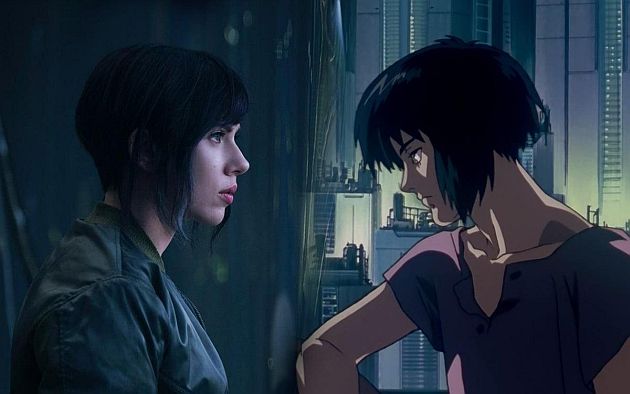
On Ghost in the Shell:

“The biggest problem – the one you already know about, thanks to the countless thinkpieces about it spewed forth from our left-leaning media cycle – is the racial one. Again, there’s an excuse: the film offers its multiracial cast, who occupy roles that are disconnected from their ethnicity, as a depiction of so-called “transhumanism” (a troubling phrase to begin with), which is supposed to tie into the big twist reveal about The Major and where she came from before all this cybernetic stuff happened. But, again, this excuse is as flimsy as wet paper – it’s obvious to anyone that Paramount (and affiliated Chinese production companies Huahua Media and Shanghai Film Group) needed to cast the biggest female star they could in order to sell their film, and the biggest star just so happened to be white. As a result of this decision, which was already artistically bankrupt, the story of the original Ghost in the Shell was rewritten to focus not on its ontological ideas about identity and consciousness, but on a hackneyed amnesia plot in which The Major – whose name is now “Mira Killian” – must discover her true identity as a Japanese girl named Motoko Kusanagi.

I don’t even know where to start with that.

Casting a white actor as a Japanese character would be troublesome enough. Changing that Japanese character into a white character in response is even more problematic. Revealing that that white character was actually a Japanese character all along is… well, “batshit insane” springs to mind.

This isn’t the remake’s only problem, but it’s surely the most damning one. It’s emblematic of a general disregard by all involved in the film for crucial sociopolitical issues that, in 2017, have been brought tooth and nail to the surface, by the bravery of those actually facing these issues daily. Marvel’s Iron Fist is one thing; that character was actually originally written as white. The rest is wishful thinking, no matter how well-intentioned (and correct, in my opinion) the fan-casting might be. This is beyond the pale, and it would utterly invalidate the film if it wasn’t already so busy doing that to itself by other means.

It’s undoubtedly a colourful, well-composed, striking-looking movie, but that’s about where its virtues end. Its depictions of a glittering cyberpunk future – a far cry from the gritty, overwhelmingly dense setting of the original – are stunning, but nearly masturbatory in their effect, as the same flyover shots are used again and again to show us the same amazing building-sized holographic advertisements we’ve seen before. It’s Blade Runner, if Blade Runner had no restraint or sense of visual purpose. Even within this fantastical future world, where nothing looks real, many of the film’s visual effects still manage to look artificial and dated. The action sequences are dull, with unfocused editing and no sense of impact, and far too infrequently placed in a film whose dialogue scenes leave much to be desired. The banter between characters is painful even in comparison to the 1995 film, whose obviousness was an issue – here the ideas are just as vapid as the dialogue used to express them. The general story structure is a latticework of bad ideas, from the clumsy way that old elements are redone (like the garbage man controlled by the hacker antagonist, or the hacker antagonist himself) to the inept way that new elements are introduced (like Killian’s mother-figure, the unscrupulous-then-scrupulous Dr. Ouelet, or Beat Takeshi’s Section 9 boss Chief Aramaki, who graduates from a technical strategist in the original to yakuza executioner here). The simplest way to describe it is to say that it’s a film whose only new ideas are bad ones, and whose execution on the old ideas is bumbling and inelegant.”

[Via]