This show is really quite funny in how it deals with serious issues. And it’s probably our favorite Australian TV show (its our only Australian TV show, really).

Realizing you’re gay has never been more awkward.


[a website for the Editor and Narrator of the Circo del Herrero series]
This show is really quite funny in how it deals with serious issues. And it’s probably our favorite Australian TV show (its our only Australian TV show, really).
Realizing you’re gay has never been more awkward.
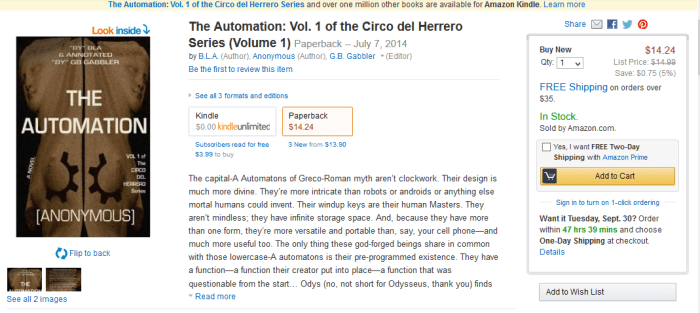
The capital-A Automatons of Greco-Roman myth aren’t clockwork. Their design is much more divine. They’re more intricate than robots or androids or anything else mortal humans could invent. Their windup keys are their human Masters. They aren’t mindless; they have infinite storage space. And, because they have more than one form, they’re more versatile and portable than, say, your cell phone—and much more useful too. The only thing these god-forged beings share in common with those lowercase-A automatons is their pre-programmed existence. They have a function—a function their creator put into place—a function that was questionable from the start…
Odys (no, not short for Odysseus, thank you) finds his hermetic lifestyle falling apart after a stranger commits suicide to free his soul-attached Automaton slave. The humanoid Automaton uses Odys’s soul to “reactivate” herself. Odys must learn to accept that the female Automaton is an extension of his body—that they are the same person—and that her creator-god is forging a new purpose for all with Automatons…
The novel calls itself a “Prose Epic,” but is otherwise a purposeful implosion of literary clichés and gimmicks: A Narrator and an Editor (named Gabbler) frame the novel. Gabbler’s pompous commentary (as footnotes) on the nameless Narrator’s story grounds the novel in reality. Gabbler is a stereotypical academic who likes the story only for its so-called “literary” qualities, but otherwise contradicts the Narrator’s claim that the story is true.
THE AUTOMATION is a this-world fantasy that reboots mythical characters and alchemical concepts. Its ideal place would be on the same bookshelf as Wilson’s ALIF THE UNSEEN and Gaiman’s AMERICAN GODS—though it wouldn’t mind bookending Homer, Virgil, and Milton, to be specific.
And, yes, “B.L.A. and G.B. Gabbler” are really just a pen name.
We knew that people hated prologues and sometimes never read them. We therefore inserted ours in the middle of our novel so it would be harder to ignore. And, at that point, we think readers are ready for a little context. They’re like, WTF is going on?!?
 There’s an ongoing debate about prologues. Do you need them? Are they superfluous? Do they set up the story, or should you cut ’em and get to chapter one already?
Plenty of opinions exist, and many opinions have to do with taste. So, before we jump on the “prologues never contribute to the story” bandwagon, I think the first step is to identify what kind of prologue one is writing and the objective of that prologue. We need to know what we’re writing and why, before we let the opinions of what’s “in vogue” influence our writing decisions.
Let’s take a look at four different kinds of prologues.
1) Future Protagonist
This prologue is written in the same voice and style as the main story and from the POV of the same protagonist. When done really well, this kind of prologue changes everything the reader thought. As the reader continues with the story…
View original post 408 more words
“You are so magnetic.”
“I am like the old Tin Man.”
“Take, take my soul.”
The story of a woman who claimed to be the medium for a prolific ghost with talent. Was it really a ghost? Was it just her pen name? Or was it something more?:
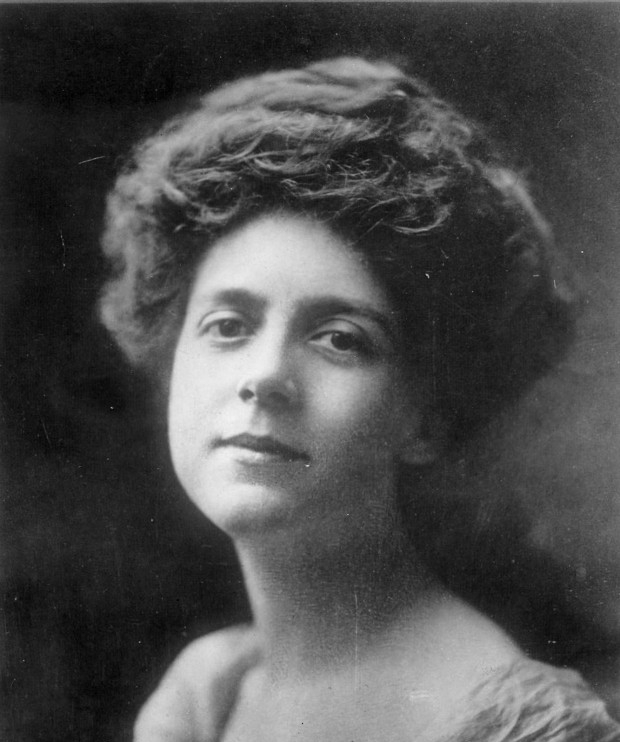
“Curran’s output prompts us to ask some fundamental questions about history, genre, intention, affect, authorship, and why we choose to read what we read. Furthermore, her writings are a fascinating curio of an era in American literary history when academics and quacks, the rational and the occult, scholarship and magic all mingled together in popular discourse…
