“The story is not all mine, nor told by me alone. Indeed I am not sure whose story it is; you can judge better. But it is all one, and if at moments the facts seem to alter with an altered voice, why then you can choose the fact you like best yet none of them are false, and it is all one story.” – Ursula K. Le Guin in The Left Hand of Darkness.
[“BLA and GB Gabbler” (really just a pen name) are the Editor and Narrator behind THE AUTOMATION, vol. 1 of the Circo del Herrero series. They are on facebook, twitter, tumblr, and goodreads.]
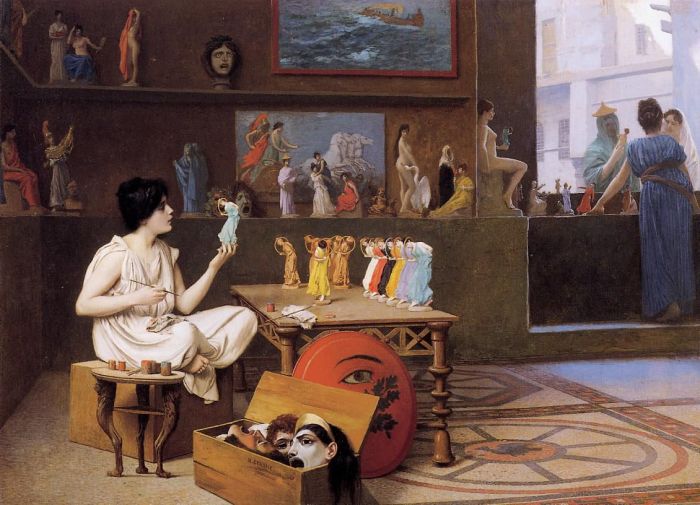
“Moreover, the creation of Pandora, the first woman, as narrated by Hesiod…is similar to that of a statue, in as much as Hephaestus fashions her of clay, though she is nevertheless a living being. The diffusion of the belief in animate, moving statues led to the practice of restraining statues representing deities of good fortune so as to prevent them from running away…However, this habit is evidence across many cultures dominated by magical thinking. This practice was also adopted at Rome, where the feet of Saturnus’ image were fastened with woolen bonds.
The attribution of life to statues may perhaps have paved the way for the belief, attested on Thasos, in the early fifth century BCE, that statues could commit murder and other crimes and therefore be tried and convicted in courts of law; but this conclusion is far from certain. In fact, inanimate objects could also be tried under Draconian law, which was adopted at Thasos; thus the fact that a statue was tried does not necessarily imply that the statue was seen as an animate object. The topos of live statues often concerns statues of the classical and especially late-classical periods: the largest body of evidence of this pattern are the epigrams of the Greek Anthology which describe works of art, especially of the fifth and even more often of the the fourth century. The prevalence of the ‘animistic’ way of regarding works of art was due partly to a ‘theatrical mentality’ (to use J. Pollitt’s phrase), which strove to show figures as plausible equivalents to the subjects represented. It was also due to the success of late classical sculpture, whose favorite subjects were naked deities, such as Aphrodite or Eros, and whose styles gave emphasis to the smoothed surfaces of the figures. These surfaces became plausible as renderings of the skin and were made even more credible usually through the smearing of transparent wax on them. These representational trends have paved the way for what was the most daring outcome of the belief in living statues: agalmatophilia, or the desire of certain men to make love to statues.”
– Greek Magic: Ancient, Medieval and Modern. Edited by J.C.B. Petropoulos.
Hephaestus’s Automata invade the modern world in this prose poem “novel.” Out now.
[“BLA and GB Gabbler” (really just a pen name) are the Editor and Narrator behind THE AUTOMATION, vol. 1 of the Circo del Herrero series. They are on facebook, twitter, tumblr, and goodreads.]
“I sometimes see the heartbreak right in people’s face that they’re not meeting Tyler Durden. It’s one reason I avoid meeting writers I like, when I’m so in love with their characters. I don’t want that character to be negated by the existence of the author. So much of what I do on tour is to mitigate the pain people feel when they realise their favourite character is just a fictional character.” – Chuck Palahniuk.